The Shallows
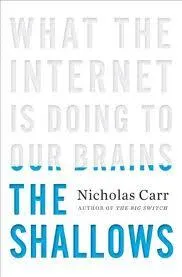
Nicholas Carr's 2010 book is the founding text of the modern screen-time argument, and every later book on the subject is either extending it or answering it. His claim is that media are not neutral pipes: because the adult brain stays plastic, the form a medium imposes reshapes the mind that uses it. Print built a linear, sustained, contemplative reader. The internet, engineered for interruption, is building something else. The historical half of that argument survives. The neuroscience half largely did not.
What it covers
The book is better made than its reputation suggests. Roughly half of it is cultural history, on writing systems, the codex, silent reading, the map, the clock and the printing press, and that half holds up. Carr concedes more than his critics allow. He accepts that the Flynn effect is real and rising, that the internet's benefits are genuine, that oral culture lost something real when literacy arrived, and that Socrates was wrong about writing.
His theoretical spine is McLuhan, whose image of content as the meat a burglar throws the guard dog opens the book. Carr's own contribution is to give the claim a mechanism McLuhan did not have, which is neuroplasticity, and a taxonomy, intellectual technologies, for the tools that extend mental rather than physical power. Each such tool, he argues, carries an unexamined intellectual ethic, a set of assumptions about how the mind ought to work.
The best argument in the book is about reading rather than brains. Sustained attention on a static object runs against an attention system evolved to track change, so deep reading is a built capacity rather than a human default. Unspaced text made early reading a decoding puzzle, word separation made fluency possible, and fluency made contemplation possible. The literary mind is roughly 550 years old.
The proposed mechanism for its loss is cognitive load, via Miller's capacity limit and Sweller's load theory: everything entering long-term memory passes through a small working-memory bottleneck, and every hyperlink is a decision that consumes some of it. Alongside it sits the chapter on memory consolidation, which argues from Kandel's work that long-term memory requires the physical growth of new synaptic connections over time, so the computer-memory metaphor is wrong in kind rather than in degree. Those two chapters are the most solid science in the book.
A 2020 edition adds an afterword in which Carr argues that the intervening decade has vindicated him.
Main topics
- The medium, not the content, McLuhan's claim given a mechanism.
- Intellectual technologies, Carr's own taxonomy of tools that extend the mind.
- The history of reading, from unspaced script to the contemplative reader.
- Cognitive load, the bottleneck argument and the cost of every link.
- Memory consolidation, why biological memory is not storage.
- The Google effect and offloading, remembering where rather than what.
- Screens and hypertext, where comprehension does and does not suffer.
- Amplification and numbing, the principle that every extended faculty dulls its natural counterpart.
Concepts drawn from it
- media determinism and intellectual technologies, the book's frame
- deep reading, the historical argument that survives untouched
- cognitive load and hypertext, the mechanism
- memory consolidation and neuroplasticity, the science he draws on rather than produces
- cognitive offloading, the weaker survivor of a failed flagship study
- amplification and numbing, attention residue, ego depletion, digital loneliness
Reliability
This is the least citable book in our library, and it is also one of the best documented. Its endnotes are real, its citations are specific, and it names its sources. The problem is what happened to those sources afterwards. We verified them against the replication literature in September 2026.
The two flagship claims, the two most quoted things in the book, are the two that failed. The Google effect, Sparrow, Liu and Wegner's 2011 finding that believing information is saved weakens recall, failed a high-powered preregistered multi-lab replication, though a smaller context-dependent offloading effect survives in a 2024 meta-analysis. Sparrow set out in 2018 what a fair retest would need to look like. The brain drain claim, that a phone's mere presence reduces cognitive capacity, largely fails meta-analytically: a four-level meta-analysis of 166 effect sizes from 53 samples, N = 4,368, gives d = -0.02, with no moderation by demographics, trait dependency or method. A separate meta-analysis of 56 studies and 7,093 participants finds null summary effects across cognitive functions with one exception, working-memory capacity, and that surviving effect is far smaller than the original.
That second one is worth dwelling on. It is the study Carr added to the 2020 afterword as fresh evidence that he had been right. An author updating a book to defend it, using evidence that then collapses, is as clean an illustration of the replication problem as we have.
Two more did not fail but were never independently replicated. The rewiring claim rests on a 2009 fMRI study of 24 people, exploratory and correlational, comparing 12 experienced with 12 novice searchers. It shows activation differences correlated with self-reported experience. It does not show structural change, persistence, or that anything was lost, and the rewiring language belongs to the press release rather than to the finding. The claim that the internet inflates what you think you know rests on a single lab's nine experiments. Nature walks restoring executive attention failed a conceptual replication and a meta-analysis of 14 studies, N = 612; nature's effect on mood is better supported than its effect on cognition.
What survives is the least dramatic material. Screen inferiority holds, with an important limit: Delgado and colleagues, 54 studies and over 170,000 participants, g = -0.21, and Clinton, g = -0.25, but the effect appears for expository text under time pressure and not for narrative text. Laptop multitasking harming lecture recall holds, and was extended by work finding that nearby non-users are harmed too. The London taxi drivers hold, replicated with a bus-driver control and strengthened by longitudinal work. Note what that best piece of evidence actually shows: a brain adapting to a demand, which is a claim about plasticity rather than about damage.
No meta-analysis establishes that ordinary internet use impairs attention, memory or comprehension. The standard review is explicitly preliminary and largely correlational. The impairment findings that do replicate are specific to problematic or pathological use, which is a different population.
Sourcing quality also varies sharply by chapter. The endnotes are full of real journal articles, but a striking number of load-bearing items are magazine pieces, blog posts, press releases and personal interviews. The F-shaped reading pattern, cited as a study of 232 people, is a post on a consultancy's own website. A survey of about 6,000 people has no named researcher.
Where Carr is careful, he is genuinely careful, and that deserves saying. He refuses to claim the internet undermines moral sense, calling the conclusion rash. He flags his own line about "the brighter the software, the dimmer the user" as something a polemicist would write. He labels a four-person study small. He notes that a photo-taking memory impairment vanished when subjects zoomed in, which locates the effect in divided attention rather than in cameras. None of that is careless work.
Our position, and it is a split one: the narrow claim is supported and the broad one is not. The reading half of the argument has held up better than the brain half. Notice also what he never actually claims. He does not say the internet makes people stupid, he says it makes a particular kind of thinking harder to do. The book's reputation is more alarmist than the book. The objection to our own position is worth keeping in view: this literature measures what is easy to measure, and a slow change in a habit of mind is close to unmeasurable by these methods.