Baker-Miller Pink
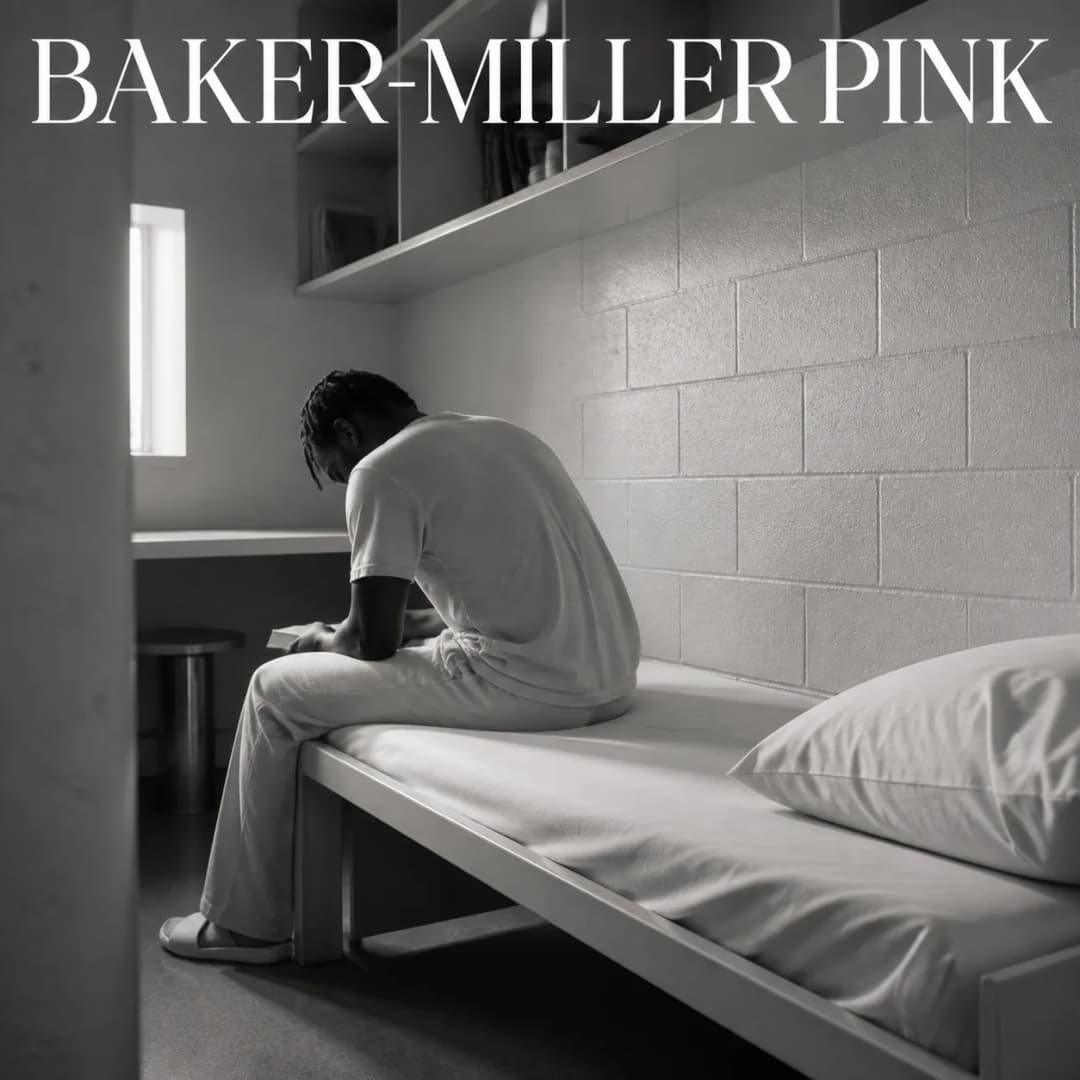
Baker-Miller pink is a shade of pink claimed to reduce aggression and physical strength on sight, and the claim was never established. It comes from a 1979 paper in the final issue of a journal that closed that year, was adopted by prisons on the strength of seven months of uncontrolled observation, and was contradicted by a 1981 paper its own discoverer co-authored. Alexander Schauss now lends his name to a company selling Baker-Miller Pink bedsheets.
What it is
Baker-Miller pink, often called drunk tank pink, is a specific shade of pink said to sap aggression and physical strength in whoever looks at it. It gave Adam Alter's 2013 book Drunk Tank Pink its title, and it has had an unusually long institutional life for something that was never demonstrated. Holding cells were painted with it. It appears in gyms, in sports facilities, in design writing, and now on bedding. Almost none of that rests on evidence.
Read this page as a case study in how a psychological effect becomes a fact, rather than as a description of an effect. The distinction matters, and it is the reason the page exists at all. Every stage of this story is instructive, and none of the stages involve fraud.
Alexander Schauss published the original finding in 1979 in Orthomolecular Psychiatry, in that journal's final issue; it ceased publication the same year. The reported work is two small studies. In the first, 153 men were judged physically weaker after staring at a pink card for one minute, with all but two showing the effect. A follow-up with 38 men measured the same thing on a hand dynamometer, reportedly with no exceptions. Uniformity that near-total in a psychological experiment is itself a signal worth noticing, and not a reassuring one.
What turned this into an institutional practice was not a further study. Two Seattle naval officers, Gene Baker and Ron Miller, painted a brig holding cell pink. Over roughly seven months, agitated new arrivals reportedly calmed down within about fifteen minutes. There was no control condition. There was no measurement beyond staff impression. That observation, and the two officers' names, are the entire basis on which the colour acquired its name and its operational career. A cell full of people who have just been detained will contain people who calm down within fifteen minutes whatever colour the walls are, and without a comparison cell there is no way to know whether the paint did anything at all.
The most damaging detail comes from Alter's own endnote, on page 229 of Drunk Tank Pink. Alter concedes that Schauss "continued to test the effect, sometimes but not always finding support", and then does something unusual for a popular science book: he lists the papers in two columns, supporting and non-supporting. Pellegrini, Schauss and Miller's 1981 paper, on a criminal detention holding cell and co-authored by Schauss himself, sits in the non-supporting column. The finding's own discoverer produced evidence against it two years later, and it kept spreading regardless.
Schauss now lends his name to a company that sells Baker-Miller Pink bedsheets.
One thing should not be flattened in the retelling. Schauss flagged his own mixed results, and Alter printed both columns rather than only the flattering one. The failure is not that anybody lied; it is that a striking claim, a fringe publication venue, an uncontrolled institutional adoption and a receptive press were together sufficient to establish something as true without anyone ever establishing it as true. That pattern is precisely what the replication crisis describes, and this case predates the crisis by three decades, which is a useful corrective to the idea that the problem began in 2011.
The frontmatter on this page reads unreviewed, and it is worth explaining why that is not a contradiction of everything above. In this project's vocabulary, unreviewed is a statement about our own sourcing rather than a verdict on the research: it means nobody here has run a formal assessment of the literature and written it up as such. The verdict is in the prose, and in our reliability audit of the book, where Baker-Miller pink is recorded as never established, alongside physical-warmth priming, money priming and romantic red, all of which failed high-powered replication attempts. If you read only the tag on this page you will read it wrongly.
In effect
The pink card, 153 men, and a journal's last issue
The research case is the whole of the research. Two studies, both from 1979, both reported by the same author, published in the closing issue of a journal that then folded. One hundred and fifty-three men judged weaker after a minute looking at a card, with all but two conforming, then thirty-eight men on a dynamometer with no exceptions at all. Small samples, no independent laboratory, a publication venue with no continuing existence, and effects so uniform they invite scrutiny rather than confidence. Two years later, Pellegrini, Schauss and Miller's study in a criminal detention setting landed in the non-supporting column of the author's own tally. That is the complete evidential record as our notes have it, and it is thinner than the colour's reputation implies by a wide margin.
The brig in Seattle, and seven months without a comparison
The everyday-reasoning case is what happened next, and it is a mistake anyone can recognise from their own life. Somebody makes a change, the situation improves, and nobody thinks to ask what would have happened without the change. Baker and Miller painted a cell, watched for seven months, and reported that agitated arrivals settled within a quarter of an hour. No control cell, no measurement, no blinding, staff who knew what the paint was supposed to do and were watching for it. The observation may well have been accurate about the calming. It simply cannot say anything about the pink. Institutions across several countries then adopted the colour on the strength of it, which is the step where an anecdote becomes policy.
Pink bedsheets, and the effect as a product
The commercial case closes the loop. Schauss now lends his name to a company selling Baker-Miller Pink bedsheets. The colour has also travelled into gym and sports-facility design and into interiors writing, where it circulates as an established piece of colour psychology. This is the commercially interesting part of the whole story for anyone in consumer psychology: a claim does not need to be true to be sellable, it needs to be memorable, physical and easy to demonstrate socially. Baker-Miller pink is all three. Nothing about buying a pink bedsheet requires the 1979 studies to have held, and nothing about the product's existence is evidence that they did.
What it does not say
It does not say pink calms people down. There is no adequate evidence for the claim in our notes. Two small 1979 studies by one author in a journal's final issue, contradicted by a 1981 study that author co-authored, is not a basis for the assertion. Our reliability audit of Drunk Tank Pink records the status as never established, which is a different and weaker position than "failed replication": nobody built a solid finding for later work to fail to reproduce.
He reported mixed results himself, and his own non-supporting paper is the strongest evidence against the claim. Treating this as a fraud story misses what makes it useful.
It does not say that because prisons used it, it worked. Institutional adoption is not evidence. The seven-month observation had no control condition and no measurement beyond staff impression, and adoption followed the anecdote rather than any test.
It does not carry the broader social-priming statistics as if they were about this claim. Across social-priming replications generally, our notes record that 94 per cent produced smaller effects than the original and only 17 per cent reached significance in the original direction. Baker-Miller pink sits in the same evidentiary category, but those figures describe a literature and were not calculated on this finding, which has essentially no replication literature to describe.
It does not tell you what to conclude about colour and behaviour in general. Some environmental effects in the same book hold up considerably better than the priming ones, and this page is not an argument that the environment does nothing. It is an argument that this particular claim was never demonstrated, and that a reader should leave more sceptical than they arrived.
Who developed it
Alexander Schauss published the finding in 1979 and continued testing it for decades, by his own account sometimes finding support and sometimes not. The colour takes its name from Gene Baker and Ron Miller, the two Seattle naval officers who painted the brig cell, neither of whom ran a study. Adam Alter is the popular vector through Drunk Tank Pink, and deserves credit for printing the non-supporting column rather than only the supporting one. Schauss has no page on this site yet.
Sources
- Schauss, A. (1979). Orthomolecular Psychiatry, final issue. The original report: 153 men judged weaker after one minute looking at a pink card, all but two showing the effect; a follow-up with 38 men on a hand dynamometer with no exceptions. The journal ceased publication the same year. Not read by us; reported via Alter (2013).
- Pellegrini, Schauss & Miller (1981). A study in a criminal detention holding cell, co-authored by Schauss, listed in the non-supporting column of Alter's own endnote. Not read by us.
- Alter, A. (2013). Drunk Tank Pink: And Other Unexpected Forces That Shape How We Think, Feel, and Behave. Penguin Press. The full arc and the supporting/non-supporting endnote table at p. 229. See the book page for the reliability audit of its headline findings.
- Baker, G., & Miller, R. The Seattle naval brig observation: a holding cell painted pink, roughly seven months, agitated arrivals reportedly calming within about fifteen minutes, no control condition and no measurement beyond staff impression. Not a study; reported via Alter (2013).
- Where this came from
- One book in this library carries this concept. A concept resting on a single popular retelling is roughly twice as likely to be contested, mixed or unverified as one two or more books carry, so treat it as unchecked until it has been taken to a primary source.