Classical Conditioning
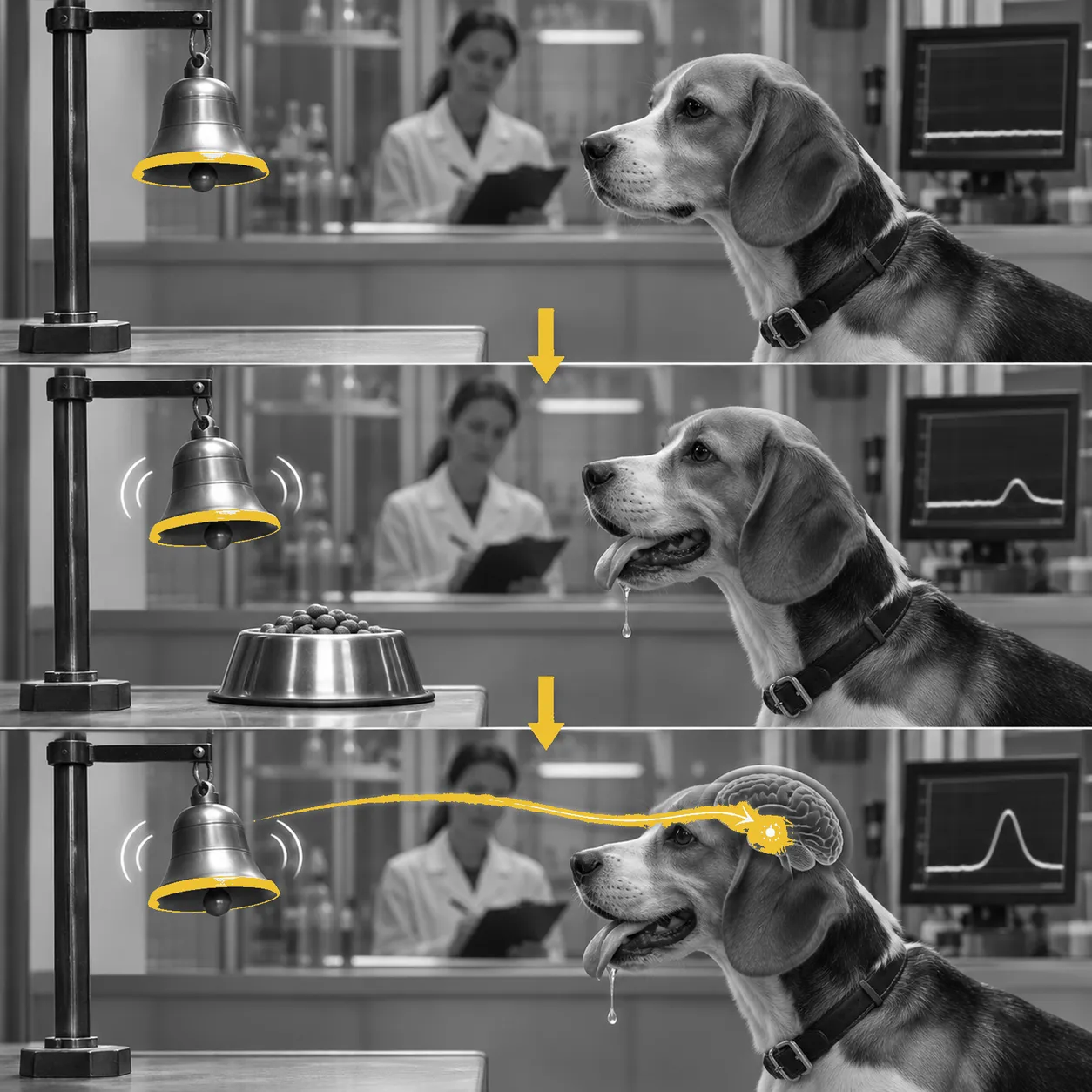
Learning in which a neutral signal comes to trigger a response because it has repeatedly arrived just before something that already triggered it.
What it is
Ivan Pavlov noticed during his research on digestion that dogs produced saliva in response to cues linked with food. He read this as a learned and temporary reflex, and later found that an outside stimulus paired in time with an ordinary reflex could become the signal for a new conditioned reflex. Robert Rescorla's 1968 experiments showed that pairing alone is not enough: a signal produced conditioning when it predicted the event, and none when the event was just as likely without it.
In effect
In the article on classical conditioning, it is the subject itself; the article on operant conditioning sets it beside learning from the consequences of behaviour.
What it does not say
It concerns learning about signals and does not cover learning from the consequences of one's own actions, which is operant conditioning. A learned response can fade through extinction, and extinction does not erase the original learning.
Sources
- Nobel Prize Outreach. Ivan P. Pavlov, biographical.
- Rescorla, R. A. (1968). Probability of shock in the presence and absence of CS in fear conditioning. Journal of Comparative and Physiological Psychology, 66(1), 1-5.
- Bouton, M. E. (2004). Context and behavioral processes in extinction. Learning & Memory, 11(5), 485-494.