Colour Constancy
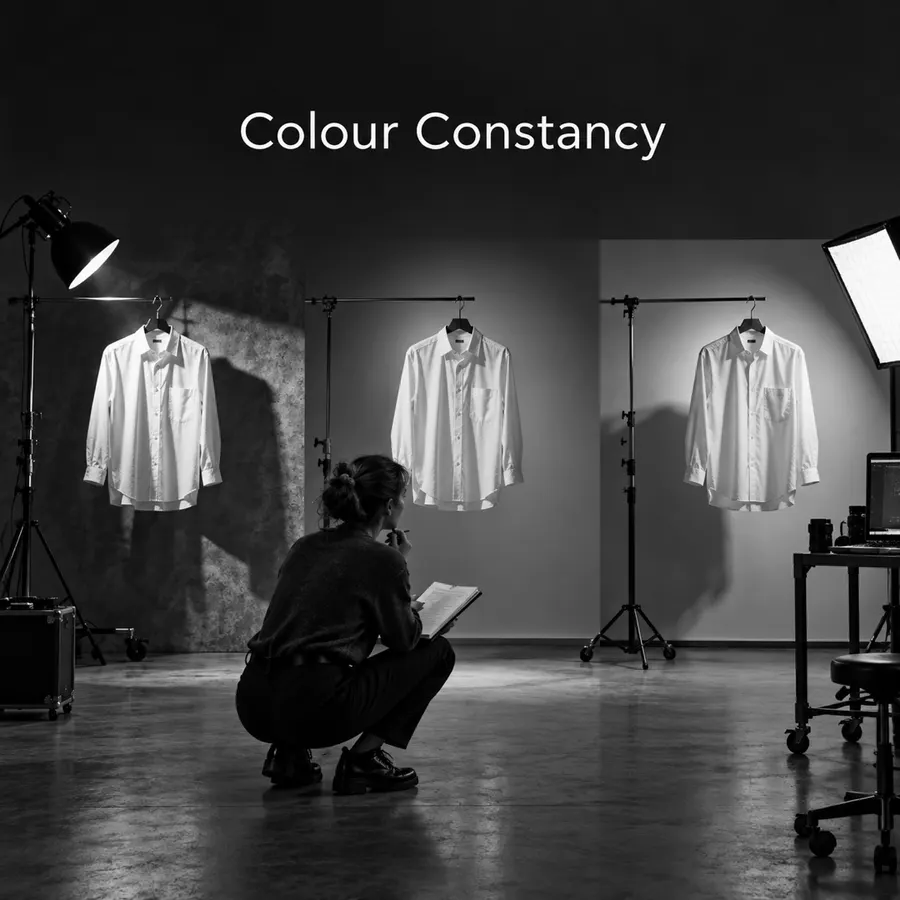
The light reaching your eye from a surface is that surface's colour multiplied by the colour of whatever is shining on it. Colour constancy is your brain estimating the illumination and subtracting it, so that a white shirt stays white under three different lamps.
What it is
The problem has no clean solution. Two unknowns, one measurement, and the visual system has to commit to an answer several times a second.
It solves it with cues from the scene: what else is in view, what the highlights look like, what the shadows imply. Where the cues are rich, everybody converges and nobody notices there was a calculation. Where the cues are thin, the estimate falls back on whatever the observer assumes by default, and people diverge.
In effect
The dress photograph of 2015 is the clearest demonstration anyone has produced, and it was an accident. Its pixels measure as brown and blue, and it is overexposed, poorly white balanced and cropped so tightly that the background says almost nothing about the light.
Observers who assume a cool bluish daylight discount the short wavelengths and see white and gold. Observers who assume a warm indoor bulb discount the long wavelengths and see blue and black. Observers assuming something neutral see what is actually there. Adding overt cues about the illumination back into the image flips which colours a person sees, which is the test that turns an explanation into a claim.
What it does not say
It does not say that anybody is seeing it wrong. Two visual systems are solving the same equation with different starting assumptions, and neither gets feedback telling it which assumption was right.
It does not describe a type of person either. Witzel and colleagues found that the dress result held and tracked individual colour constancy, while individual differences in every other ambiguous phenomenon they measured were independent of the dress and of each other. There is one specific computation in which people differ, and no evidence for a general perceptual style.
Sources
- Lafer-Sousa, R., Hermann, K. L., & Conway, B. R. (2015). Striking individual differences in color perception uncovered by the dress photograph. Current Biology, 25(13), R545-R546. doi:10.1016/j.cub.2015.04.053
- Witzel, C., O'Regan, J. K., & Hansmann-Roth, S. (2017). The dress and individual differences in the perception of surface properties. Vision Research, 141, 76-94. doi:10.1016/j.visres.2017.07.015
- Feitosa-Santana, C., Lutze, M., Barrionuevo, P. A., & Cao, D. (2018). Assessment of #TheDress with traditional color vision tests. i-Perception, 9(2). doi:10.1177/2041669518764192
- Witzel, C., & Gegenfurtner, K. R. (2018). Color perception: objects, constancy, and categories. Annual Review of Vision Science, 4, 475-499. doi:10.1146/annurev-vision-091517-034231
- Where this came from
- No book in this library is the source of this concept. It entered the vault from Why You and I See Different Colours, built from primary sources rather than from a book.