Conspicuous Consumption
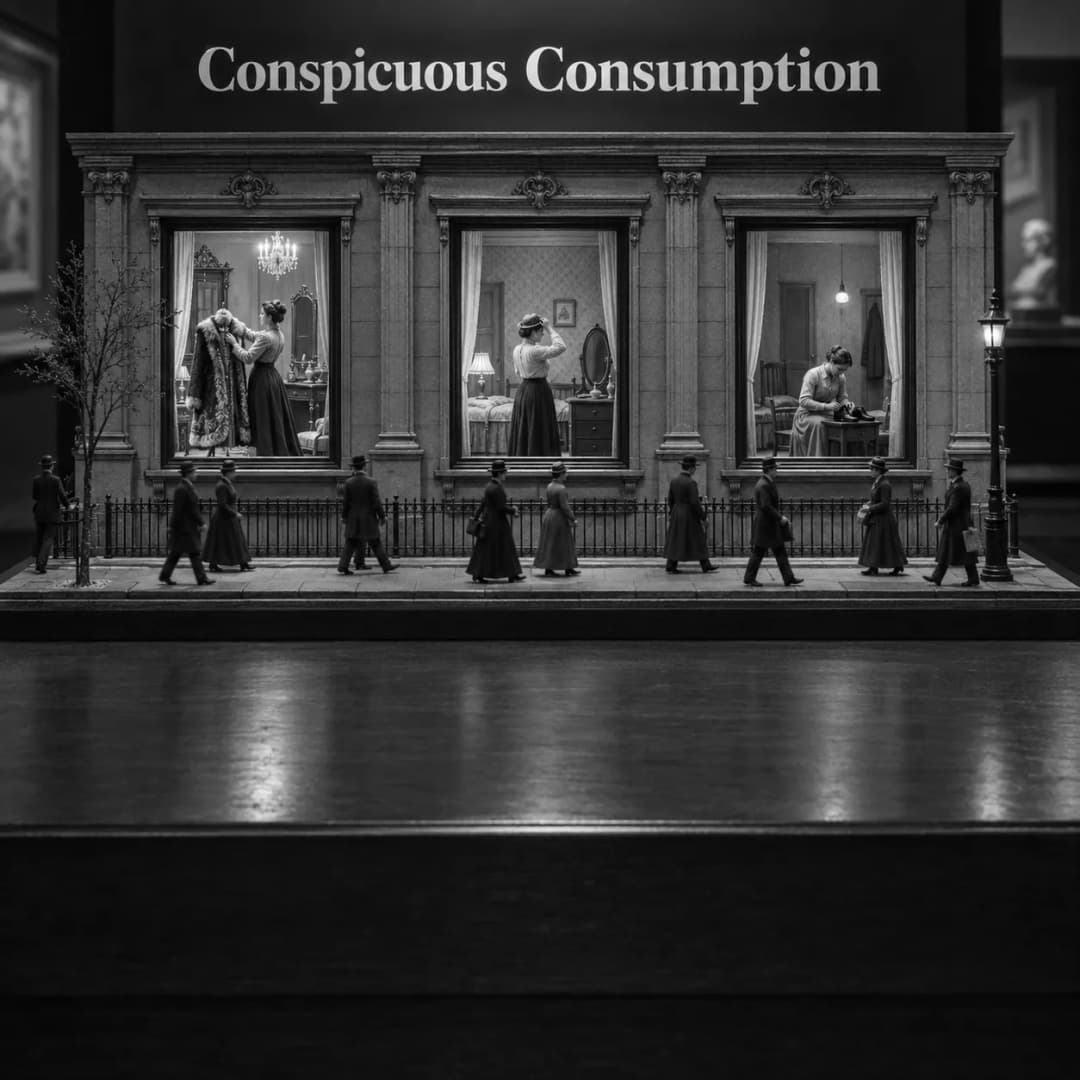
Spending on what can be seen, in order to communicate standing. Veblen's 1899 account is wider and stranger than the phrase now suggests: his subject is not rich people showing off but a whole society's standards of decency, set at the top and travelling all the way down, so that the poorest household still spends something on appearances. This record had the narrower version until somebody read the primary text.
What it is
The Theory of the Leisure Class puts conspicuous leisure in chapter three and conspicuous consumption in chapter four, and the order is the argument rather than an accident of drafting.
Demonstrating that you do not have to work is the older and originally stronger signal. Buying visibly overtakes it only as populations become urban, mobile and anonymous, because a stranger cannot see how you spend your Tuesday but can see what you are wearing. That shift, from a signal requiring an audience who knows you to one that works on strangers, is the most useful thing in the book for anybody writing about consumption today.
The reach of the claim is what the popular version drops. Veblen states in chapter four that no class of society, not even the most abjectly poor, forgoes all customary conspicuous consumption. The standard is set at the top and the obligation runs downwards, which makes this an argument about social norms rather than about vanity.
In effect
The practical consequence is that spending on appearances is not irrational and not confined to the wealthy. It is the cost of meeting a standard of decency that somebody else set.
It also predicts something the modern evidence has struggled with. If the signal requires an audience capable of reading it, then the same display should pay differently in front of different audiences. The best-controlled field test of the modern costly-signalling version found exactly that kind of dependency, reporting no positive effect of a luxury label in five experiments and a negative tendency in poorer neighbourhoods. Veblen's framing anticipates that result better than the theory that replaced it.
What it does not say
It does not say the signal always works, or that it works the same way everywhere. It says the standard is socially set, which implies the opposite.
It does not rank consumption above leisure. The ordering of the chapters makes leisure the prior and stronger signal, and dropping that is the most common error in secondary accounts, including an earlier version of this record.
And it is not experimental evidence. This is an 1899 work of economic sociology, built from observation and argument. Its value here is the mechanism and the scope of the claim, not a measured effect size.
Sources
- Veblen, T. (1899). The Theory of the Leisure Class. Chapters 1 to 4 read directly and in full from the primary text in this vault, 20 September 2026. That read corrected this record, which had previously described the concept as being about wealth signalling by the rich.
- No external verification pass has been run. For a work of this age the useful pass is reception rather than replication, and it has not been done here.