Costly Signalling
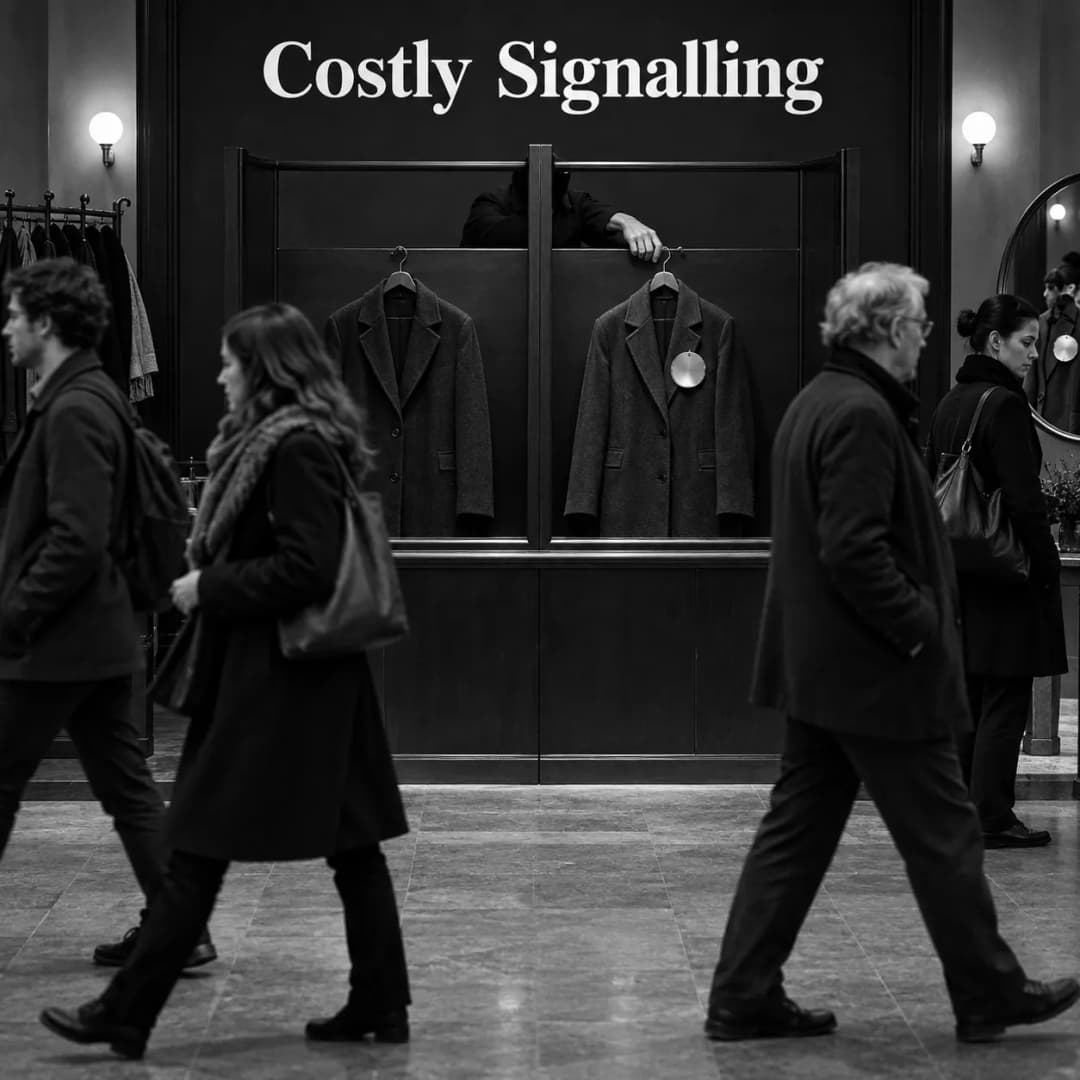
A signal is credible when it is expensive, because the cost is what stops everybody sending it. Applied to consumption, the theory says a luxury label communicates status precisely because it is hard to afford. The best-controlled field test of that prediction found no effect at all, which makes this a good example of a theory that is elegant, widely taught, and shakier in the field than its popularity suggests.
What it is
The logic comes from evolutionary biology and transfers to consumption directly. If a display costs something, only those who can bear the cost will produce it, so an observer can use the display as a shortcut to an underlying quality without having to verify anything.
Rob Nelissen and Marijn Meijers put the consumer version in the field, publishing in Evolution and Human Behavior in 2011 under the title "Social benefits of luxury brands as costly signals of wealth and status". They reported positive evidence: people displaying luxury labels received better treatment in ordinary social encounters. The paper has been cited several hundred times and became the standard reference for why logos work.
The idea is considerably older than the experiment. Thorstein Veblen set out the same mechanism in 1899 without the vocabulary, and his version is in some respects more careful, because he treated the signal as something that needs an audience able to read it.
In effect
Then the replication, which has not travelled nearly as far as the original.
Joël Berger noticed that some of the 2011 experiments were not conducted in a perfectly double-blind manner, meaning the people delivering the treatment could know which condition they were in. He rebuilt the design double-blind, added a "green" label condition to test whether signalling also explains environmental behaviour, and ran it in both average and below-average socioeconomic neighbourhoods, where the theory predicts luxury signals should work harder still.
Five experiments. No positive effect of the luxury brand label in any of them. No green-signalling effect either. And in poorer neighbourhoods a negative tendency of the luxury label became evident, meaning the logo appeared to cost the wearer rather than pay them.
His own conclusion is the useful one, and it is not that signalling is nonsense: any signalling account has to take the characteristics of the observer into account, including their own social status. The signal is not a property of the object. It is a transaction, and one party has to want to be impressed.
What it does not say
It does not say the theory is refuted. One well-controlled null across five experiments is strong evidence against one prediction in one setting, not a verdict on costly signalling as a framework.
It does not isolate blinding as the cause of the divergence. Berger changed the procedure, added conditions, and changed the neighbourhoods and population. The honest statement is that the original did not survive a better-controlled attempt.
And it sits awkwardly beside a finding that points the other way. Silvia Bellezza, Francesca Gino and Anat Keinan's red sneakers effect reports that visible nonconformity can raise inferred status. Conforming expensively and conspicuously not conforming cannot both be simple consequences of price, so whatever observers read off clothing is more complicated than cost.
Sources
- Nelissen, R. M. A., & Meijers, M. H. C. (2011). "Social benefits of luxury brands as costly signals of wealth and status." Evolution and Human Behavior, 32(5), 343-355. doi:10.1016/j.evolhumbehav.2010.12.002. Verified at the published record, 1 October 2026.
- Berger, J. (2017). "Are luxury brand labels and 'green' labels costly signals of social status? An extended replication." PLOS ONE, 12(2), e0170216. doi:10.1371/journal.pone.0170216. Open access. Verified at the published record, 1 October 2026.
- Bellezza, S., Gino, F., & Keinan, A. (2014). "The red sneakers effect: inferring status and competence from signals of nonconformity." Journal of Consumer Research, 41(1), 35-54. doi:10.1086/674870.
- Veblen, T. (1899). The Theory of the Leisure Class. Read from the primary text in this vault, 20 September 2026.