Cues to Deception
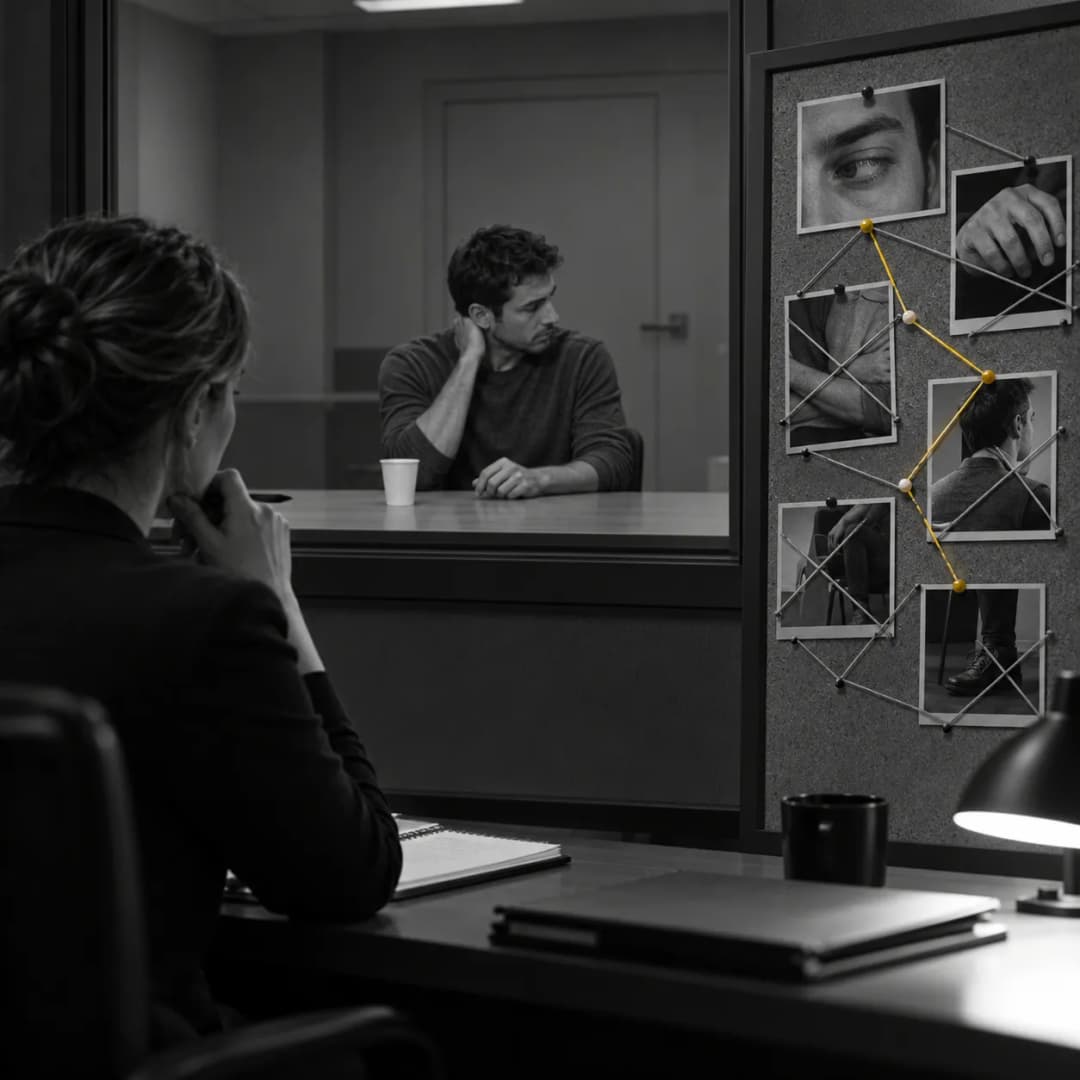
Cues to deception are the behaviours that might separate a liar from a truth-teller: looking away, fidgeting, blushing, stammering. The 2003 meta-analysis by Bella DePaulo and colleagues combined 1,338 estimates of 158 cues and found that many had little or no measurable link to lying. Hartwig and Bond (2011) conclude that gaze aversion is not a valid indicator of lying. The cues that do differ are weak, and people already use them sensibly. The weakness lies in the signal.
What it is
A cue to deception is any observable feature of how someone speaks or behaves that is claimed to differ between lying and telling the truth. The category is wide. It covers nonverbal behaviour such as gaze, posture and hand movement, vocal features such as pitch and hesitation, and features of the story itself such as how much detail it contains and how plausible it sounds. Cue research asks a prior question to the one about judges: before asking whether people can read the signs, it asks whether the signs exist.
The main answer comes from DePaulo, Lindsay, Malone, Muhlenbruck, Charlton and Cooper, whose 2003 paper in Psychological Bulletin is titled "Cues to deception". It combined 1,338 estimates of 158 possible cues. Many behaviours had little or no measurable connection to lying. Where differences did appear, liars were less forthcoming and told less convincing stories. Their accounts contained fewer ordinary imperfections and fewer unusual details. They made a more negative impression and looked more tense. The differences were larger when liars were motivated to succeed, especially when the motive was tied to identity rather than money or material gain, and when the lie concerned a transgression.
Maria Hartwig and Charles Bond summarised the same ground in 2011 in blunt terms. Gaze aversion, they wrote, is not a valid indicator of deception, and many signs of nervousness, such as fidgeting, blushing or speech disturbances, are not systematically linked to it. Their analysis then turned to a second question: do people rely on the wrong cues? The answer was no, which changes what the weak signal means.
In effect
The belief that crosses cultures
The Global Deception Research Team ran two studies, an open-ended question about how to tell when someone is lying and a questionnaire, across 75 countries and 43 languages. They found a dominant pan-cultural stereotype that liars avert their gaze, and they offered a social-control interpretation of why such a belief might persist. The meta-analytic evidence says that the cue everyone names is not a valid indicator. A belief that is both universal and unsupported is the central case for this concept.
The lens model and the weak signal
Hartwig and Bond used Brunswik's lens model, a framework for studying human predictions of criteria that are probabilistically related to cues. Their first meta-analysis covered 153 independent sender samples from 128 documents and 66 cues. They then compared the cues that go with actual deception to the cues that go with perceived deception. Across studies the correlation was .59, and within studies, drawn from 25 sender samples, it was .72. People rarely rely on the wrong cues. Their intuitive judgements were also more accurate than their stated beliefs. Combining several cues into one model gave a validity of about .35, a modest value that explains why even a sensible judge stays close to chance.
What follows for interviewing
If observers already weigh the available cues in roughly the right way and the cues are weak, training observers to watch more carefully has little to work with. Hartwig and Bond concluded that the best way to improve judgment achievement is to increase behavioural differences between liars and truth-tellers. The finding that liars give less forthcoming and less detailed accounts points to the content of what is said as the more promising place to look, since an interviewer can ask for more and listen to how much arrives.
Motivation cuts both ways
Stakes change what an observer sees. In their 2006 synthesis of judgments, Bond and DePaulo found that motivated senders were easier to detect in within-study comparisons, which fits the 2003 finding that cues grow when liars care about the outcome. They also found that people who are motivated to be believed look deceptive whether or not they are lying. A weak cue that strengthens under pressure therefore also lands on honest people who are under the same pressure, which is one more reason a single glance is a poor basis for a verdict.
What it does not say
It does not say that liars behave exactly like truth-tellers. The 2003 analysis found real differences, and they are mostly in the story, in tension and in the impression made, not in the behaviours people usually name. It does not say that cues can never be combined to useful effect; a later meta-analysis by Hartwig and Bond, "Lie detection from multiple cues", looked at that question, and this page does not summarise its findings. It does not say that people are poor judges of behaviour in general, only that the behaviours linked to lying are faint.
It is also silent on tools that do not rely on watching, such as checking a statement against known facts, and on physiological methods such as the polygraph, which have their own evidence.
Who developed it
The foundational synthesis is Bella DePaulo's 2003 meta-analysis with five co-authors. Maria Hartwig and Charles Bond supplied the lens-model account of why the weak signal, and not a failure of judgment, limits accuracy.
Sources
- DePaulo, B. M., Lindsay, J. J., Malone, B. E., Muhlenbruck, L., Charlton, K., & Cooper, H. (2003). "Cues to deception." Psychological Bulletin, 129(1), 74-118. doi:10.1037/0033-2909.129.1.74
- Hartwig, M., & Bond, C. F., Jr. (2011). "Why do lie-catchers fail? A lens model meta-analysis of human lie judgments." Psychological Bulletin, 137(4), 643-659. doi:10.1037/a0023589
- Hartwig, M., & Bond, C. F., Jr. (2014). "Lie detection from multiple cues: A meta-analysis." Applied Cognitive Psychology, 28(5), 661-676. doi:10.1002/acp.3052
- Bond, C. F., Jr., & DePaulo, B. M. (2006). "Accuracy of deception judgments." Personality and Social Psychology Review, 10(3), 214-234. doi:10.1207/s15327957pspr1003_2
- The Global Deception Research Team (2006). "A world of lies." Journal of Cross-Cultural Psychology, 37(1), 60-74. doi:10.1177/0022022105282295
- Vault note: [[Cues to Deception]].