Engram
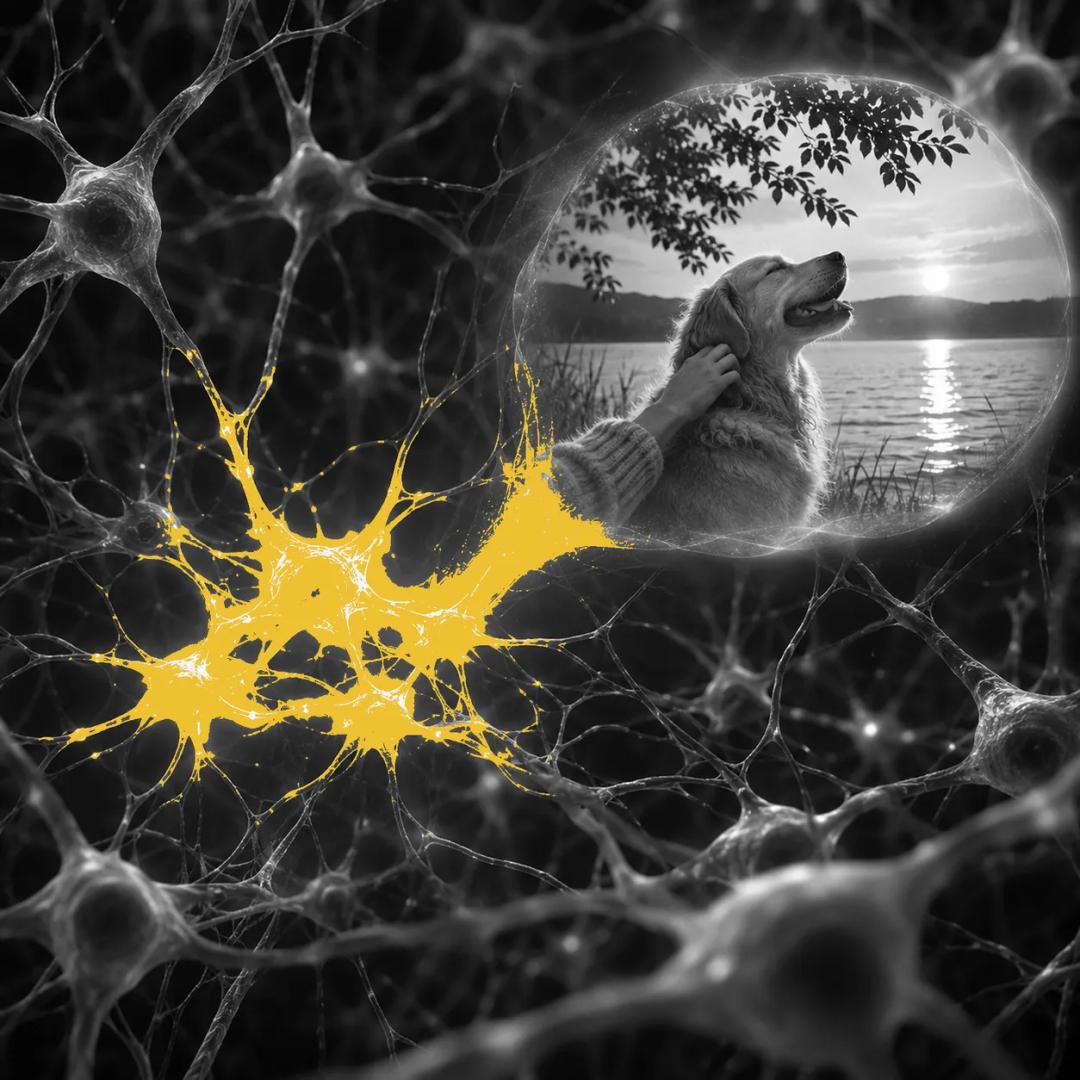
The lasting physical change that an experience leaves in a specific group of brain cells.
What it is
Richard Semon proposed in 1904 that experience activates cells, leaves them changed, and that reactivating them later drives recall. Reijmers and colleagues found that amygdala cells active during fear learning in mice were reactivated at retrieval, with more reactivated cells going with a stronger fear response. Liu and colleagues found that light on tagged dentate gyrus cells made mice freeze in a different setting, which they read as recall of the fear memory. Zaki and Cai argue that engram representations are more dynamic and flexible than previously thought.
In effect
The article on what an engram is uses it as the thread from Semon's 1904 proposal to tagging and light studies in mice.
What it does not say
The mouse studies tag and reactivate cells linked to a fear memory, which is narrower than a full account of how a human memory is stored. The idea is also under revision, since the 2025 review describes engrams as flexible and not fixed.
Sources
- Josselyn, S. A., & Tonegawa, S. (2020). Memory engrams: Recalling the past and imagining the future. Science, 367(6473), eaaw4325.
- Reijmers, L. G., Perkins, B. L., Matsuo, N., & Mayford, M. (2007). Localization of a stable neural correlate of associative memory. Science, 317(5842), 1230-1233.
- Liu, X., Ramirez, S., Pang, P. T., Puryear, C. B., Govindarajan, A., Deisseroth, K., & Tonegawa, S. (2012). Optogenetic stimulation of a hippocampal engram activates fear memory recall. Nature, 484(7394), 381-385.
- Ramirez, S., Liu, X., Lin, P.-A., Suh, J., Pignatelli, M., Redondo, R. L., Ryan, T. J., & Tonegawa, S. (2013). Creating a false memory in the hippocampus. Science, 341(6144), 387-391.
- Zaki, Y., & Cai, D. J. (2025). Memory engram stability and flexibility. Neuropsychopharmacology, 50(1), 285-293.
- Bruce, D. (2001). Fifty years since Lashley's In Search of the Engram: Refutations and conjectures. Journal of the History of the Neurosciences, 10(3), 308-318.