Extinction (Operant Conditioning)
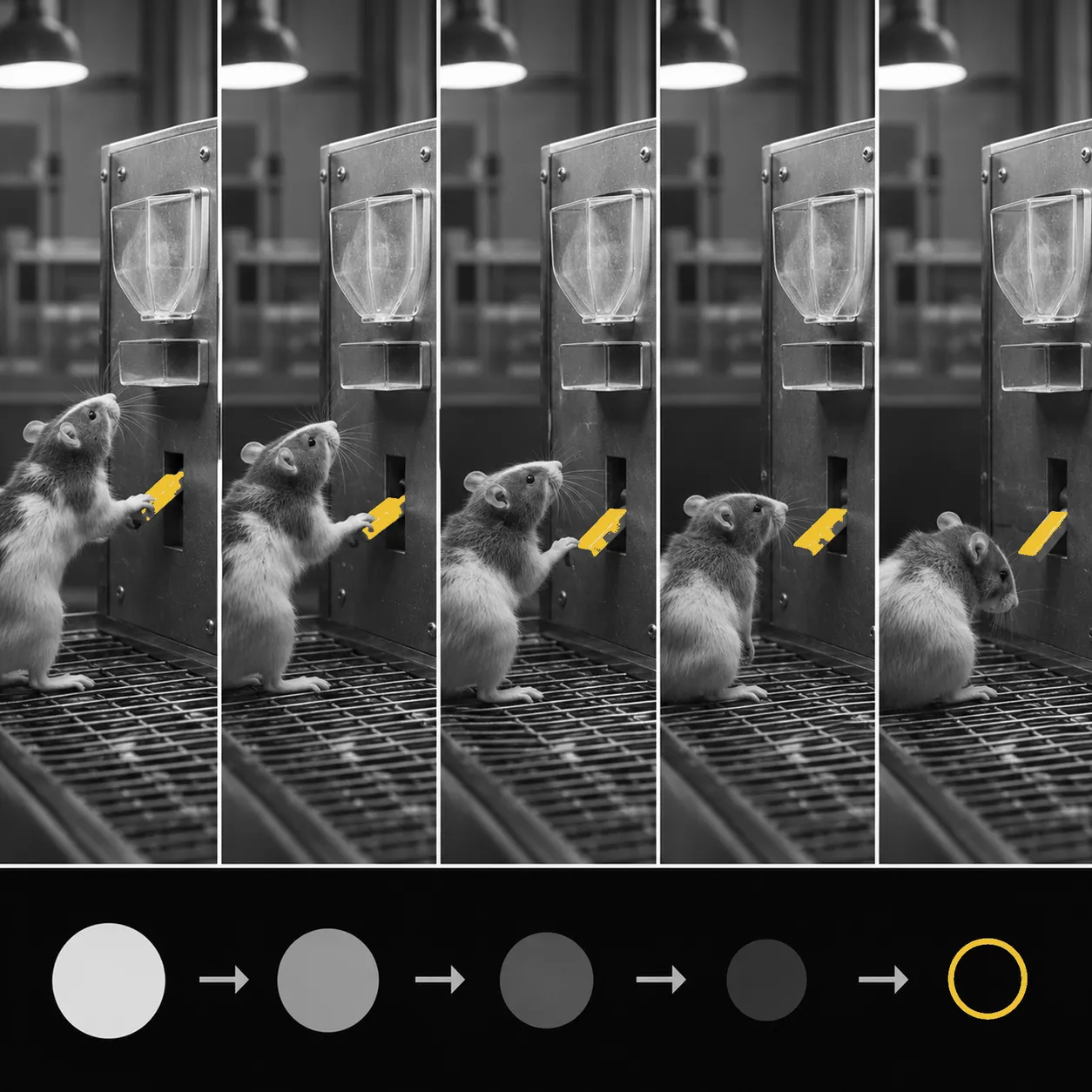
The fading of a behaviour once its consequence stops arriving.
What it is
In Skinner's 1948 pigeon experiment, one bird whose food was withdrawn made more than 10,000 responses before its routine nearly stopped, and the routine came back quickly once food resumed. In a 1979 study with 3-month-old infants whose kicks moved a crib mobile, responding fell in the part of the schedule where the mobile no longer moved.
In effect
In the article on operant conditioning, it is the fourth row of the consequence table and the closing finding.
What it does not say
It does not say that a behaviour stops as soon as the consequence ends; responding can continue for a long time first.
Sources
- Skinner, B. F. (1948). 'Superstition' in the pigeon. Journal of Experimental Psychology, 38(2), 168-172.
- Rovee-Collier, C. K., & Capatides, J. B. (1979). Positive behavioral contrast in 3-month-old infants on multiple conjugate reinforcement schedules. Journal of the Experimental Analysis of Behavior, 32(1), 15-27.