Flicker Paradigm
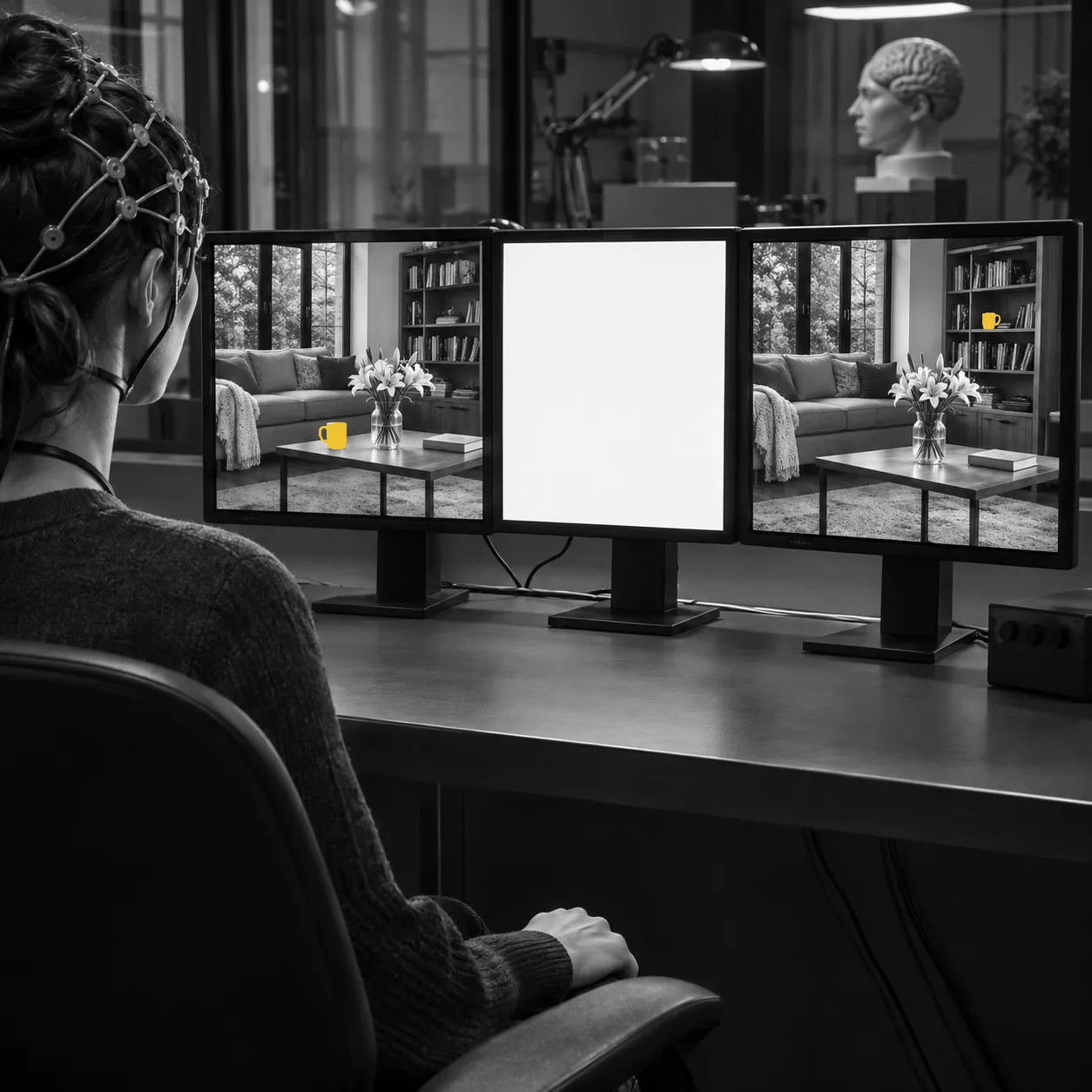
A method that alternates an original and a changed image with brief blanks between them.
What it is
In the flicker paradigm, introduced by Rensink, O'Regan and Clark in 1997, an original and a modified scene alternate with short blank fields while observers search for the difference. The blanks remove the motion signal that would otherwise draw the eye, so observers can take a long time to find even large changes.
In effect
In the article on change blindness, the flicker task is the clearest demonstration that seeing a change requires attention to the item that changed.
What it does not say
It is a laboratory method, not a measure of how often changes are missed in everyday life.
Sources
- Rensink, R. A., O'Regan, J. K., & Clark, J. J. (1997). To see or not to see: The need for attention to perceive changes in scenes. Psychological Science, 8(5), 368-373.
- Jensen, M. S., Yao, R., Street, W. N., & Simons, D. J. (2011). Change blindness and inattentional blindness. Wiley Interdisciplinary Reviews: Cognitive Science, 2(5), 529-546.