Hysteria
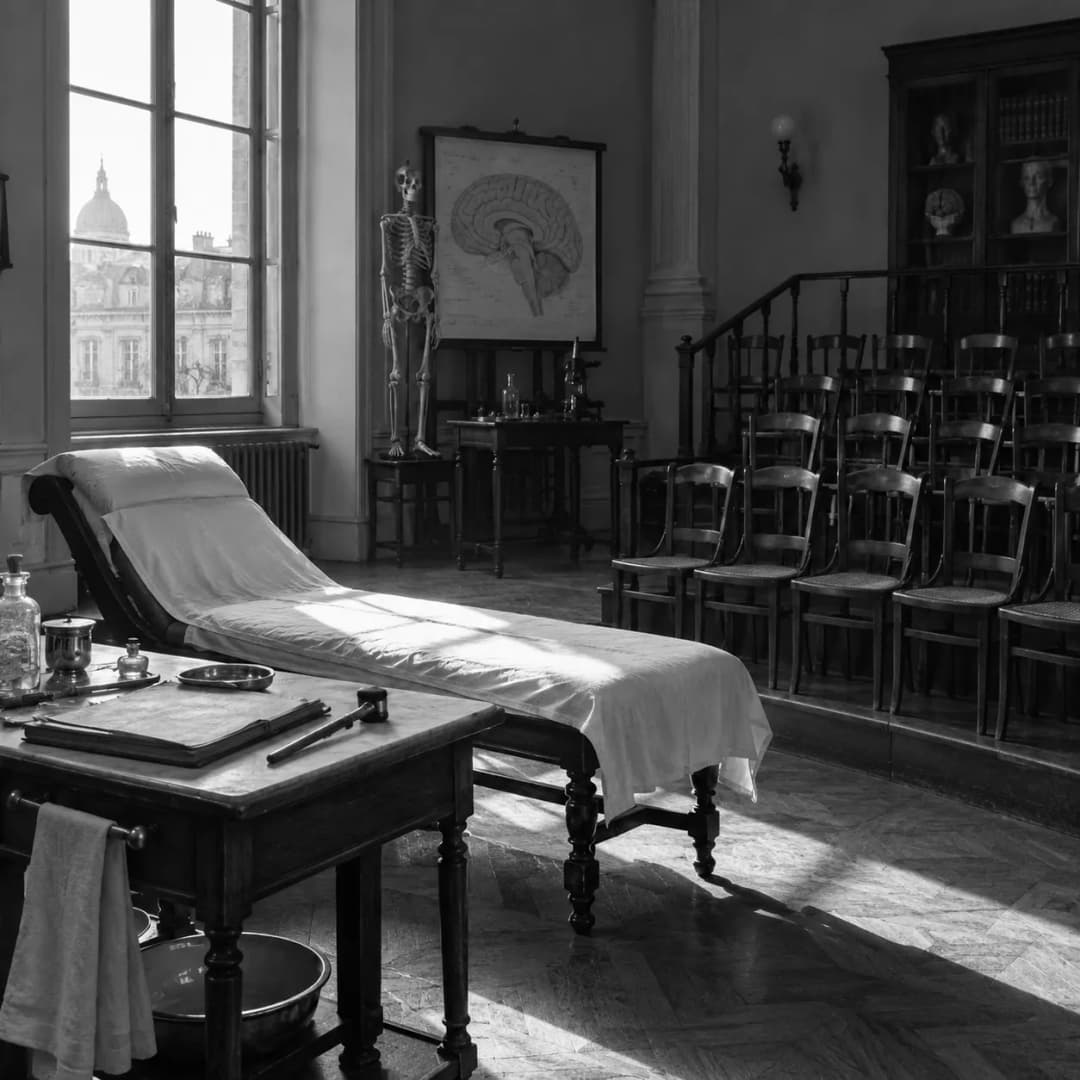
Hysteria was the nineteenth-century medical label for physical symptoms, such as paralysis or fits, that doctors attributed to the mind rather than to disease. Charcot's work in Paris and Breuer's and Freud's in Vienna made it the starting point of psychoanalysis. In the twentieth century, follow-up studies tested how often the label had hidden a physical illness.
What it is
Peter Watson's The Modern Mind (2001) gives the history on p. 13. Freud studied in Paris under Jean-Martin Charcot, who ran an asylum for women with incurable nervous disorders, and Watson credits Charcot, without qualification, with showing that hysterical symptoms could be induced under hypnosis. From December 1880 the Viennese physician Josef Breuer treated Bertha Pappenheim, known as Anna O., and found that letting her talk at length made her symptoms disappear, and she named this the "talking cure". She ended treatment "totally cured" in June 1882 and, Watson adds, was admitted to a sanatorium within a month.
Freud moved from hypnosis to free association, and from there to the unconscious and repression (pp. 13 to 14). In 1905, Watson records, Freud reported paternal syphilis in more than half of his severe cases of hysteria (pp. 106 to 107).
The label was later tested. E. Slater followed up patients diagnosed with hysteria between 1951 and 1955, and a 2005 systematic review led by Jon Stone records that 32 of the 97 patients Slater traced had been misdiagnosed. Stone's review gathered 27 studies covering 1,466 adults with unexplained motor or sensory symptoms, followed for a median of five years. Misdiagnosis fell from 29 per cent for diagnoses made in the 1950s to 17 per cent in the 1960s and 4 per cent from the 1970s onwards. The authors judged the fall was probably due to better study design rather than brain scanning.
In effect
For a reader, the history shows how attractive an early, tidy explanation has been, even to expert judgement, and how long it took for anyone to check it. The question has not gone away: in a 2026 survey led by Melanie Sloan, people with autoimmune diseases reported that their illness had first been put down to a psychiatric or psychosomatic cause, women more often than men. This page is history and a summary of research, not medical advice.
What it does not say
It does not treat hysteria as a current diagnosis; the word is used here as a historical label. The nineteenth-century account rests on one popular intellectual history, which this library treats as a map to the material rather than an authority for its dates or figures. Slater's paper was not read directly, and its figures come from Stone's review.
Stone's review does not show that diagnoses of unexplained symptoms are usually wrong. From the 1970s onwards, such a diagnosis usually held. The 2026 survey relied on patients' own reports, and its authors call the work exploratory.
Sources
- Watson, P. (2001). The Modern Mind: An Intellectual History of the 20th Century. HarperCollins (Perennial edition 2002), pp. 13 to 14, 27, 106 to 107.
- Slater, E. (1965). "Diagnosis of 'hysteria'." British Medical Journal, 1(5447), 1395-1399. doi:10.1136/bmj.1.5447.1395.
- Stone, J., and colleagues (2005). "Systematic review of misdiagnosis of conversion symptoms and 'hysteria'." BMJ, 331(7523), 989. doi:10.1136/bmj.38628.466898.55.
- Sloan, M., and colleagues (2026). "Sex and disease differences in patients' diagnostic experiences in autoimmune diseases: an international cross-sectional study." eClinicalMedicine, 104259. doi:10.1016/j.eclinm.2026.104259.