Impression Management
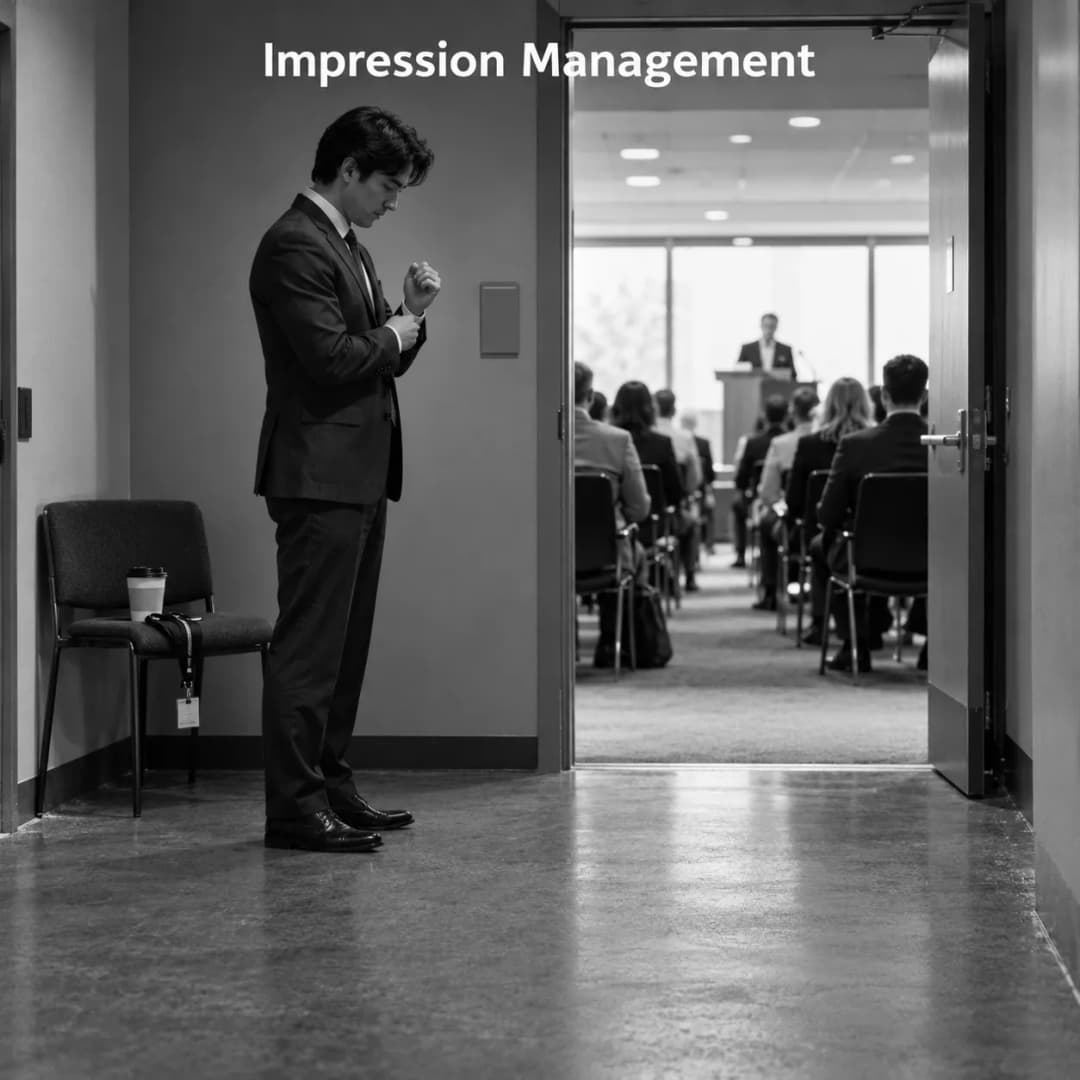
Impression management is presenting a favourable public image so that other people form positive judgements of you. Erving Goffman's contribution was to treat this as theatre rather than as deception: a person has a front stage where the performance happens, a backstage where it is prepared and dropped, and an off stage where neither applies. It is a dramaturgical framework, so it describes a structure rather than predicting an effect, and it is cited as an idea attributed to him.
What it is
The interesting question the framework raises is not whether people manage impressions, which everyone does, but which settings make the front-stage performance compulsory.
The service counter, the interview, the client call and the all-hands are front stage. The break room, the group chat with two colleagues in it, and the walk to the car are backstage. Most workplace friction about professionalism is really an argument about where the line between the two sits, and whose job carries more front stage than they were told it would.
The attribution in the secondary source used here is worth recording, because it is odd in two ways. Goffman is described as a sociologist and social psychiatrist, which is an unusual descriptor; he is universally a sociologist and did not carry the second label. And the work is dated only as over seventy years ago, with no year given. The book meant is The Presentation of Self in Everyday Life. Goffman does not appear in that chapter's reference list at all, despite being discussed at length and supplying its central apparatus.
In effect
The chapter carries an argument of its own that should be graded as opinion. It holds that authenticity is not really a psychological concept, and that in many jobs full authenticity is unhelpful or impossible. Nothing is cited for either half.
Both halves deserve separate treatment. There is a real research literature on authenticity as a measurable construct, which cuts against the first claim, whatever one thinks of how well it has been operationalised. The second claim, that some roles structurally require managed self-presentation, is well supported by the emotional labour literature, and this publication agrees with it. Impression management becomes emotional labour at the point where an employer requires it and pays for it.
There is a rival account of the same territory worth setting against Goffman, because the two disagree about the audience. Kevin Simler and Robin Hanson's The Elephant in the Brain pushes the structure inwards. Goffman's performer knows he is performing and can drop it when the door closes. Their performer does not know, because the audience has been internalised. Two devices carry that claim: a press secretary module whose job is to explain the organisation's behaviour to outsiders and which is not told the real reasons, and an imagined audience, described at page 68, where a couple using euphemism perform for a cast of peers waiting in the wings and neither party need be consciously aware of performing for anyone.
That last clause is what to notice. It is a reasonable claim about how social habits form, and it is also the sentence that puts every self-report beyond reach, so no introspective evidence could count against the account. Backstage, on this reading, is another stage, which is a genuinely interesting extension of Goffman offered with no evidence that would distinguish it from Goffman's original.
The checkable contribution in that book is elsewhere. Its chapter 4 distinction between how widely a thing is known and how openly it is known is a real analytic move, and it makes impression management measurable in a way the dramaturgical frame does not.
What it does not say
It is not a research claim and does not have a replication record. It is a framework and should be attributed rather than cited as evidence.
It does not say self-presentation is dishonest. Treating it as theatre rather than as deception is the whole of Goffman's move.
It does not establish that authenticity is not a psychological concept. That is the secondary source's own argument, uncited, and there is a literature that cuts against it.
It does not reach the unconscious version for free. The account in which the performer does not know they are performing is a different and much harder claim, and as stated it is not testable by any self-report.
Sources
- Goffman, E. The Presentation of Self in Everyday Life. Front stage, backstage and off stage. Credited in the prose of the chapter used here and absent from its reference list; dated there only as over seventy years ago.
- Furnham, A. The New Psychology, ch. 3. The authenticity argument is the author's own and uncited, and is attributed to him rather than to a literature.
- Simler, K., & Hanson, R. The Elephant in the Brain. The press secretary in ch. 6; the imagined audience at p. 68, including the claim that neither party need be consciously aware of performing. The distinction between how widely and how openly a thing is known is in ch. 4.