Impulse Buying
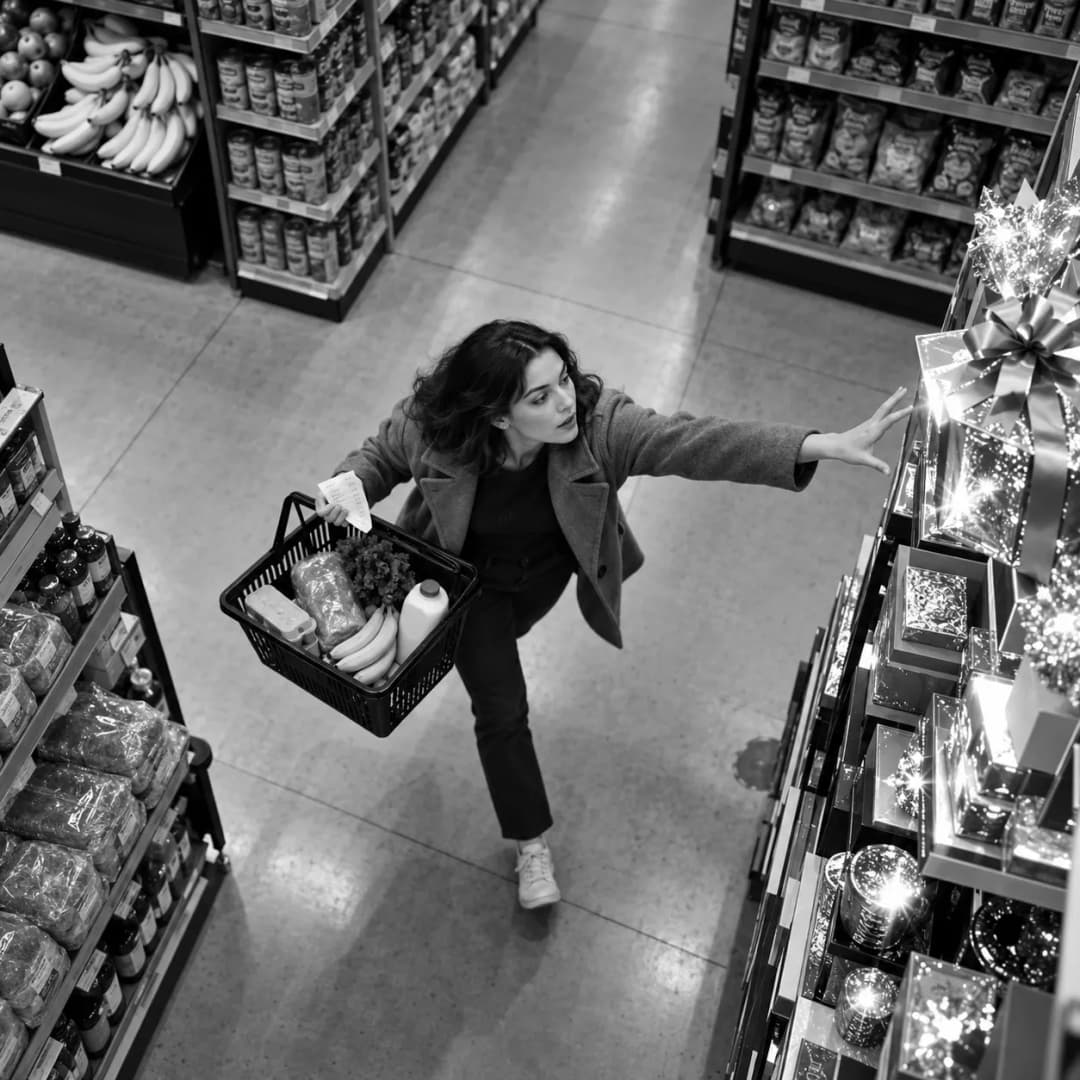
Impulse buying is a purchase made on a sudden, felt urge to buy something now. It is a stricter idea than an unplanned purchase, which only means the item was not intended when the shopper walked in. In stores, the purpose of the trip predicts unplanned buying better than hunger does.
What it is
The definition most of the field uses comes from D. W. Rook in 1987: "a consumer experiences a sudden, often powerful and persistent urge to buy something immediately". A meta-analysis by Gopalkrishnan Iyer and three colleagues, pooling 231 samples and more than 75,000 consumers, linked higher self-control to fewer impulse purchases and counted marketing stimuli such as discounts among the main triggers.
The wider category of unplanned buying has been measured in stores. J. Jeffrey Inman, Russell Winer and Rosellina Ferraro interviewed 2,300 shoppers in 28 stores and put the baseline chance of an unplanned purchase at 46 per cent, rising to 93 per cent. David Bell and colleagues, following the same households across trips, found unplanned buying rose steadily as the trip goal became more abstract. A 2026 receipt study led by Sait Durgun covered 323 shoppers. Browsers had nearly nine times the odds of an unplanned purchase compared with routine shoppers, while hunger showed no reliable link across the basket, except in snacks and confectionery and among younger shoppers.
In effect
For a consumer, the trip matters more than the stomach. A specific goal and a list go with fewer unplanned purchases. Not every unplanned purchase is an impulse: shoppers hold mental trip budgets with unassigned slack kept for decisions at the shelf.
What it does not say
It does not rest on the 62 per cent figure. The Future of Shopping (2022), by Jörg Snoeck and Pauline Neerman, states that as many as 62 per cent of in-store purchases are impulse purchases and credits Iyer and colleagues. In the meta-analysis the figure appears once, in the introduction, as an estimate credited to a 2015 newspaper column; it is not one of its findings.
Large replications do not support the idea that a tiring day drains self-control and so drives buying. Kathleen Vohs and Ronald Faber reported the effect in three studies in 2007, but a registered replication across 23 laboratories and 2,141 participants in 2016, and a preregistered test led by Vohs across 36 laboratories and 3,531 participants in 2021, found no reliable evidence for it.
Sources
- Rook, D. W. (1987). "The buying impulse." Journal of Consumer Research, 14(2), 189-199.
- Iyer, G. R., Blut, M., Xiao, S. H., & Grewal, D. (2020). "Impulse buying: a meta-analytic review." Journal of the Academy of Marketing Science, 48, 384-404. doi:10.1007/s11747-019-00670-w.
- Inman, J. J., Winer, R. S., & Ferraro, R. (2009). Journal of Marketing, 73(5), 19-29. doi:10.1509/jmkg.73.5.19.
- Bell, D., Corsten, D., & Knox, G. (2011). Journal of Marketing, 75(1), 31-45. doi:10.1509/jmkg.75.1.31.
- Durgun, S., Çetinkaya, B. D., & Koç, H. (2026). Journal of Retailing and Consumer Services, 93, 104947. doi:10.1016/j.jretconser.2026.104947.
- Stilley, K. M., Inman, J. J., & Wakefield, K. L. (2010). Journal of Consumer Research, 37(2), 264-278. doi:10.1086/651567.
- Vohs, K. D., & Faber, R. J. (2007). Journal of Consumer Research, 33(4), 537-547. doi:10.1086/510228.
- Hagger, M. S., Chatzisarantis, N. L. D., and colleagues (2016). Perspectives on Psychological Science, 11(4), 546-573. doi:10.1177/1745691616652873.
- Vohs, K. D., Schmeichel, B. J., and colleagues (2021). Psychological Science. doi:10.1177/0956797621989733.
- Snoeck, J., & Neerman, P. (2022). The Future of Shopping. LannooCampus, pp. 108 to 109.