Inhibitory Norms
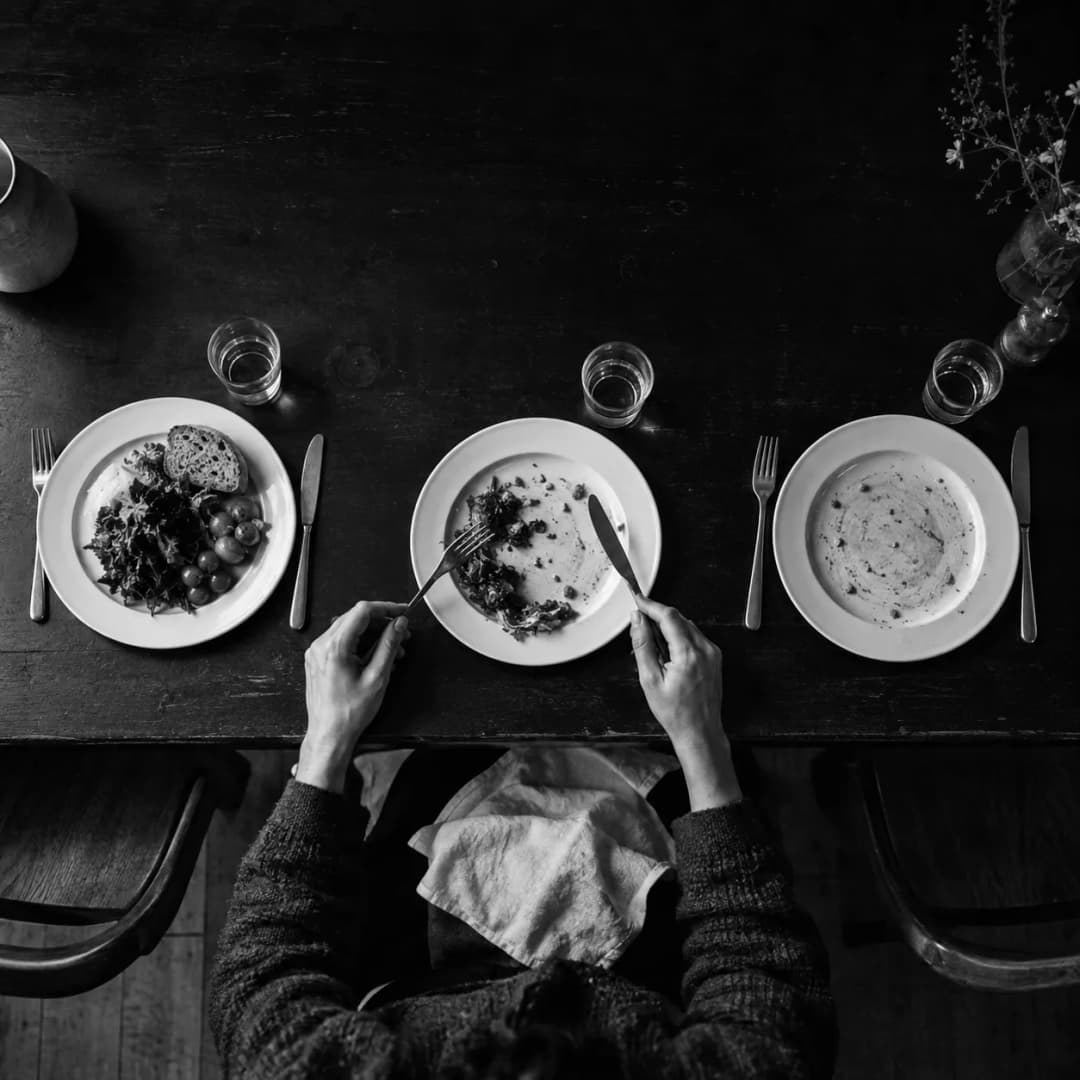
Inhibitory norms are the cues people take from their surroundings about when to stop. When nothing inside you is clearly saying enough, you look outward, and what the situation tells you can push consumption up or down. The idea comes from a 2003 review of research on eating in company, where it reconciled three sets of findings that had contradicted each other.
What it is
Research on eating with other people had produced three answers. Some studies found people eat more in groups than alone. Others found people eat less when they are being watched. A third set found people eat roughly whatever the person beside them eats.
Peter Herman, Deborah Roth and Janet Polivy argued that all three are the same process. With tasty food in front of you and no clear signal of fullness, there is a moment where you could stop and nothing internal is deciding. People fill that gap from the situation. A long, relaxed meal says carry on. A setting where you feel judged says hold back. A companion's plate gives you an amount to match.
In effect
The concept explains why the same food can be eaten in very different amounts depending on the setting. Shared plates, courses arriving in sequence and a table nobody hurries you from all remove the cue that you have finished. A business lunch supplies the opposite cue.
For somebody who wants to eat less in company, the practical reading, which is ours rather than the authors', is to decide the amount before arriving, so the gap is filled by your own decision rather than by the room.
What it does not say
It is not a new experiment. It is a model fitted to findings other researchers produced, and a model that explains three sets of results has not yet been tested against a fourth.
It does not say company makes people eat more, or less. It says company supplies the rule, and the direction depends on which rule.
It does not recommend a diet. The authors propose a mechanism; any advice drawn from it is an inference.
Sources
- Herman, C. P., Roth, D. A., & Polivy, J. (2003). "Effects of the presence of others on food intake: a normative interpretation." Psychological Bulletin, 129(6), 873-886. doi:10.1037/0033-2909.129.6.873. Verified at the published record, 6 October 2026.