Moral Panic
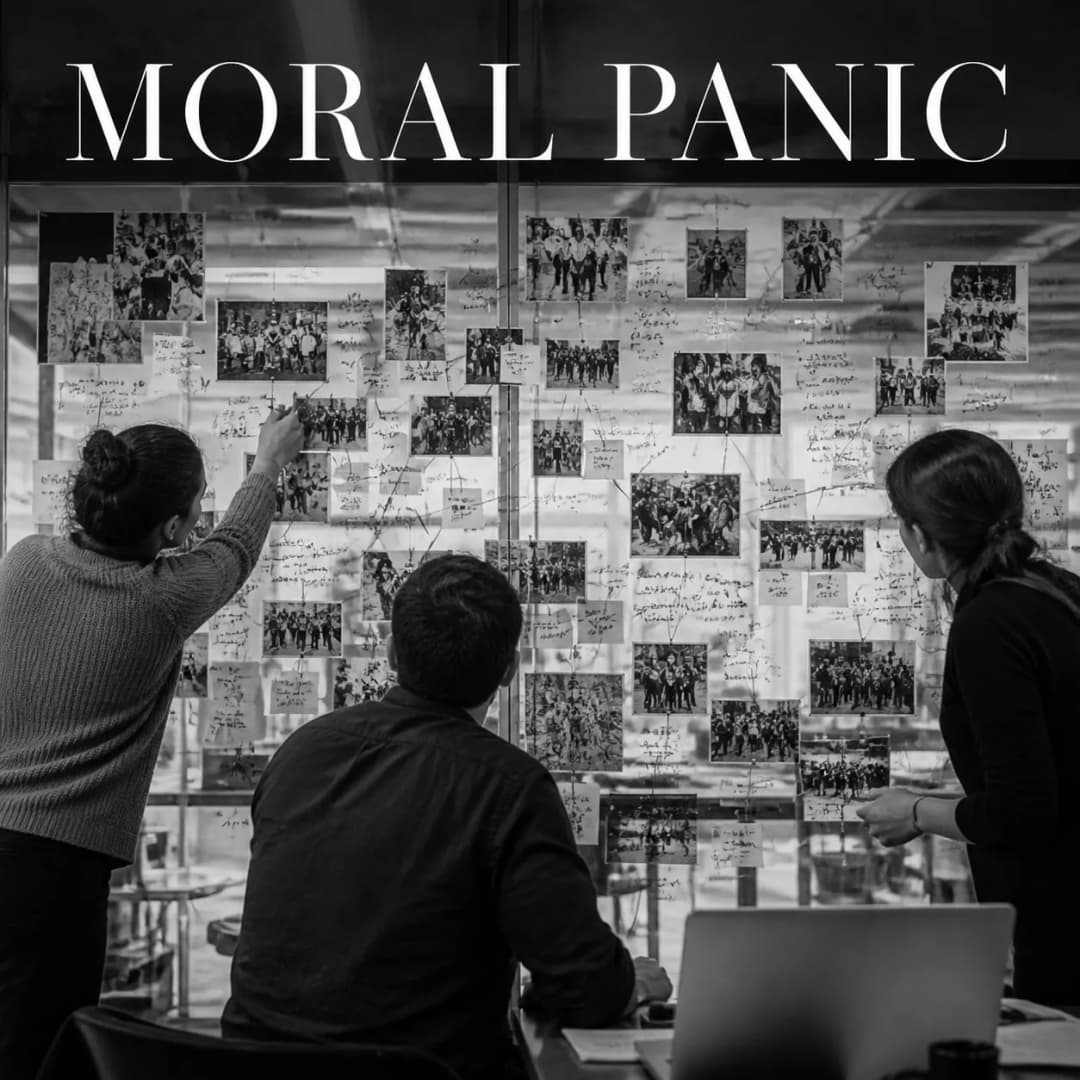
A moral panic is Stanley Cohen's 1972 term for an episode in which a society decides that a particular group threatens its values, states the threat in a stylised form through the press, and answers it with a reaction out of scale with the harm. The group at the centre is the folk devil. Erving Goode and Nachman Ben-Yehuda later gave the concept five criteria. It is a sociological framework rather than a testable effect, and it is graded accordingly.
What it is
Something happens, and it is small. Within a week it is a category.
Cohen built the concept on the mods and rockers, two English youth subcultures whose bank-holiday clashes at seaside towns in 1964 were reported nationally as a symptom of collapse in the young. What interested him was not the fighting. It was the machinery around it: how a local disturbance acquired a name, how newspapers supplied a stereotype, how the stereotype changed the policing, and how the policing then produced more of the thing it was policing. The panic is not a response to deviance. It is one of the things manufacturing it.
The group at the centre of the process is the folk devil, and the naming matters. A panic needs a face. It cannot run on an abstract danger, which is why every case in the literature attaches to a real subculture, a real profession or a real category of person.
Two features separate a moral panic from ordinary public concern about a real problem. The reaction is disproportionate to the demonstrable harm. And the folk devil is not merely dangerous but is held to represent something rotten in the society, which is what makes the panic moral rather than practical. That is why the analytic category belongs to sociology. It describes how a society processes deviance, not a mechanism inside a head.
Goode and Ben-Yehuda turned a loose idea into a checklist in Moral Panics: The Social Construction of Deviance, published by Blackwell in 1994 and reissued by Wiley-Blackwell in 2009. Five criteria, all of which must hold:
Concern, a measurable rise in public worry about a group's behaviour. Hostility, in which the group is cast as an enemy rather than as a problem to be managed. Consensus, meaning the concern is broadly shared across at least a substantial segment of the society. Disproportionality, where the alarm exceeds what evidence of harm supports. Volatility, because these things erupt and subside quickly, though what they leave behind does not.
The same year they published a compressed statement as "Moral Panics: Culture, Politics, and Social Construction" in the Annual Review of Sociology. Its most useful contribution is a set of three competing accounts of where panics originate: grassroots, genuine bottom-up fear; elite-engineered, manufactured from above; and interest group, driven by an organisation with a stake in the outcome. Anyone applying the concept to a current argument should be forced to say which of the three they are claiming. The abstract also draws the line against fads. Both are short-lived. Only a moral panic reliably leaves an informal legacy, and often an institutional one, which is the volatility criterion doing more work than it first appears to.
The criticism is real and belongs on the page rather than in a footnote.
Disproportionality carries the whole framework and is the hardest criterion to operationalise. Calling a reaction out of proportion requires an agreed measure of the actual harm, and in most of the cases the concept gets applied to, either no such measure exists or the measure is itself the thing being argued about. The charge that follows is that the analyst's politics end up deciding which reactions count as panics, which would make the label a rhetorical move dressed as a finding.
Angela McRobbie and Sarah Thornton pressed a different objection in the British Journal of Sociology in 1995. Cohen's model, they argue, assumes a media landscape that has since disappeared: few outlets, broad consensus, and folk devils with no voice of their own. In a fragmented media environment the folk devils answer back, often in the same publications that condemned them, and some subcultures actively court a panic because it is good for them. We reached their argument through the abstract and through secondary accounts, not the full text.
Neither objection retires the concept. Both mean it should be used as a lens with a known bias rather than as a verdict, and that "this is a moral panic" is a claim carrying the same burden of proof as the claim it answers.
In effect
The mods and the rockers
The founding case is Cohen's, and the honest thing to say first is that this site has not read the book.
What is well attested is the shape. Two youth subcultures, a set of bank-holiday disturbances at English seaside resorts in 1964, national press coverage that treated them as evidence of moral collapse, and a legislative and policing response that outran anything the disturbances warranted. Cohen's argument, developed from doctoral research at the London School of Economics, was that the press did not merely report the subcultures. It supplied the categories, sharpened the distinction between them, and gave people who had not previously identified as either a template to adopt.
Everything in this section comes from secondary accounts, which is why no page number, figure or quotation from Cohen appears anywhere on this page. Anyone who needs his own words has to go and get them.
The screen-time argument, currently running
The live case is the claim that smartphones are causing a mental-health crisis in adolescents, and it is a useful test because both sides are named and neither is obviously ridiculous.
Jean Twenge argues that the generation born after 1995 is on the brink of the worst mental-health crisis in decades and that the timing points at phones. Christopher Ferguson, in Psychiatric Quarterly, finds only a negligible relationship between screen time and depression and supports a moderation reading. Andrew Przybylski, at the Oxford Internet Institute, finds wellbeing rising with moderate use, with the harm at the heaviest levels running at about a third as bad as missing breakfast. Sarah Rose Cavanagh's objection is that Twenge reviewed only supporting studies. Those figures reach us through Nir Eyal's account in Indistractable rather than from the papers, and should be treated as his reporting.
What the moral panic framework contributes here is not a verdict. It is a set of questions. Is the concern measurable, is the hostility aimed at a folk devil, is the disproportionality claim itself evidenced, and which of Goode and Ben-Yehuda's three origins is being alleged. Note also that the framework cuts both ways: a sceptic who dismisses every worry about a new medium as a moral panic is running the same reasoning error in the opposite direction, and the concession the sceptics themselves make, that harm shows up above roughly five hours a day, is the part most likely to get lost. See techno-panic for the longer lineage.
The MySpace panic, and the product it shaped
The commercial case is Alice Marwick's, published in First Monday in 2008, and it is on this page because a panic ended in shipped product features rather than in editorials.
Marwick traces two episodes: the cyberporn panic of 1996 and the panic over online predators and MySpace that was running as she wrote. Her argument is that internet content legislation is directly linked to media-fuelled moral panics over uses of technology deemed harmful to children, that both episodes ran on the same fuel, and that both produced legislation carefully drafted to survive First Amendment challenge. The bill in play was the Deleting Online Predators Act, then before Congress. Her judgment on the response is flat: it is an extraordinary reaction, it is misguided, and in many cases it masks the underlying problem.
The product consequence is the part that outlasted the panic. Age gates, default-private profiles for minors, keyword filtering, moderation staffed to a legislative standard rather than a safety one, and network-level blocking in schools and libraries. That is the volatility criterion at work. The concern subsided; the compliance architecture did not, and it is now simply how social products are built. Marwick's paper is also where the subtype gets its name. Her abstract describes moral panics over contemporary technology, "or technopanics", which is the term Adam Thierer later developed at length.
What it does not say
It does not say the concern is always unfounded. This is the most common misuse of the term and it inverts the framework. Disproportionality is a criterion to be established, not an assumption to start from. Some panics attach to real harms that were being genuinely under-addressed, and the label describes the shape of the reaction, not the falsity of the claim.
It is not a research finding and does not have an effect size. This page is graded not-a-research-claim, and that grade is a statement about what kind of thing the concept is rather than a criticism of it. Goode and Ben-Yehuda's five criteria are a definition. There is nothing here to replicate or to fail to replicate, and any page presenting moral panic theory as an experimentally supported result is misdescribing it.
Its central criterion is contested. Disproportionality is what does the analytic work and it is the hardest thing in the framework to measure. That objection has been in the literature since the 1990s and has not been answered. It should be conceded by anyone using the term, not left for an opponent to raise.
It has not been read here in the original. Cohen's 1972 book, Goode and Ben-Yehuda's book beyond its front matter, and McRobbie and Thornton's paper are all known to this site through abstracts and secondary accounts. The five criteria are consistently reported and safe to attribute. Anything narrower, including publication details, is not. The 1972 edition is usually credited to MacGibbon and Kee, but contemporaneous reviews indexed in Crossref list the same book as Granada Publishing, 1972 and as London: Paladin, 1973, which is unresolved here.
Who developed it
Stanley Cohen, in Folk Devils and Moral Panics: The Creation of the Mods and Rockers, 1972. He has no page on this site yet.
The attribution is not fully settled, and this site records it at medium confidence for that reason. The phrase appears earlier, in Jock Young's The Drugtakers (1971) and in Young's chapter for Cohen's own edited collection Images of Deviance, also 1971. The two were close colleagues working the same material at the same time, and secondary accounts, including Young's own later writing, describe the concept as co-introduced by the two books, with Young never claiming it and his name subsequently thinning out of the citation record. Every source consulted here on the priority question is secondary. Cohen is where the concept is developed, applied and named in a title, and the subsequent literature builds on him, which is why he carries the credit. Young should be named alongside.
Erving Goode and Nachman Ben-Yehuda supplied the five criteria in 1994. Neither has a page on this site yet.
Sources
- Cohen, S. (1972). Folk Devils and Moral Panics: The Creation of the Mods and Rockers. London: MacGibbon and Kee. Secondary sources only. The book has not been read. Publisher unresolved: contemporaneous reviews indexed in Crossref list it as Granada Publishing, 1972, 224 pp. (International Journal of Offender Therapy and Comparative Criminology, 17(3), 330) and as London: Paladin, 1973, 224 pp. (Urban Life and Culture, 2(3), 380-381).
- Young, J. (1971). The Drugtakers: The Social Meaning of Drug Use. London: MacGibbon and Kee. Secondary sources only. Named for the priority question.
- Goode, E., & Ben-Yehuda, N. (1994). Moral Panics: The Social Construction of Deviance. Oxford: Blackwell. Second edition, Wiley-Blackwell, 2009. Second-edition front matter and preface read; the body has not been. The 1994 date and publisher are confirmed from the second edition's own edition history.
- Goode, E., & Ben-Yehuda, N. (1994). "Moral Panics: Culture, Politics, and Social Construction." Annual Review of Sociology, 20, 149-171. Abstract read in full. Source for the grassroots, elite-engineered and interest-group trio and for the distinction from fads.
- McRobbie, A., & Thornton, S. L. (1995). "Rethinking 'Moral Panic' for Multi-Mediated Social Worlds." British Journal of Sociology, 46(4), 559-574. Abstract and secondary accounts only.
- Marwick, A. E. (2008). "To catch a predator? The MySpace moral panic." First Monday, 13(6), 2 June 2008. Abstract read in full. The cyberporn and MySpace episodes, the Deleting Online Predators Act, and the coinage of technopanic.
- Thierer, A. (2013). "Technopanics, Threat Inflation, and the Danger of an Information Technology Precautionary Principle." Minnesota Journal of Law, Science & Technology, 14(1). Not read. Listed as the fullest treatment of the subtype.
- Eyal, N. (2019). Indistractable: How to Control Your Attention and Choose Your Life. BenBella Books. Ch. 29, pp. 213-217, for the screen-time exchange between Twenge, Ferguson, Przybylski and Cavanagh. Those figures are Eyal's reporting and have not been taken to the primary papers here.
- Where this came from
- 4 books in this library carry this concept, which is corroboration worth knowing about, though these authors read each other and often draw on the same experiments, so it is not independent confirmation.