Obedience to Authority
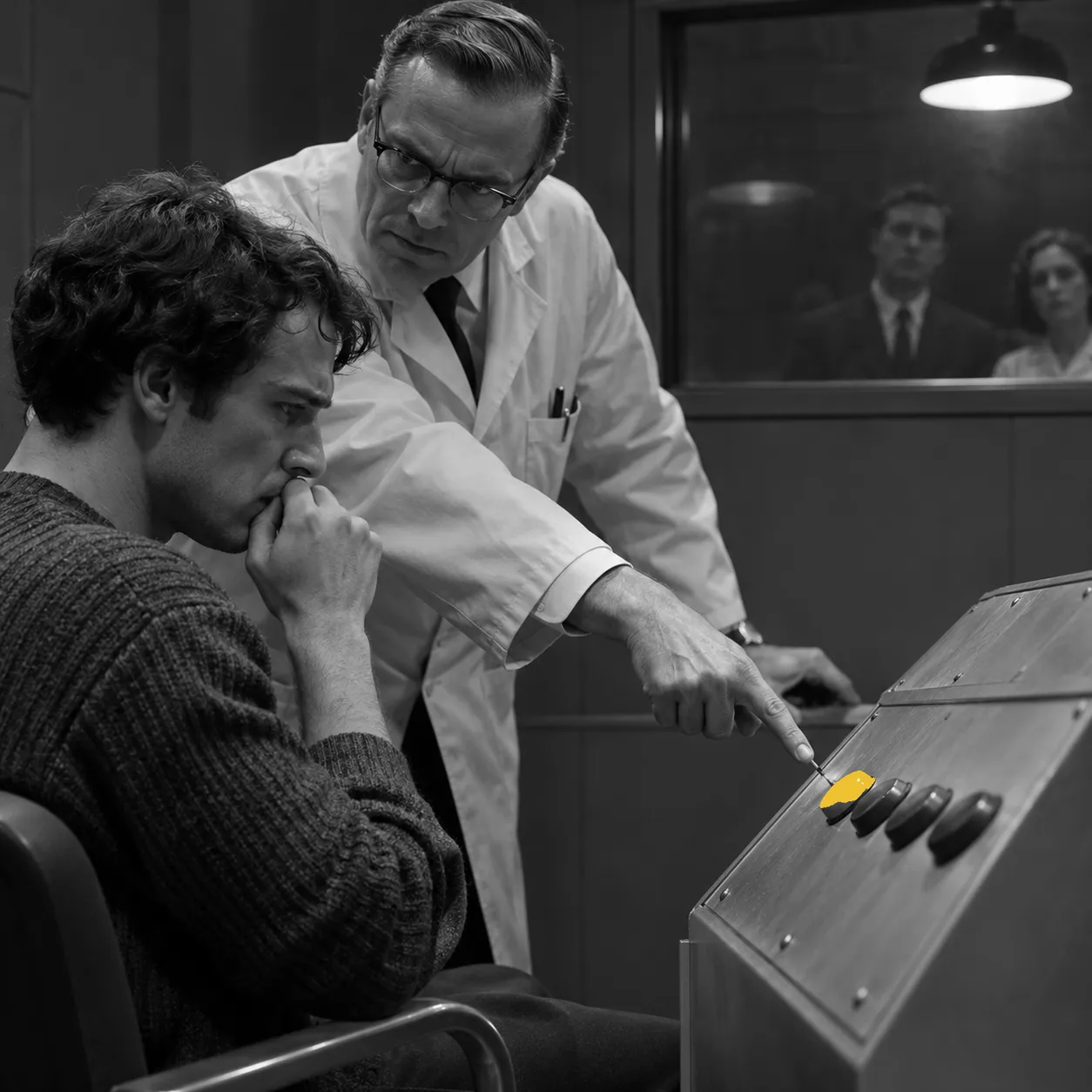
The tendency of ordinary people to carry out an authority's instructions, shaped strongly by the setting and the people around them.
What it is
In Stanley Milgram's 1963 report, participants were told they were taking part in a learning experiment and were asked to give graded shocks to a learner, who was a confederate; 26 of 40 went to the end of the scale and 14 stopped earlier. Jerry Burger's 2009 partial replication stopped at the first point of protest and found obedience rates only slightly lower than in the original. Later work asks why people continued: Haslam, Reicher and Birney found that continuation rose when the prods appealed to scientific goals and fell when they sounded more like orders.
In effect
In the article on what the Milgram experiment really showed, it is the classic finding that the later readings set out to explain.
What it does not say
It describes behaviour in a staged laboratory procedure. It does not say that people will follow any instruction, and it says nothing about the character of the participants. Later work offers different accounts of why people continued, and those readings sit beside the original finding.
Sources
- Milgram, S. (1963). Behavioral study of obedience. Journal of Abnormal and Social Psychology, 67(4), 371-378.
- Burger, J. M. (2009). Replicating Milgram: Would people still obey today? American Psychologist, 64(1), 1-11.
- Haslam, S. A., Reicher, S. D., & Birney, M. E. (2014). Nothing by mere authority: Evidence that in an experimental analogue of the Milgram paradigm participants are motivated not by orders but by appeals to science. Journal of Social Issues, 70(3), 473-488.