Objective Self-Awareness
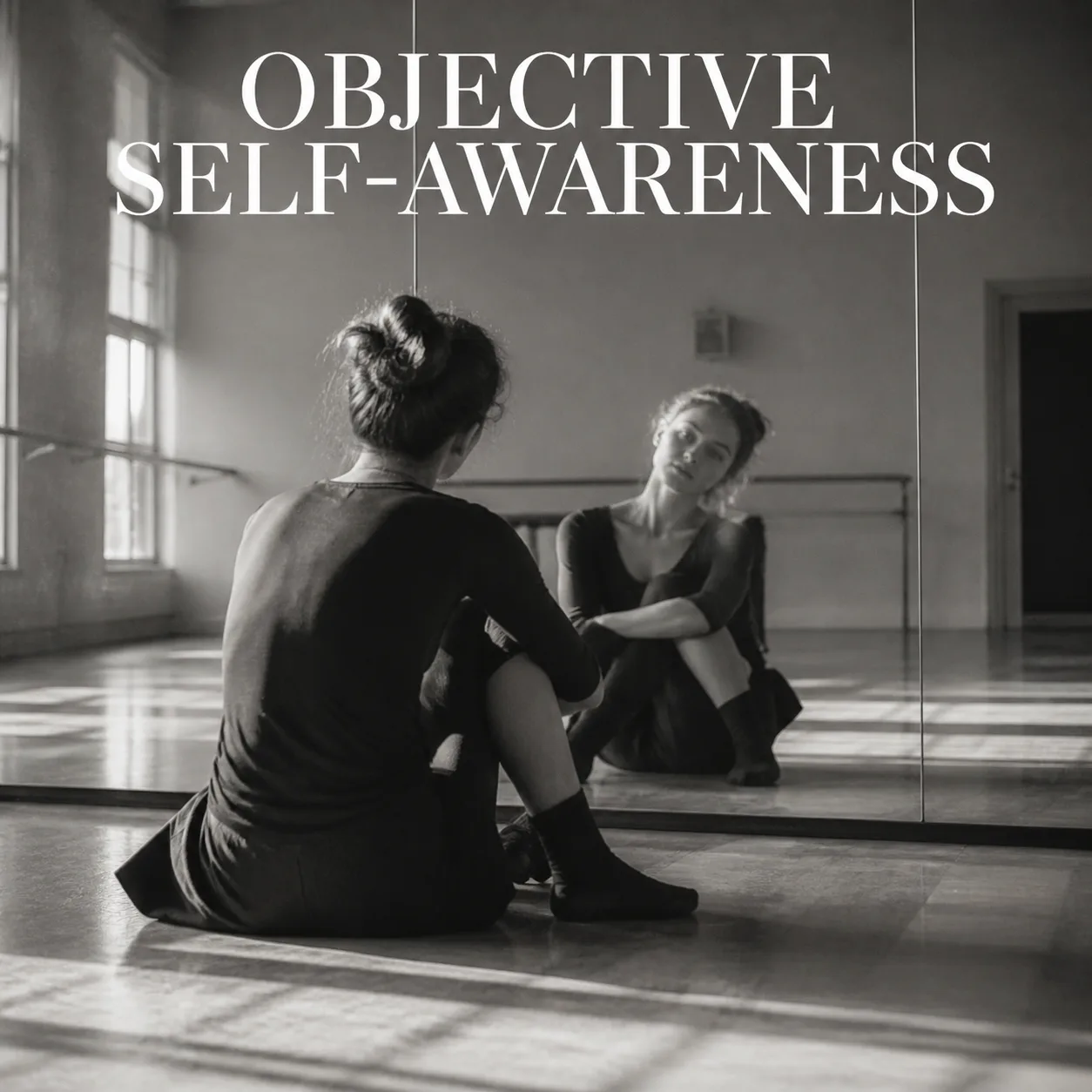
Objective self-awareness is Shelley Duval and Robert Wicklund's 1972 theory that attention has a direction, and that pointing it at yourself changes what you do. Made an object of your own attention, usually by a mirror or a camera, you compare yourself against a standard you already hold and move towards it. The mirror evidence is the strong half. The eyes-poster version that borrowed the idea has a poor replication record, and the two are routinely cited as though they were one finding.
What it is
Attention points somewhere. Duval and Wicklund's move was to treat its direction as the variable rather than its intensity. When attention is on the world, they called the state subjective self-awareness, and the self operates as the thing doing the looking. When something turns attention back, a mirror, a camera, a recording of your own voice, the self becomes the thing being looked at, and a comparison starts running automatically: this is how I am behaving, and that is the standard I say I hold.
The comparison has two exits. Bring the behaviour towards the standard, or get out of the state. Both are observed. The theory was published as A Theory of Objective Self-Awareness (Academic Press, 1972), and it belongs to a period in social psychology when the object of study was the structure of attention rather than the size of an effect.
The canonical demonstration is Diener and Wallbom's 1976 study in the Journal of Research in Personality, under the flat title "Effects of self-awareness on antinormative behavior". Students worked on an anagram task with an opportunity to cheat. In the self-aware condition they faced a mirror while hearing a recording of their own voice. Reported cheating was 71 per cent in the control condition and 7 per cent with the mirror running. Our verification pass of 1 September 2026 confirmed that those figures match what is commonly cited from the paper. It also confirmed the limit on that check: the full text was not reached, so the per-cell counts behind the two percentages remain unconfirmed here, and the source is the abstract plus secondary accounts.
Replication is genuinely mixed, and both halves belong on the page.
Supporting it, Heine, Takemoto, Moskalenko, Lasaleta and Henrich published "Mirrors in the Head: Cultural Variation in Objective Self-Awareness" in Personality and Social Psychology Bulletin in 2008. The pattern held for North American participants. Japanese participants showed no effect, behaving as though the mirror added nothing, which the authors read as a population already operating in something close to a chronically self-aware state. So the effect exists and is culturally bounded rather than a fact about human attention.
Against it, the wider family of small incidental honesty primes has done badly. The watching-eyes literature, in which a printed pair of eyes above an honesty box is supposed to raise payment, has accumulated failed replications, including a PLOS ONE replication and extension that found no effect on dishonesty. That literature is not Duval and Wicklund's, and it is not Diener and Wallbom's. It got attached to them because it tells the same story with a cheaper prop.
No direct, modern, high-powered replication of the 1976 mirror paradigm itself has been found here, in either direction. That is the position: a fifty-year-old result whose figures check out against the record, one cross-cultural extension that partly supports it, and a neighbouring literature that has fallen over. The shape is the risky one, a large behavioural swing produced by a tiny incidental cue, which is the exact silhouette of the findings that did not survive the past fifteen years. It has more support than most things of that shape. This page flags it and does not debunk it.