Operant Conditioning
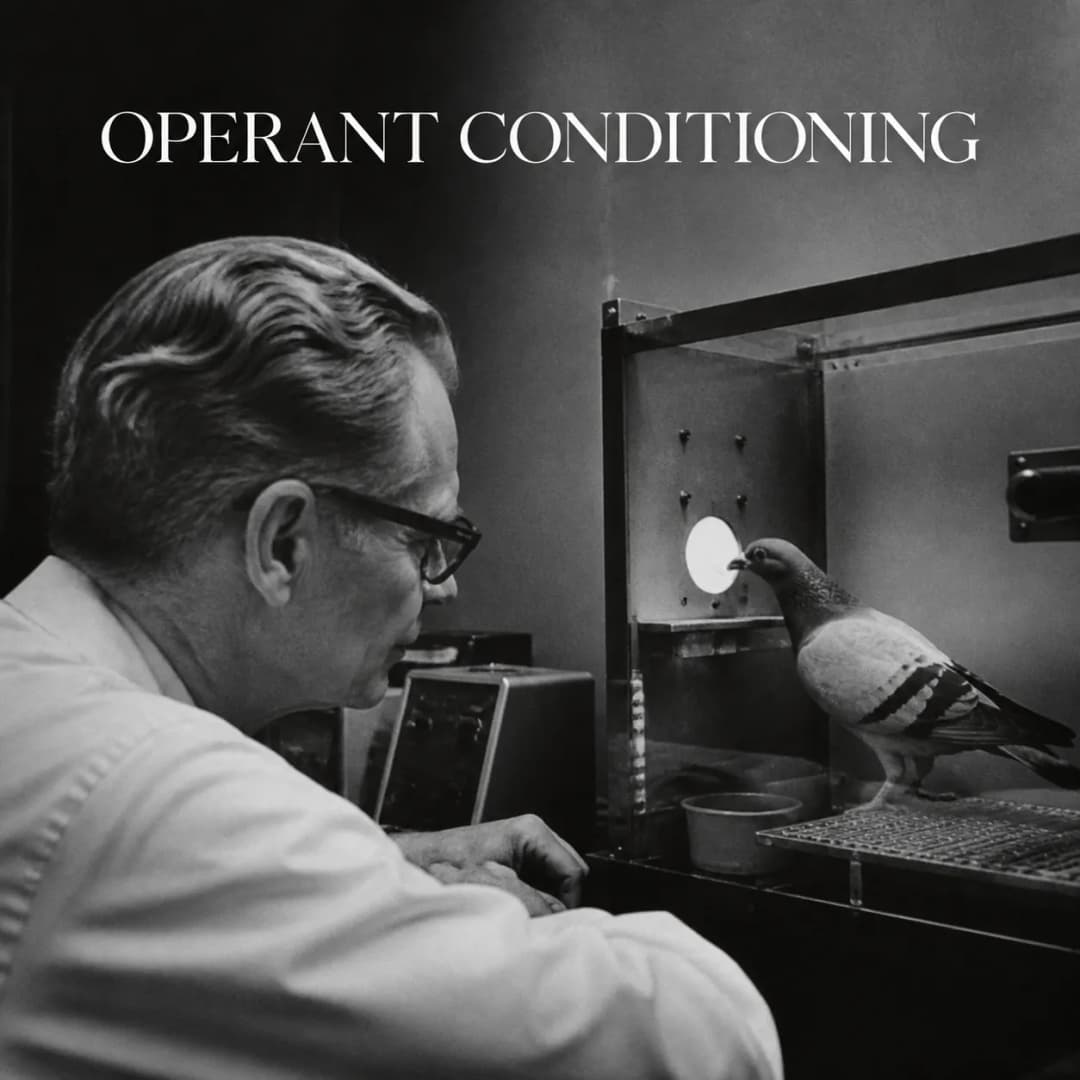
Operant conditioning is B.F. Skinner's finding that behaviour is shaped by its consequences rather than by conscious intent: reward or punish an action and its future frequency changes. The sharper, more consequential part of Skinner's work is not reward itself but the schedule on which it arrives. Reinforce a behaviour on a variable, unpredictable interval or ratio and it becomes far more durable, and far harder to extinguish, than the same behaviour rewarded every time. This schedule effect is the mechanism behind most "just checking" habits built into modern software.
What it is
Skinner's core claim, developed through decades of laboratory work with pigeons and rats from the 1930s onward, is that behaviour is selected by what follows it. An action that is rewarded becomes more frequent. An action that is punished, or simply ignored, becomes less frequent. None of this requires the animal, or the person, to reason about the connection. The consequence does the shaping directly, which is what separates operant conditioning from an account of behaviour built on beliefs or decisions.
The part of the finding that matters most for anything built to hold attention is not that rewards work, which is close to a truism, but that the timing of rewards changes how the behaviour responds once the rewards stop. Skinner compared several reinforcement schedules directly: a fixed schedule, where a reward arrives after a set number of responses or a set interval of time, against a variable schedule, where the number or the interval is unpredictable from one reward to the next. Behaviour under a fixed schedule tracks the schedule closely, rising as the next reward approaches and falling away quickly once rewards stop arriving. Behaviour under a variable schedule shows no such tracking, because there is no interval to learn, and it persists at a high rate for far longer after reinforcement ends. This is the schedule effect, and it is considerably more durable than ordinary reward learning.
Skinner took the finding seriously enough to build an applied programme around it during the Second World War. Project Pigeon trained pigeons, using exactly this reinforcement logic, to peck at a target image projected onto a screen inside a missile's nose cone, keeping the missile on course. The programme never saw combat use, but it demonstrates how seriously Skinner treated the schedule as a general-purpose behavioural tool rather than a laboratory curiosity confined to food pellets and levers.
The schedule effect is the direct ancestor of nearly every checking habit modern software produces. An inbox, a notifications feed, a feed of any kind, delivers its content on an unpredictable schedule: most checks turn up nothing worth having, and occasionally one does, with no way to tell in advance which check that will be. Nobody engineered most inboxes to run on a variable-interval schedule deliberately. The schedule simply is the natural shape of correspondence, and it produces the checking behaviour Skinner's pigeons demonstrated decades before email existed. Later product design made the same schedule deliberate rather than incidental, which is the difference between operant conditioning as a description of how behaviour works and operant conditioning as a lever someone has chosen to pull.
In effect
Skinner's pigeons under a fixed schedule and a variable one
In Skinner's operant chamber studies, pigeons rewarded with food for pecking a lever on a fixed schedule pecked at a moderate, steady rate and stopped almost as soon as the rewards stopped. Pigeons rewarded on a variable schedule, an unpredictable number of pecks or an unpredictable stretch of time before the next pellet, pecked faster and kept pecking long after the food stopped coming altogether. The comparison is the clean version of the finding: identical average reward rate, radically different persistence, with the schedule as the only variable that changed.
The inbox nobody designed to be addictive
Tim Wu's The Attention Merchants applies the same logic to an ordinary inbox. Most incoming mail is routine or unwanted, yet the inbox gets checked again and again, because the next message might be the one that matters and there is no way to know which check that will be. The cognitive scientist Tom Stafford, quoted by Wu, states the mechanism directly: "Checking email is a behavior that has variable interval reinforcement." Nobody built the postal system, or early email, to exploit Skinner's finding on purpose. The schedule simply is what correspondence looks like, and it produces the behaviour regardless of intent.
Eyal's Hook Model, built directly on the schedule
Nir Eyal's Hooked names the variable-reward stage of his Hook Model as the loop's dopamine engine, and traces it explicitly to Skinner's intermittent reinforcement research. Eyal cites neuroscientist Brian Knutson's fMRI work reframing the underlying signal as anticipation of a reward rather than the pleasure of receiving it, a reframing that lines up with Robinson and Berridge's separate finding that dopamine tracks wanting rather than liking. Eyal's contribution is not a new mechanism. It is Skinner's schedule, built deliberately into a product loop rather than arrived at by accident, with the schedule as the explicit design target rather than a side effect of how the product happens to work.
What it does not say
Operant conditioning does not claim that all behaviour is reducible to reward and punishment, or that internal states like beliefs, goals and enjoyment play no role in what people do. Skinner's own position on this was more totalising than most psychologists now accept, and the schedule-effect finding used throughout this page, that variable reinforcement outlasts fixed reinforcement, is far better supported than his broader claims about the irrelevance of internal mental states to behaviour generally.
The schedule effect also does not, on its own, say anything about pleasure or satisfaction. A behaviour can persist strongly under a variable schedule while the organism performing it likes the outcome less and less, more, or exactly the same amount, because the schedule governs frequency and persistence rather than hedonic experience. That is a separate question, addressed by Robinson and Berridge's wanting and liking dissociation rather than by Skinner's reinforcement schedules, and the two should not be treated as making the same claim.
Who developed it
B.F. Skinner developed operant conditioning and its reinforcement schedules through laboratory research spanning the 1930s to the 1950s. The site does not carry a person page for him. Nir Eyal built the variable-reward stage of the Hook Model directly on Skinner's schedule research, and Adam Alter names the same mechanism as an ingredient of behavioural addiction.
Sources
- Skinner, B. F. Operant conditioning and reinforcement schedule research, conducted from the 1930s through the 1950s, including Project Pigeon.
- Wu, T. (2016). The Attention Merchants. Knopf. (Skinner's pigeons and Project Pigeon, pp.186–188; Tom Stafford quotation, p.188.)
- Eyal, N. (2014). Hooked: How to Build Habit-Forming Products. Portfolio/Penguin. (Variable-reward stage built on Skinner, p.99; Knutson's fMRI reframing, pp.95–97.)
- Where this came from
- 4 books in this library carry this concept, which is corroboration worth knowing about, though these authors read each other and often draw on the same experiments, so it is not independent confirmation.