Payment Coupling
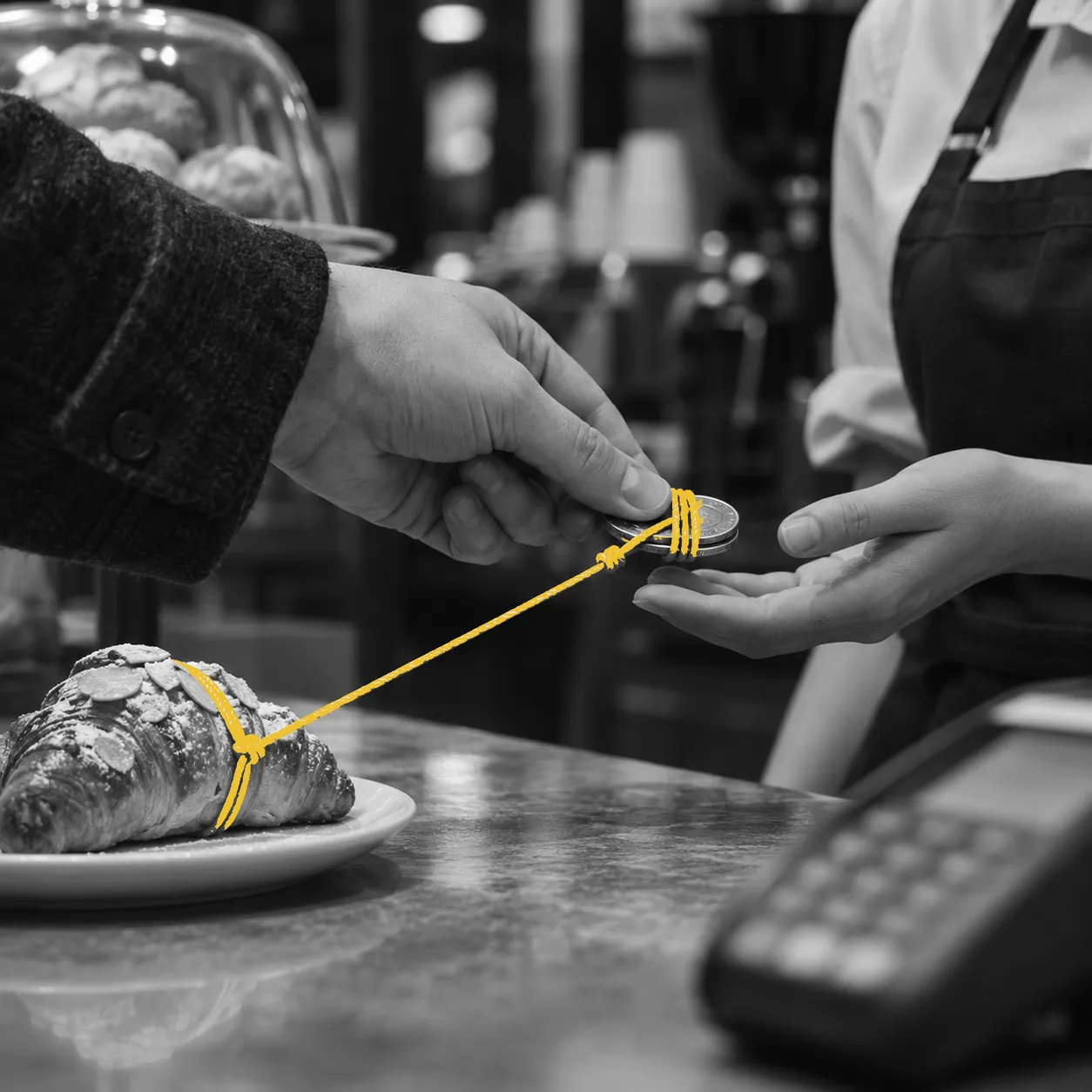
Payment coupling is how strongly paying for something brings the thing to mind, and how strongly using it brings the payment to mind. The form of the money can tighten or loosen the link.
What it is
Drazen Prelec and George Loewenstein argued in 1998 that cash couples the two tightly, while credit cards loosen the link, which may make card spending feel lighter. In 2001, Prelec and Duncan Simester found that people told to pay by credit card were willing to pay more.
Priya Raghubir and Joydeep Srivastava reported four studies in 2008. A credit card logo raised willingness to spend, and breaking an expense into parts reduced the effect. In the last two studies, cash was compared with scrip and with gift certificates of equal face value. Spending varied by payment mode, and the gap between cash and gift certificates changed with how much the money was in view.
In effect
In the article on gift cards, a card is money in a form that is not cash, so the pain of paying is separated from the moment of spending. That is one reason the card can sit unused or be spent more freely.
What it does not say
The studies compared willingness to spend and spending, not how long a card waited. The pattern depends on the form of the money and on how visible it is, and it is not a fixed rule.
Sources
- Raghubir, P. and Srivastava, J. (2008), Journal of Experimental Psychology: Applied 14(3), 213-225.
In these themes
- Subscriptions and Memberships
Why we sign up, why we stay, and why we pay for things we do not use.
- Gifting and Generosity
Why we give, and why choosing a gift is harder than it should be.