Persuasive Design
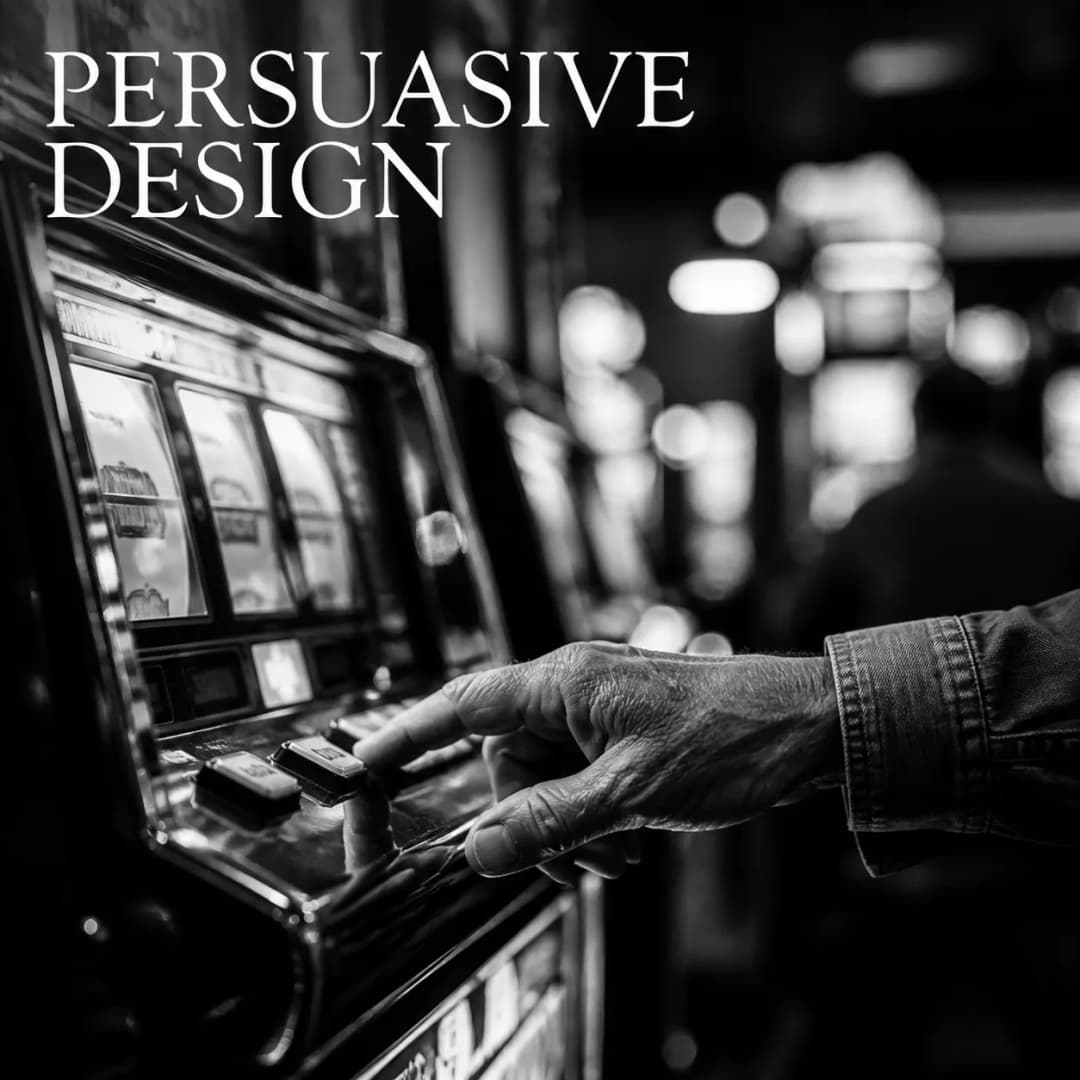
Persuasive design is the deliberate engineering of products, interfaces, games, feeds, notifications, to maximise engagement by exploiting known psychological mechanisms. The discipline traces to B.J. Fogg's Persuasive Technology Lab at Stanford, founded in the late 1990s, and it turns a useful tool into a compulsive one, usually through repeated testing against real users until the variant that holds attention longest wins. Sean Parker, Facebook's first president, has said its social-validation feedback loop was "exploiting a vulnerability in human psychology."
What it is
Persuasive design starts from an observation that is not itself controversial: interfaces already persuade, whether or not anyone designed them to. A button in a certain colour gets clicked more; a form with fewer fields gets completed more often; a notification worded one way gets opened more than the same notification worded another way. What turns this into a named discipline is treating that persuasion as the primary design target rather than a side effect of building something useful.
The academic root of the field is B.J. Fogg's work at Stanford, where his Persuasive Technology Lab, later renamed the Behaviour Design Lab, trained a generation of Silicon Valley product people. Fogg's own contributions, the B=MAT behaviour model and a set of principles for reducing the effort a task requires, supply the field's theoretical backbone; the practitioner literature built on top of it, most visibly Nir Eyal's Hook Model, translates the theory into a repeatable production method.
The production method itself is what separates persuasive design from ordinary product design: scale and iteration. A team does not design one version of a feed and ship it. It designs many, tests them against millions of users, and keeps the variant that produces the most time-on-site, the most return visits, or the most notifications tapped, discarding the rest regardless of what anyone on the team believes about it. Adam Alter, in Irresistible (2017), describes tech companies running "thousands of tests with millions of users" to tune engagement this way, arriving at what he calls an "irresistible, weaponized version of the experience it once was." That is not a metaphor for how the process feels; it is close to a literal description of A/B testing run at a scale no individual designer could have decided on deliberately. The difference between an early version of a product and its mature version, background colours, notification cadence, reward timing, is the output of that selection process, with engagement standing in for fitness.
Tim Wu's history of attention-capture businesses places the discipline in a longer lineage: the same persuasive techniques, tested and refined for maximum reflexive pull, were developed first by patent-medicine advertisers and then by wartime propaganda bureaus, decades before there was a product interface to apply them to. Persuasive design, on this account, is not a new invention so much as an old one running on new hardware, with a faster feedback loop than a poster or a radio spot ever allowed.