Placebo Effect
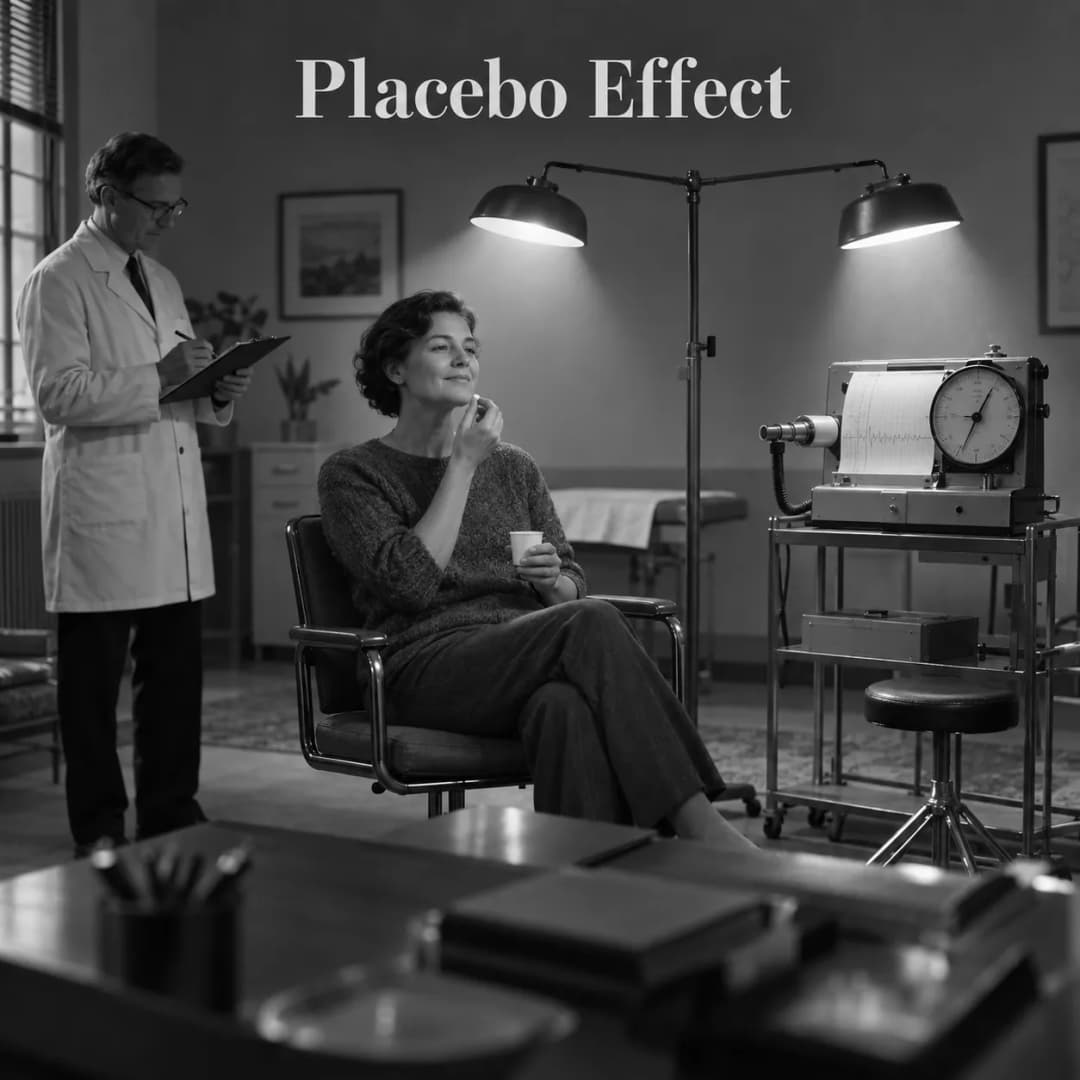
The placebo effect is an improvement that follows a treatment because of what the patient expects from it rather than because of what the treatment does. The single most useful thing to know about it is the split by endpoint. Placebo reliably moves how people say they feel, it has real physiology behind it in opioid and dopaminergic pathways, and it does not reliably move disease: objective and biological endpoints do not follow the subjective ones. The historical anchor everybody quotes, Henry Beecher's one-third figure from 1955, does not hold, although Beecher himself founded the modern study of the subject. Nothing here tells anybody what to take, start or stop, and where a reader needs guidance the answer is a clinician.
What it is
Henry Beecher published "The Powerful Placebo" in the Journal of the American Medical Association in 1955, pooling fifteen trials covering just over a thousand patients and reporting an average placebo effectiveness of about thirty-five per cent. That is where the one-third figure entered medical teaching, and it is the number the mind-power genre still reaches for seventy years later.
The defect is structural and it is fatal to the number. None of the fifteen trials had a no-treatment arm. Without one there is no way to separate a placebo response from spontaneous remission, the natural history of the illness, regression to the mean, symptom fluctuation, rating-scale artefacts and observer effects. Beecher was measuring everything that happens to a patient who gets better while taking an inert pill and calling all of it placebo. Gunver Kienle and Helmut Kiene reanalysed his fifteen source studies in the Journal of Clinical Epidemiology in 1997 and found no evidence of a placebo effect in any of them, attributing the improvements to exactly those confounds. The current position in the placebo literature is that the one-third figure should be abandoned.
Beecher should be credited properly in the same breath, and that is not a courtesy. He founded the modern study of placebo, and his wartime pain work of 1946 is a genuine observation about context and meaning modulating reported pain. The founding is his and stands. The headline number is not and does not.
The evidence that replaced it comes from trials containing both a placebo arm and a no-treatment arm, which is the comparison Beecher lacked. Asbjørn Hróbjartsson and Peter Gøtzsche assembled them, first in the New England Journal of Medicine in 2001 and then in a Cochrane review updated in 2010 covering roughly two hundred trials. Subjective continuous outcomes such as pain, fatigue and quality of life showed a small to moderate effect, amounting in the pain trials to a few millimetres on a hundred-millimetre rating scale. Objective continuous outcomes, meaning biomarkers and physiological measures, showed a very small effect that did not reach significance. Binary outcomes, including survival and whether an event occurred, showed no significant effect. In plain terms, placebo reliably moves how people say they feel and does not reliably move disease, and that sentence is the ceiling on every mechanistic story beneath it.