Reconstructive Memory
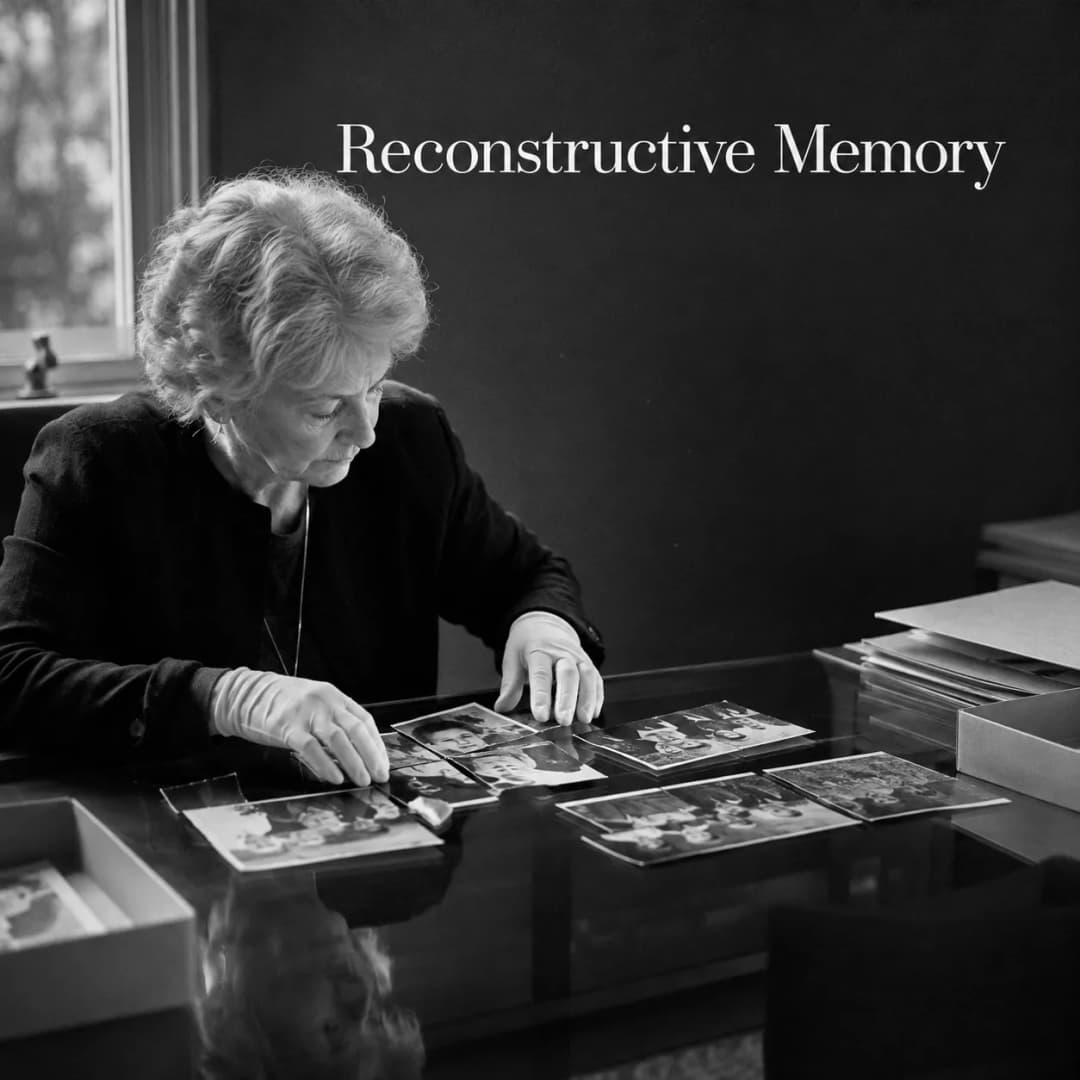
Memory assembles rather than retrieves. What comes back is built at the moment of asking, from fragments, and the build is shaped by present mood, present belief and everything learned since the event. Elizabeth Loftus spent a career showing how little it takes to alter the assembly, including a single leading verb inside a question. The limit is worth stating precisely, because it gets stretched: her work establishes that retrieval is open to influence, and licenses no verdict on any particular recollection.
What it is
The intuitive model of memory is a recording. Something happens, a copy is stored, and remembering is playing the copy back, with the only expected failure being that the copy fades or is lost. Almost nothing about that model survives contact with the evidence.
What the evidence describes instead is assembly. Fragments are held, they are not held as a unit, and the act of remembering constructs an episode out of them in the present, using whatever is available to fill the gaps. The material used for the filling includes present mood, present belief, general knowledge about how events of that kind usually go, and everything the person has learned since. The output feels like playback because there is no separate sensation attached to the parts that were reconstructed rather than stored. A memory does not arrive labelled with its provenance.
Loftus is the name attached to the demonstration of how easily the assembly can be steered. Her work shows that information supplied after an event can be incorporated into the memory of it, and that the amount of information required is very small. A verb inside a question can be enough to shift what people subsequently report. That is a laboratory result, obtained under controlled conditions with events the researchers staged or presented, and it has replicated widely.
Being precise about what it establishes is the whole job on this page, because this is one of the most over-extended findings in psychology. It establishes that retrieval is open to influence. It does not establish that old memories are generally wrong, it does not license a verdict on any particular recollection, and it is not a licence to tell a person that something they remember did not happen. Openness to influence is a property of the system. It is not a probability attached to any given output of that system, and treating it as one is the error that has caused the most harm in the applied settings where this research gets used.
The reason it matters for Nostalgia is that nostalgic memories sit in exactly the conditions where the mechanism has the most room. They are old, which means more assembly to do and fewer fragments to do it from. They carry emotional weight, which means the assembly has a direction, and that direction has been measured on real events: see Rosy Retrospection. What people are consulting when they consult a nostalgic memory is not a record of a period. It is a construction assembled now, out of what is left of it.
In effect
Research: the leading verb (Loftus)
The clearest form of the finding is the smallest intervention that produces it. Loftus's work established that the wording of a question asked after an event alters what people later report about the event, with a change of verb sufficient to shift subsequent estimates and recollections. The design is what makes it convincing: the event is held constant, the only difference between conditions is a word inside a question asked afterwards, and the effect shows up in what people report about the original event rather than in their answer to the question itself. Something entering after the fact has been incorporated into the record of what came before it.
Everyday life: the story that has been told several times
The recognisable case is a story a person has recounted many times. Each telling is a retrieval, each retrieval is an assembly, and the assembly is shaped in part by the previous tellings, which had an audience and therefore a shape. The version that ends up feeling most vivid is often the most rehearsed rather than the most accurate, and there is no internal signal distinguishing the two. This is illustration rather than evidence: no study cited on this page measured family anecdotes. What the mechanism predicts is exactly this profile, a memory that gets more confident and more narratively tidy with use.
Commerce: memory as the material of marketing
Advertising that works on the past is working on an editable record rather than a fixed one, and the industry has known this for a long time without needing the psychology. Anniversary campaigns, heritage packaging, reissues and the deliberate reuse of period music and design cues all supply present material for an assembly about the past. Shop atmospherics do the same thing physically, and the honest caveats on that literature are set out on Nostalgia: the effects are weak, they wear off quickly, and there is little theory saying why. The claim here is narrow. Reconstructive memory is what makes the material workable in the first place, not evidence that any particular campaign worked.
What it does not say
It does not say memory is unreliable in general. It says retrieval is open to influence. Most of what people remember about their own lives is broadly right, and this literature contains no estimate of how often it is not.
It does not license a verdict on any particular recollection. Nothing on this page can be used to tell a person that something they remember did not happen. The research is about the properties of a system, not about the truth of individual outputs, and the applied damage caused by conflating the two is the reason the distinction is stated twice.
It does not mean nostalgic memories are false. It means they are constructed, which every memory is. Whether the construction has drifted, and in which direction, is a separate question with its own separate evidence.
It does not settle whether the drift is a problem. The argument in Your Nostalgia Is Lying to You is that the functions nostalgia serves may depend on the drift rather than survive it, and that is a reading of two literatures rather than a finding in either.
Who developed it
Elizabeth Loftus is the name attached to the modern experimental demonstration, from the 1970s onward, and the vault records her as originator with medium confidence because the constructive view of memory has older roots than her programme. What is unambiguously hers is the evidence on how little it takes to alter an assembly after the fact.
Sources
- Loftus, E. F. Reconstructive memory and the misinformation effect. The programme establishing that information supplied after an event can be incorporated into the memory of it, including by a leading verb inside a question.
- Mitchell, T. R., Thompson, L., Peterson, E. & Cronk, R. (1997). "Temporal Adjustments in the Evaluation of Events: The 'Rosy View'." Journal of Experimental Social Psychology. The measured direction of the drift, on real events.
- Frankenbach, J., Wildschut, T., Juhl, J. & Sedikides, C. (2021). Meta-analysis of nostalgia's functions and affective consequences, N = 3,556. The other literature, which does not cite this one.
- Where this came from
- One book in this library carries this concept. A concept resting on a single popular retelling is roughly twice as likely to be contested, mixed or unverified as one two or more books carry, so treat it as unchecked until it has been taken to a primary source.