Reminiscence Bump
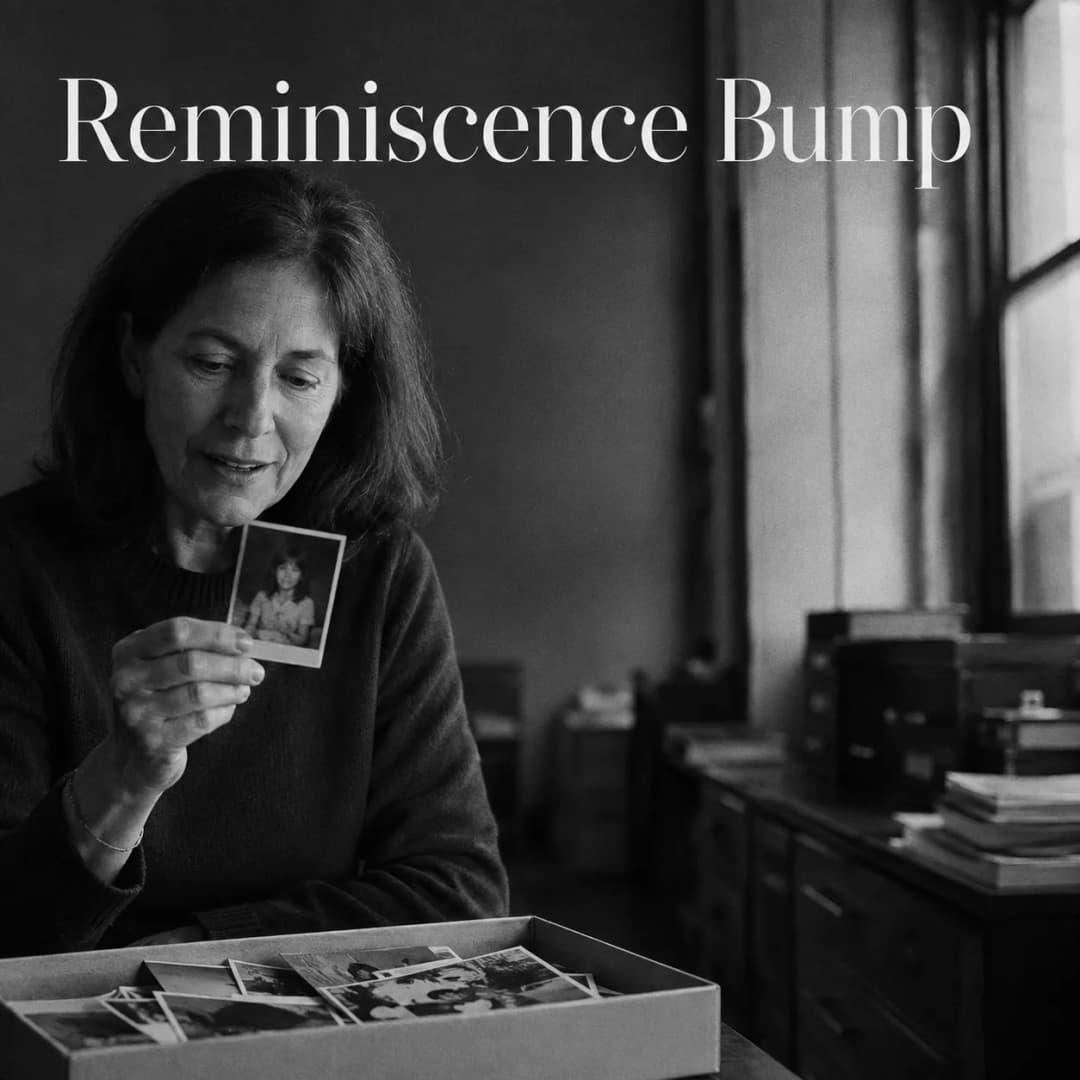
Autobiographical memories are not spread evenly across a life. Ask people over thirty for their most important memories and the returns cluster roughly between ages 10 and 30. David Rubin and colleagues established the pattern and it has replicated across cultures and retrieval methods. It decides what people are nostalgic about rather than how they feel about it, which means some of the specialness attaching to those years is a fact about retrieval rather than about the years.
What it is
The method is simple enough to describe in a sentence, which is part of why the finding has travelled. Ask a person over thirty to name their most important memories, plot the ages those memories come from, and the distribution is not flat. There is a dip for early childhood, which is expected, a rise across adolescence and early adulthood, and a decline afterwards that runs until the recent past, where recency produces a second rise. The elevated stretch in the middle is the bump, and for the important-memories method it sits roughly between ages 10 and 30.
Rubin and colleagues established the pattern and it has held up unusually well. It replicates across cultures and across retrieval methods, which is the property that matters most: a distribution artefact produced by one way of asking would not survive being asked differently. The temporal location does move with the method, and this is worth stating rather than smoothing over. Roughly 10 to 30 is the figure for the important-memories method. Word-cuing and life-script methods produce wider or differently placed windows. Quoting a single age range as the bump, full stop, is quoting one method's answer.
Several explanations have been offered for why the period is privileged, and this page does not adjudicate between them. What matters for the argument it sits inside is narrower and more secure than any of them: whatever causes it, the bump decides the raw material.
That has a consequence people usually miss. The years most people are nostalgic for are the years they can most easily reach. Whether those years were in fact better is a separate question the clustering cannot settle, and some of the specialness attaching to that period is a fact about retrieval rather than about the period. A person comparing their twenties to their forties is not comparing two equally documented stretches of a life. They are comparing a densely populated region of autobiographical memory with a sparse one, and the density is doing work that feels like evidence.
Set beside the other two distortions this makes a stack. The bump decides what gets remembered. Reconstructive Memory means what comes back is assembled rather than played back. Rosy Retrospection supplies the direction the assembly drifts. The output of all three is the material Nostalgia runs on, and the nostalgia literature and the memory literature do not cite each other.
In effect
Research: a pattern that survives being asked differently (Rubin and colleagues)
The evidential strength of the bump comes from its robustness to method rather than from any single striking study. It appears when people are asked for their most important memories, and versions of it appear under word-cuing, where a cue word prompts whatever memory comes to mind, and under life-script methods, which ask what events a typical life contains rather than what happened to the respondent. It replicates across cultures. The fact that the temporal window shifts by method is not a weakness in the finding; it is the reason the finding has to be quoted with its method attached, and it is why this page gives 10 to 30 for the important-memories version specifically.
Everyday life: the music that gets called the best music
The most familiar consequence is aesthetic. People tend to rate the music, films and public events of their adolescence and early twenties as unusually significant, and they experience that as a judgment about the work. The bump offers a competing account of at least part of it: that period is over-represented in autobiographical memory, so its cultural furniture arrives attached to more retrievable personal material than anything from a later decade. This is an illustration of the mechanism rather than a study of musical taste, and the honest position is that both accounts can be partly right at once.
Commerce: the twenty-year revival cycle
Nostalgia marketing runs on a predictable lag, and the bump explains why a lag exists at all rather than a general fondness for the past. The people with disposable income and cultural influence at any moment were adolescents and young adults roughly two decades earlier, which is precisely the stretch their autobiographical memory over-represents. Reissues, anniversary editions, revived formats and heritage design cues are aimed at that window. The industry arrived at the timing empirically and long before the research existed, and nothing in Rubin's work measures a marketing campaign. What the bump supplies is a reason the empirical timing is not a coincidence.
What it does not say
It does not say those years were better. The clustering is a fact about retrieval, and the question of whether the period was objectively better is one the distribution of memories cannot answer.
It does not say the bump has one location. Roughly 10 to 30 is the figure for the important-memories method. Word-cuing and life-script methods produce different windows, and a single age range quoted without its method is an overstatement.
It does not explain itself. Several accounts have been offered for why the period is privileged, and this page takes no position on them. The finding is the distribution; the cause is unsettled.
It says nothing about the accuracy of the memories in the bump. Over-representation is about how many memories come from a period, not about how faithful they are. The faithfulness questions belong to Reconstructive Memory and Rosy Retrospection.
It is not a claim about individuals. Some people's most important memories cluster somewhere else entirely, and a population-level distribution does not predict where any particular life's density sits.
Who developed it
David Rubin and colleagues established the pattern, with the founding work dated to 1986 in this vault. The finding is usually cited to Rubin and collaborators collectively rather than to a single paper, because its standing rests on replication across methods and cultures rather than on one demonstration.
Sources
- Rubin, D. C. and colleagues. The reminiscence bump: autobiographical memories cluster roughly between ages 10 and 30 for the important-memories method. Temporal location varies by method, with word-cuing and life-script methods producing different windows.
- Mitchell, T. R., Thompson, L., Peterson, E. & Cronk, R. (1997). "Temporal Adjustments in the Evaluation of Events: The 'Rosy View'." Journal of Experimental Social Psychology. The other distortion in the stack.
- Frankenbach, J., Wildschut, T., Juhl, J. & Sedikides, C. (2021). Meta-analysis of nostalgia's functions and affective consequences, N = 3,556. The literature that runs on this material.
- Where this came from
- No book in this library is the source of this concept. It entered the vault from Your Nostalgia Is Lying to You, built from primary sources rather than from a book.