Self-Continuity
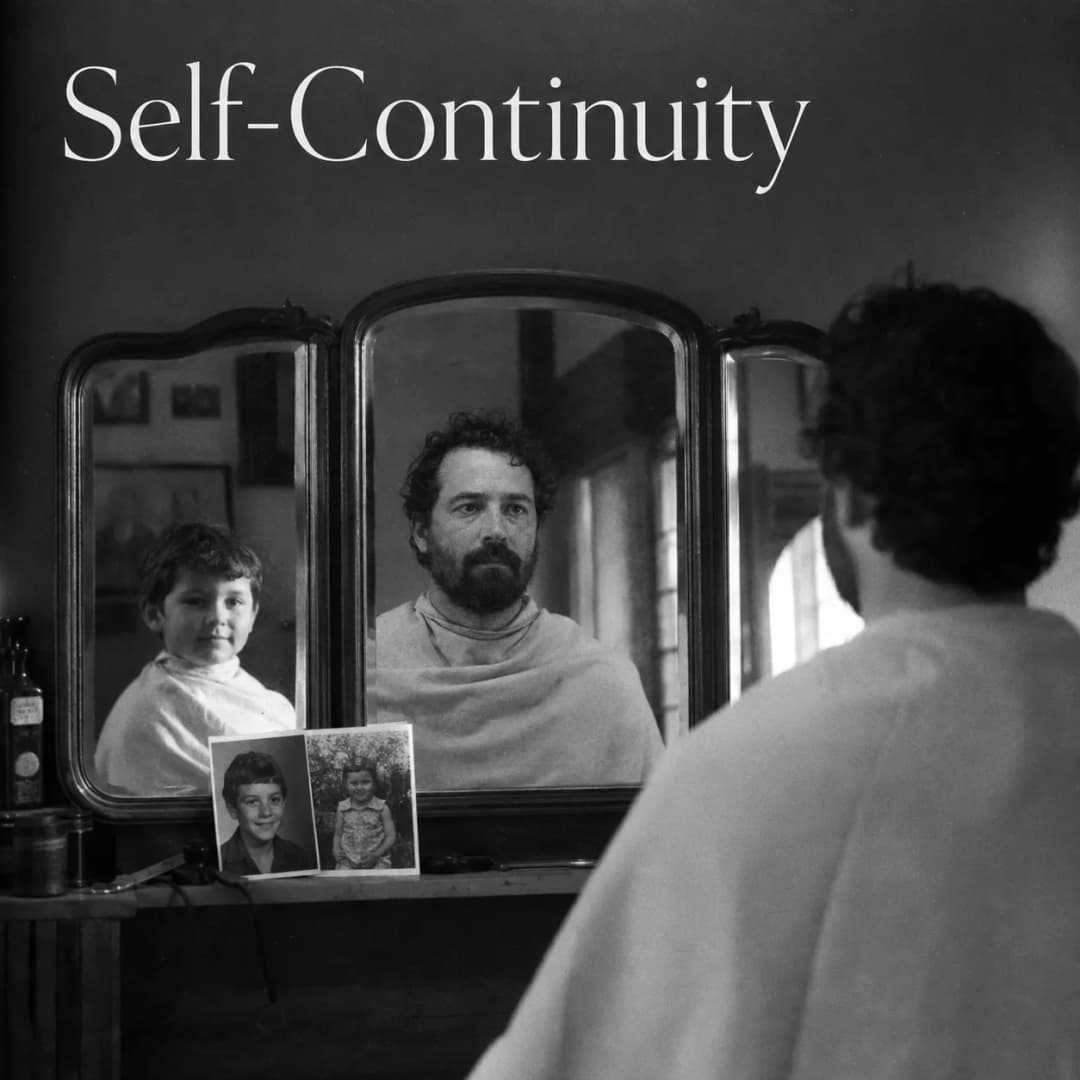
Self-continuity is the sense that the person you were and the person you are belong to one life. It is one of the functions nostalgia reliably serves, alongside self-esteem, optimism, meaning in life and social connectedness, and the evidence is strong: Frankenbach, Wildschut, Juhl and Sedikides pooled 116 studies of nostalgia's functions and 39 of its affective consequences in 2021, across 3,556 participants, and found the main effects robust. It is also the function most likely to depend on the memory being inaccurate.
What it is
Identity over time is not given. A person at forty shares very little material with the same person at eighteen, holds different beliefs, wants different things and would probably disagree with them about most of it. What supplies the sense that these are nevertheless one life, rather than a sequence of people occupying the same name, is autobiographical memory. Self-continuity is the name for that sense, and it is treated in this literature as a psychological good rather than a metaphysical fact: what is measured is whether a person feels connected to their own past, not whether they are.
Nostalgia is one of the reliable routes to it. The Southampton programme run by Constantine Sedikides and Tim Wildschut has established a set of functions the emotion serves, and self-continuity sits on that list with self-esteem, optimism, meaning in life and social connectedness. The evidence is pooled rather than anecdotal. Julius Frankenbach, working with Wildschut, Jacob Juhl and Sedikides, combined 116 functions studies and 39 affect studies in 2021, covering 3,556 participants, and found the main effects held across the board. Separately, Joost Leunissen with Wildschut, Sedikides and Clay Routledge ran an integrative data analysis of 41 nostalgia-induction experiments, N = 4,659, finding that inductions raised positive and ambivalent affect and did not significantly move negative affect.
So the function is well established, which is what makes the next observation interesting rather than merely sceptical.
Continuity is a claim about identity rather than about fact. It does not require the remembered past to be accurate; it requires it to be recognisably yours and joined to the present. And an edited past is easier to feel continuous with than a faithful one. The version of a period that has had its boredom deleted, its anxieties resolved and its people warmed slightly is a version a present self can own without friction. The unedited version contains a person who wanted things the present self finds embarrassing and worried about things that turned out not to matter, which is harder to file as the same life.
The three memory pages on this site describe exactly the editing that would produce the easier version. The Reminiscence Bump selects the period. Reconstructive Memory means it is assembled at the moment of asking. Rosy Retrospection supplies the upward direction, measured on real events. Every function on Frankenbach's list is a function that improves as the record improves, and the record has been improving since the day it was laid down.
That is a reading, not a result. The two literatures have not been run against each other and the experiment would be awkward to design, since it would require inducing a more accurate recollection and measuring what happened to the continuity people felt. It follows naturally from both bodies of work, and it would explain why the effects are so consistent. It is offered here as the most interesting available hypothesis and nothing more.
In effect
Research: the pooled functions evidence (Frankenbach and colleagues)
The reason self-continuity is treated as established rather than plausible is the 2021 meta-analysis. Frankenbach, Wildschut, Juhl and Sedikides pooled 116 studies of nostalgia's functions and 39 of its affective consequences, covering 3,556 participants, and the main effects held on self-esteem, optimism, meaning in life, self-continuity and social connectedness. A single laboratory induction showing a bump in a continuity scale would prove very little. A pooled result across that many studies is a different class of evidence, and it is why the modern account of nostalgia is not merely a fashion.
Everyday life: the photograph that makes a life feel like one life
The everyday form is the reason people keep things. A photograph, a jacket, a route walked again after twenty years: what these deliver is not information, since the person already knows what happened. What they deliver is the joining. The feeling is one of recognising yourself rather than learning anything, which is precisely the profile of a continuity function rather than a memory function. It also explains why the accuracy of the object's associations is beside the point to the person holding it, and why being corrected about the details of a treasured memory feels like an attack rather than a favour.
Commerce: heritage as an asset class
Continuity is what a long-lived brand is selling when it sells its own age. Anniversary editions, reissued designs, the retained logo, the founding date printed on the packaging: none of these improve the product, and all of them offer the customer a line drawn between a past self who used the thing and a present self who still does. The same logic underwrites alumni networks and membership renewals. This is an application of the construct rather than a finding about it, and the caveats on the commercial nostalgia literature are set out on Nostalgia: the effects are weak, they wear off quickly, and there is little theory saying why.
What it does not say
It does not say that an accurate past produces less continuity. That is the hypothesis, not the finding, and no study cited here has tested it.
It does not say nostalgia is the only route to self-continuity. It is one well-evidenced route among others, and the meta-analytic work establishes the association rather than exclusivity.
The pooled effects are not evidence about accuracy. Frankenbach and Leunissen measured what nostalgia does to people. Neither paper measured whether the memories involved were faithful, and neither cites the memory-distortion literature.
It does not follow that anyone should stop correcting the record. If the trade-off is real, it is a trade-off with two live sides: an edited past is more comforting and less fit for the one use people most want to put it to, which is deciding whether to go back. Which side to take is a question about the next decision rather than about the last twenty years, and this page does not answer it for anybody.
Who developed it
Constantine Sedikides and Tim Wildschut at Southampton have run the programme that established self-continuity as a nostalgia function, with the vault recording them jointly as originators from the 2000s at medium confidence. The two pooled analyses that carry the evidential weight are first-authored by Julius Frankenbach and Joost Leunissen, and this site cites them under those names rather than under the better-known ones.
Sources
- Frankenbach, J., Wildschut, T., Juhl, J. & Sedikides, C. (2021). Meta-analysis of nostalgia's functions and affective consequences. 116 functions studies and 39 affect studies, N = 3,556; robust main effects on self-esteem, optimism, meaning in life, self-continuity and social connectedness.
- Leunissen, J., Wildschut, T., Sedikides, C. & Routledge, C. (2021). "The Hedonic Character of Nostalgia: An Integrative Data Analysis." 41 experiments, N = 4,659; inductions raised positive and ambivalent affect and did not significantly alter negative affect.
- Mitchell, T. R., Thompson, L., Peterson, E. & Cronk, R. (1997). "Temporal Adjustments in the Evaluation of Events: The 'Rosy View'." Journal of Experimental Social Psychology. The measured drift the dependency hypothesis rests on.
- Where this came from
- 2 books in this library carry this concept, which is corroboration worth knowing about, though these authors read each other and often draw on the same experiments, so it is not independent confirmation.