Self-Distanced Self-Talk
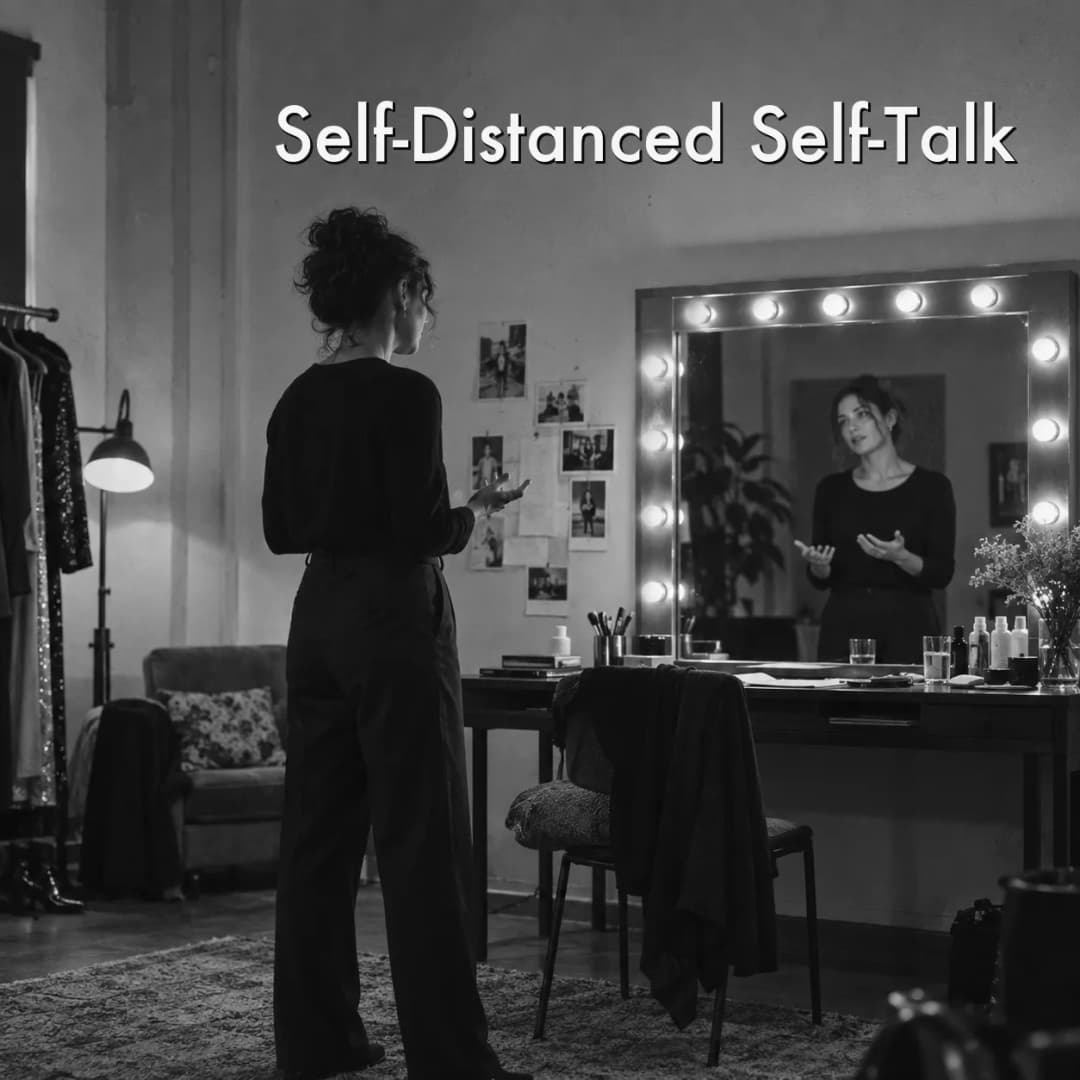
Self-distanced self-talk is talking to yourself using your own name or the word "you" instead of "I". "Faisal, why are you upset about this?" rather than "why am I upset about this?" The pronoun change appears to shift the vantage point from inside the experience to just outside it, and that small shift is enough to change how the feeling is handled. Ethan Kross and colleagues established the effect across a series of experiments in 2014.
What it is
Someone about to give a speech coaches themselves through the last minute before walking on. Done in the first person it tends to run as a rehearsal of everything that could go wrong. Done in the second or third person it tends to run as advice. That is the same asymmetry Solomon's paradox describes, arrived at through grammar instead of through instruction.
The interesting property is its cheapness. A later study using both electrical recordings from the scalp and brain scanning found that third-person self-talk regulated emotion without recruiting the brain's cognitive control machinery, the effortful system that deliberate reappraisal leans on. In plain terms: it appears to work without feeling like work.
That effortlessness is the signature it shares with affect labelling, and it is why the two get merged in popular writing. They should not be merged. Labelling changes what you call the feeling. Distancing changes who is looking at it. Erik Nook and colleagues found that naming an emotion before trying to reframe it made the reframing worse, which is not what you would predict if naming and distancing were the same operation.