Self-Interruption
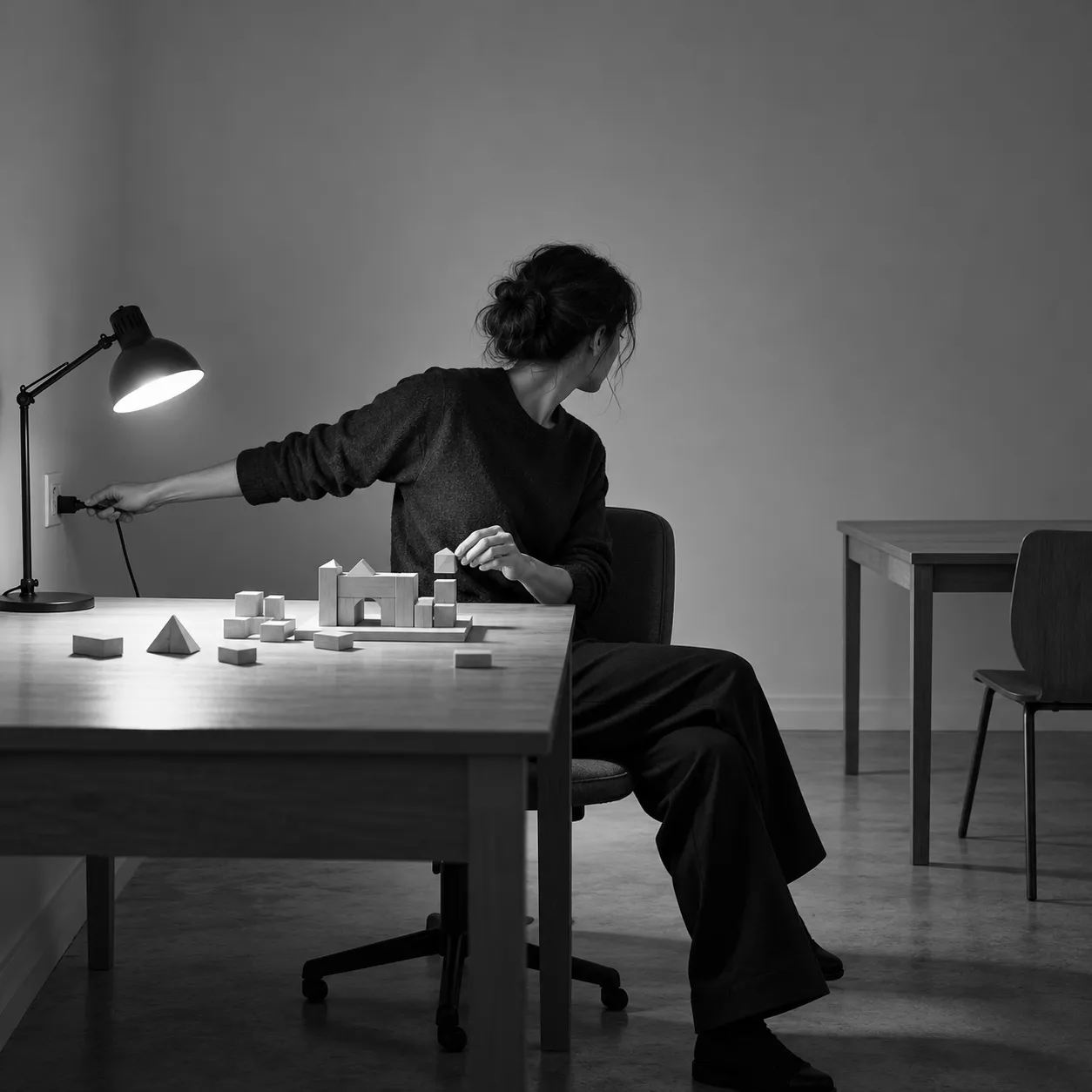
Abandoning a task before completion and switching away with no external prompt. Laura Dabbish and colleagues coded it as stopping work in the current working sphere for no apparent reason, prior to event completion, and switching to a different one. It is the most awkward fact in the attention literature, because an account that treats attention purely as something taken from us has to explain it. The widely quoted figure, that two-thirds of workplace interruptions are self-generated, is not supported at its source, and the published proportions are about half.
What it is
The behaviour is measured by shadowing people through a working day and coding every switch, which is why the figures come from field observation rather than from surveys. Gloria Mark's 2005 study of twenty-four information workers, over seven hundred formal hours, found fifty-two per cent of interruptions internal against forty-eight per cent external, with managers skewing towards the external kind while analysts and developers experienced the two about equally. Dabbish, Mark and Víctor González's 2011 reanalysis of a larger dataset, thirty-six people across three organisations and ninety-six days of observation, recorded 889 self-interruptions out of 2,030 interruptions, which is about forty-four per cent, or eighteen per cent of all task switches once natural event completions are counted too. Jing Jin and Dabbish put the field's own shorthand in the opening line of a 2009 paper: the typical information worker is interrupted every twelve minutes, and half of the time they are interrupting themselves.
In effect
The 2011 reanalysis is the closest thing to a causal clue. Organisational environment accounted for thirteen per cent of the variance in self-interruption rate and individual differences for a further fourteen, while job role showed no association at all. Sitting in an open-plan cubicle rather than an enclosed office was associated with a sixty-four per cent higher rate of self-interruption. And the finding the whole argument turns on: external interruptions in one hour significantly increased self-interruptions in the next, one additional external interruption being associated with an eight per cent rise, while self-interruptions did not predict their own recurrence. The authors' reading is that people may be conditioned to self-interrupt by being interrupted, which makes the hijacking story and the self-generated story continuous rather than rival.
What it does not say
It does not support two-thirds. That figure comes from Adam Gazzaley and Larry Rosen's The Distracted Mind, attributed there to Judy Wajcman's shadowing study of eighteen employees at an Australian telecommunications company. Wajcman and Emily Rose's 2011 paper is paywalled, its abstract makes a framing argument rather than reporting a proportion, no open copy could be located after six separate attempts, and no citing source we found prints the percentage, so the number is unverified at source and every observational figure that can be read is at or below about fifty-two per cent. It also does not explain itself: the lagged external-to-internal effect is one regression coefficient in a four-page note, on a dataset from the early 2000s, accounting with time of day for four per cent of the variance, and the authors volunteer that a large portion of variance in the behaviour remains unexplained. Three phone-checking figures that circulate alongside this material are quarantined here and are not printed in any form: the claim that eighty per cent of smartphone users check before brushing their teeth, which traces to a marketing company's blog post with no survey behind it; the hundred-and-fifty-checks-a-day figure, which traces to an industry slide deck; and the Basex cost estimate.
Sources
- Dabbish, L., Mark, G., & González, V. M. (2011). "Why do I keep interrupting myself?: environment, habit and self-interruption." Proceedings of CHI '11, 3127-3130. doi:10.1145/1978942.1979405. Full text read; Dabbish first author. Thirty-six individuals across three organisations, three workdays each, ninety-six days, 5,089 observed working spheres.
- Mark, G., González, V. M., & Harris, J. (2005). "No task left behind? Examining the nature of fragmented work." Proceedings of CHI '05, 321-330. doi:10.1145/1054972.1055017. Full text read; Mark first author. Twenty-four information workers, over seven hundred formal hours.
- Jin, J., & Dabbish, L. A. (2009). "Self-interruption on the computer: a typology of discretionary task interleaving." Proceedings of CHI '09, 1799-1808. doi:10.1145/1518701.1518979. Abstract read in full; Jing Jin first author. Qualitative; the seven categories and the sample size are not available and are not listed here.
- Wajcman, J., & Rose, E. (2011). "Constant Connectivity: Rethinking Interruptions at Work." Organization Studies, 32(7), 941-961. doi:10.1177/0170840611410829. Abstract read at Crossref, OpenAlex and LSE Research Online. The source the two-thirds figure is attributed to. Full text not open anywhere located; the figure, the sample of eighteen and the Australian telecommunications setting could not be verified at source.
- Adler, R. F., & Benbunan-Fich, R. (2013). "Self-interruptions in discretionary multitasking." Computers in Human Behavior, 29(4), 1441-1449. doi:10.1016/j.chb.2013.01.040. Full text read; Adler first author. A laboratory tab-switching task with 212 undergraduate participants; of the 166 whose reasons could be classified, about forty per cent reported no self-interruptions at all.
- Gazzaley, A., & Rosen, L. D. (2016). The Distracted Mind: Ancient Brains in a High-Tech World. MIT Press. For the two-thirds claim and the proposed explanation.
In these themes
- Digital Behaviour and Social Media
What feeds, phones and notifications do to attention, and what the evidence says.