Social Currency
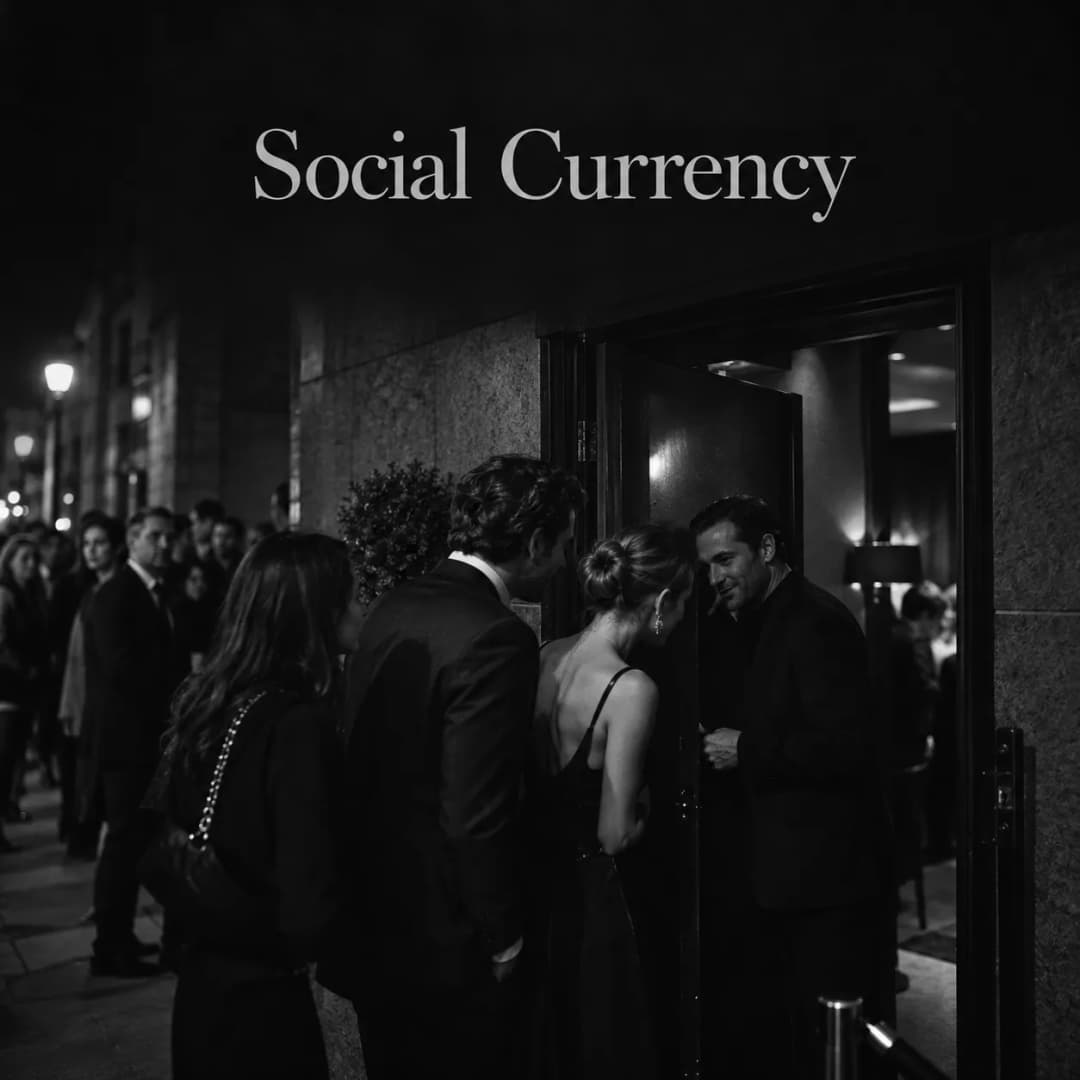
Social currency is Jonah Berger's term for the first of the levers in his framework for why things catch on: people share things that make them look good. Talking is self-presentation, so the currency being spent is the teller's reputation rather than the product's merit. It is a practitioner's framework rather than a tested effect, and the supporting research is thinner than the weight the argument puts on it.
What it is
Berger names three ways to mint it. Inner remarkability, meaning something genuinely surprising inside the ordinary thing. Game mechanics, meaning a visible measure of standing that people can win at. And making people feel like insiders, meaning access that not everyone has.
The common element is that all three give the sharer something to be, not just something to say. What travels is not the object but the position the teller occupies by knowing about it.
In effect
The illustration that carries the chapter is a New York bar reached through a phone booth inside a hot dog shop, which has never advertised and is among the hardest reservations in the city. What is being shared is not the cocktails. It is the fact that you know about it.
The research underneath is real and thin relative to the use made of it. The word-of-mouth work Berger leans on for self-enhancement as a motive was a working paper at the time of writing, which is worth knowing before anyone cites the chapter as settled. His own research on identity signalling is the better-established neighbour, and the sociological literature on status signalling describes the same currency from another direction.
The practical reading is narrower than the framework's ambition. If you want something shared, the question is what the act of sharing it says about the sharer, and that is a question about audience rather than about product.
What it does not say
It does not say that the three minting methods are exhaustive or tested. They are a practitioner's taxonomy, and no study carves them apart.
It does not say that people share only what flatters them. Self-presentation is one motive among several, and the framework picks it out rather than proving it dominant.
It does not rest on published evidence at the point where it most needs to. The self-enhancement paper behind the motive was unpublished when the argument was written.
It does not measure anything. Nothing in the chapter supplies an effect size, a sample or a comparison.
Sources
- Berger, J. Contagious, ch. 1, pp. 29 to 60. The lever, the three minting methods and the bar case.
- Wojnicki, A., & Godes, D. (2010), on word-of-mouth as self-enhancement. A working paper at the time the chapter was written.
- Evidence status: not-a-research-claim.