Social Facilitation
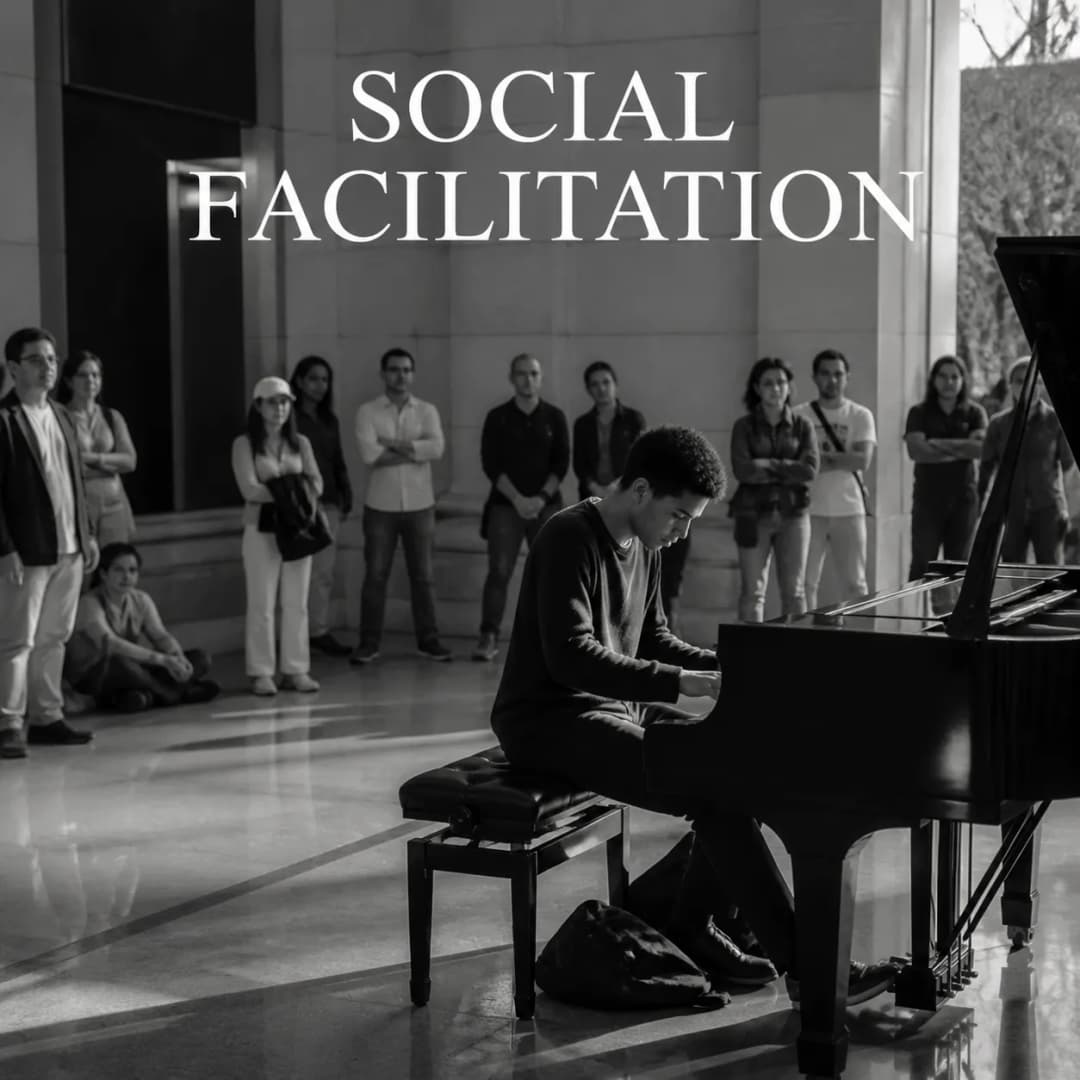
Social facilitation is the finding that an audience improves performance on tasks you have mastered and hurts performance on tasks that are hard or unfamiliar. Robert Zajonc's dominant-response account explains the split: arousal from being watched amplifies whichever response is already strongest, which is the right one on a well-learned task and the wrong one on a novel one. It is among the oldest effects in social psychology and among the better replicated. The pooled effect is also small.
What it is
Being watched changes what you can do, and the direction depends on the task. On something you could do in your sleep, an audience helps. On something you are still working out, the same audience makes you worse. For most of the twentieth century this looked like two contradictory literatures, because researchers kept finding both and arguing about which was the real result.
Zajonc's 1965 paper in Science resolved it with a single move. Arousal, he argued, does not improve or impair performance as such. It raises the probability of the dominant response, meaning the response highest in the organism's repertoire at that moment. On a well-learned task the dominant response is the correct one, so the audience helps. On an unfamiliar task the dominant response is whatever habit is nearest to hand, which is usually wrong, so the audience hurts. His formulation was that an audience impairs the acquisition of new responses and facilitates the emission of well-learned ones. The theoretical machinery came from Clark Hull's drive theory. The generality of the claim is why he was willing to test it on cockroaches, and it held there too.
Earlier work fits the same shape. Pessin and Husband ran blindfolded participants through mazes and found the characteristic split between easy and hard versions of the task. Norman Triplett's 1898 study, in the American Journal of Psychology, is the one usually cited as the origin: cyclists rode faster when paced or racing than alone, and children worked faster in pairs than singly.
Triplett's study is not what the textbooks say it is, and this page corrects our own copy of the error. Strube's 2005 reanalysis in the same journal and Wolfgang Stroebe's 2012 follow-up in Perspectives on Psychological Science establish that it was not the first experiment in social psychology, that it was not even the first study of social facilitation, that the task has been described wrongly for a century, and that Triplett's evidence for the effect was overstated. The children were turning a reel on a laboratory apparatus. They were not reeling in fishing lines, which is how the vault note and our own effort pacts page describe it, following the same secondhand chain everyone else follows. The date usually given for the study, 1897, is the year of the work rather than the 1898 publication.
None of that dislodges the effect, which is the useful thing about it. Bond and Titus pooled 241 studies and nearly 24,000 participants in Psychological Bulletin in 1983. The presence of others speeds up simple task performance and slows down complex task performance, slightly improves accuracy on simple tasks and impairs it on complex ones. The direction is exactly as Zajonc predicted. The magnitude accounts for between 0.3 and 3 per cent of the variance in a typical experiment, which is a real effect and a small one. The same analysis found social facilitation surprisingly unrelated to the performer's evaluation apprehension, which is inconvenient for the intuitive account, the one where you falter because you are worried about being judged.
Why the concept keeps its standing on a site that spends a lot of time on findings that collapsed: this one predates the priming era by decades, its direction was specified in advance by a theory, and the largest synthesis of it confirmed the direction rather than reversing it. Adam Alter groups it with diffusion of responsibility and the mere exposure effect as the durable material in his own book on situational influence, sitting beside chapters that have not aged nearly as well.
The vault records this note as unreviewed, meaning nobody here had assessed the evidence when it was written. The citations on this page were checked at search level on 2 September 2026, against abstracts and bibliographic records rather than full texts, and the numbers reported here are flagged accordingly in the sources.
In effect
The pool hall, and four people watching
Michaels and colleagues took the effect out of the laboratory in 1982, into a student billiards hall. Players were rated as above or below average by prior observation, then a group of four confederates walked over and watched them closely for several rounds. Accuracy among the good players rose from 71 to 80 per cent. Among the weaker players it fell from 36 to 25 per cent. Same room, same intervention, opposite results, split by how well the skill was already established.
The design is the point. Nobody was told they were in an experiment, nobody was asked to try harder, and the manipulation was four strangers standing nearby.
The driving test and the recital
The everyday version arrives twice in most lives. A learner driver who has done fifty hours with an instructor makes mistakes in the test that they had stopped making a month earlier, because the manoeuvre is not yet automatic and an examiner is sitting in the passenger seat. A musician who has played the same piece two hundred times often plays it best in front of an audience, and then falls apart on the new piece they learned last week.
The advice people give, calm down and concentrate, treats the arousal as the problem. On the well-learned piece the arousal was doing the work.
FocusMate, and co-working sold as a product
The commercial application is remote work's replacement for the office. Nir Eyal's argument in Indistractable is that the ambient social pressure of a visible desk in a visible room was doing real work on people's attention, and that it disappeared with the personal computer and then with remote working. Co-working in timed sprints with a friend is the low-tech reconstruction. FocusMate, which pairs strangers over video for a fixed session, is the productised one. Eyal discloses in a footnote that he has invested in it.
Zajonc's account carries a design implication that the productivity version rarely mentions. A watched session should help most with work you already know how to do, and can hurt on the genuinely unfamiliar problem, which is the opposite of when people usually reach for it.
What it does not say
It does not say audiences make people perform better. Half the finding is that they make people worse, and which half you get depends on how well the task is already learned. A team that installs open-plan desks or a shared screen on the strength of "social facilitation is well replicated" has bought both halves.
It does not support a large effect. Bond and Titus put it at 0.3 to 3 per cent of variance across 241 studies. Reliable and small are compatible, and popular writing tends to quote the reliability while implying the size.
It does not confirm the evaluation-apprehension story. The obvious mechanism, that you choke because you fear being judged, was unrelated to the effect in the 1983 synthesis. Mere presence appears to be enough, which is also why the cockroach experiment mattered.
It does not rest on the Triplett story as usually told. The origin study was misdescribed for a century, its evidence was weaker than advertised, and it was not the first of its kind. The effect survives that correction because of what came after it, not because of what Triplett found.
It is not diffusion of responsibility. Both are effects of other people being present, and they run through different mechanisms in opposite directions: one raises arousal in a performer, the other spreads accountability across a group until nobody acts.
Who developed it
Norman Triplett ran the first published experiments, in the American Journal of Psychology in 1898, with the qualifications above. Robert Zajonc supplied the account that made the field coherent, in Science in 1965, and neither has a page on this site yet.
Our vault note names Zajonc as originator with the year 1897, which pairs his name with Triplett's date and is the sort of small collision that later hardens into a misattribution. Zajonc's contribution is the theory, not the first demonstration. The confidence marker on the vault note was already medium, and the split above is the correction.
Sources
- Zajonc, R. B. (1965). "Social Facilitation." Science, 149(3681), 269-274. The dominant-response account, drawing on Hull's drive theory. Verified at search level, 2 September 2026; abstract and bibliographic record, not full text.
- Triplett, N. (1898). "The Dynamogenic Factors in Pacemaking and Competition." American Journal of Psychology, 9(4), 507-533.
- Strube, M. J. (2005). "What did Triplett really find? A contemporary analysis of the first experiment in social psychology." American Journal of Psychology, 118(2), 271-286. The reanalysis that found the evidence overstated and the task misdescribed.
- Stroebe, W. (2012). "The Truth About Triplett (1898), But Nobody Seems to Care." Perspectives on Psychological Science, 7(1), 54-57. Establishes that it was neither the first social psychology experiment nor the first on social facilitation.
- Bond, C. F., & Titus, L. J. (1983). "Social facilitation: a meta-analysis of 241 studies." Psychological Bulletin, 94(2), 265-292. Nearly 24,000 participants. Presence of others speeds simple performance and slows complex performance, slightly aids simple accuracy and impairs complex accuracy, accounting for 0.3 to 3 per cent of variance in the typical experiment, and unrelated to evaluation apprehension. Abstract only.
- Michaels, J. W., Blommel, J. M., Brocato, R. M., Linkous, R. A., & Rowe, J. S. (1982). "Social facilitation and inhibition in a natural setting." Replications in Social Psychology, 2, 21-24. Pool players observed by four confederates: above-average players 71 to 80 per cent accuracy, below-average players 36 to 25 per cent. Secondary sources, not full text.
- Alter, A. (2013). Drunk Tank Pink. Penguin Press. The group chapters, where social facilitation sits with diffusion of responsibility and the mere exposure effect as the pre-priming, well-replicated material.
- Eyal, N. (2019). Indistractable. BenBella Books. The social version of an effort pact, co-working and FocusMate, with the investment disclosed in a footnote.
- Where this came from
- One book in this library carries this concept. A concept resting on a single popular retelling is roughly twice as likely to be contested, mixed or unverified as one two or more books carry, so treat it as unchecked until it has been taken to a primary source.