Social Learning Theory
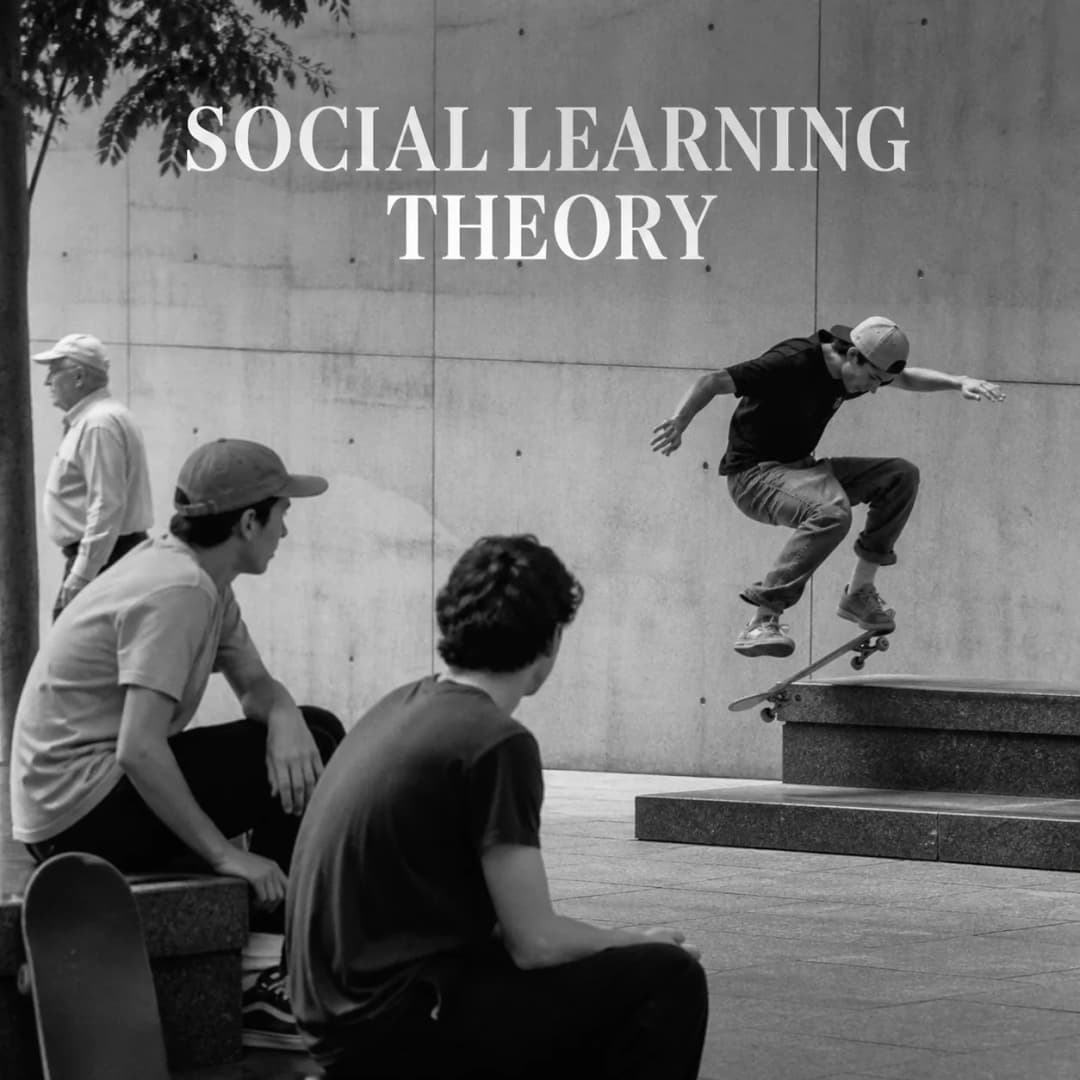
Social learning theory is Albert Bandura's account of how behaviour spreads without anyone being rewarded for it directly. Watching another person do something and get paid for it changes what the observer does next, and the effect scales with resemblance: a model who is like you, or only slightly further along, moves you more than a distant expert does. Bandura's Bobo doll studies from 1961 are the founding evidence. The theory is the reason a feed of people similar to you outperforms a feed of celebrities.
What it is
Behaviourism had a clean account of how behaviour changes and one large hole in it. Reinforcement explains why an animal repeats what it was rewarded for. It does not explain how a person acquires a behaviour they have never performed, and therefore have never been rewarded for, simply by having seen someone else do it.
Bandura's answer was that observation is itself a learning channel, and that consequences landing on somebody else are informative in roughly the way consequences landing on you are. The observer is not copying an action. They are reading a contingency: in this environment, this behaviour pays.
The founding evidence is the Bobo doll work. Bandura, with Dorothea Ross and Sheila Ross, published "Transmission of aggression through imitation of aggressive models" in the Journal of Abnormal and Social Psychology in 1961. Children between roughly three and five watched an adult behave aggressively towards an inflatable doll, and later reproduced the behaviour with the doll themselves, including specific actions the adult had improvised.
The study that matters more for how the theory is used commercially came four years later. In 1965 Bandura showed children a film of an aggressive model who was either rewarded, punished, or left with no consequence at all. Children who had watched the model punished imitated least. Then he offered every child a reward for reproducing what they had seen, and the differences vanished. All three groups had learned the same amount. What the model's punishment had changed was not learning but performance. That distinction, learning against performance, is the theory's most useful and least quoted result.
Bandura named the framework in Social Learning Theory (Prentice-Hall, 1977), and later rebuilt it as social cognitive theory in 1986, on the grounds that the original name understated how much cognition was doing. Self-efficacy, his other well-known construct, came out of the same programme.
The detail our notes single out is the resemblance condition. The closer the model is to the observer, in age, in circumstance, in apparent skill, the stronger the imitation, and a model only slightly ahead of the observer beats a model far ahead. Nir Eyal reaches for this in Hooked to explain why the social variable-reward type works at all: seeing a friend's photograph accumulate approval primes you to post your own, even though nothing has been given to you. The vault's status for this note is unreviewed, which is a statement about our sourcing rather than about Bandura, and the citations above were traced to the record after the note was written rather than read in full.
In effect
Research: the doll, and the film that separated learning from performance
The 1961 study is the one in every textbook and the 1965 one is the one worth knowing. Watching a model get punished did not stop children learning the behaviour. It stopped them showing it, until showing it was made worth their while, at which point the learning that had been there all along came straight out. Anyone reasoning about what an audience absorbs from watching consequences land on other people needs that split. Suppression is not absence.
Everyday life: the child one year above
Resemblance is easiest to see in children because the gap is measurable. A five-year-old imitates a seven-year-old far more readily than an adult, and a beginner at anything copies the person one rung up rather than the master. Bandura's account explains why: the model has to be close enough that the observed contingency looks like it would also apply to you. Watching an expert do something is entertainment. Watching someone barely ahead of you do it is information about your own prospects.
The same asymmetry runs through workplaces. What people learn from an all-hands meeting is not the stated values, it is who got named and for what, and the strongest signal comes from the colleague nearest to them in seniority.
Product design: manufacturing the resemblance condition
Recommendation systems built around "people like you" are, mechanically, resemblance engines. A demographically matched feed is doing the thing Bandura's research says makes imitation strongest, at scale and continuously, which is why matched feeds outperform aspirational ones on engagement.
Three named products make the reward side visible rather than implied. Stack Overflow runs a full status economy of reputation points and badges, with senior contributors' profiles serving as public evidence that answering questions pays in standing. League of Legends awards Honor Points for good conduct as a teammate. Facebook's feed does the simplest version, displaying other people's approval counts to an audience of people who post. In each case, the observer is shown a similar person receiving a reward, and no reward whatsoever needs to be delivered to the observer for their behaviour to change. This is the psychological grounding under variable rewards of the social kind, and it is the reason watching is already part of the loop rather than a prelude to it.
What it does not say
It is not social proof. Social proof is copying others under uncertainty, on the assumption that they know something you do not. Social learning theory is narrower and more specific: copying a behaviour you watched get rewarded, where the reward is what carries the information. The two are routinely used as synonyms and they make different predictions, most obviously when the crowd is doing something visibly unrewarding.
It is not mimetic desire. René Girard's account has the observer copying the model's desire itself, wanting the object because the model wants it, with no reward required anywhere in the system. Bandura's imitation is behaviourist in its bones and needs the reward to do the work. The two theories look adjacent and disagree about the mechanism entirely.
It is not emotional contagion, which transfers affect rather than modelled behaviour and runs far more automatically.
It does not establish what the Bobo doll studies are usually recruited for. The doll is an inflatable toy built to be struck and to bounce back. The setting was a laboratory, the children were told nothing about norms, and the outcome measure was behaviour towards an object minutes later. It shows observational learning. It does not, by itself, support conclusions about media violence and real aggression, which is the argument it was drafted into for four decades and which has its own considerably messier literature.
It does not have a verified evidence base in this vault. The note is tagged unreviewed and reached us through a trade book. Eyal's application of Bandura to the tribe reward type is an interpretation, and a reasonable one; it is not a test of anything.
It does not say imitation requires reward to occur. The 1965 result is precisely that learning happened in all conditions. Reward governed whether the learning was expressed.
Who developed it
Albert Bandura, at Stanford. The Bobo doll experiments with Dorothea Ross and Sheila Ross were published in 1961, the vicarious-reinforcement study in 1965, and the framework was named in his 1977 book. He renamed it social cognitive theory in 1986.
Our vault note carried Bandura correctly but at medium confidence with no year attached, which is why this page dates the founding work explicitly. Ross and Ross are named here for the same reason attributions are checked at all on this site: the study is universally called Bandura's, and two other people ran it with him. Bandura has no page on this site yet.
Sources
- Bandura, A., Ross, D., & Ross, S. A. (1961). "Transmission of aggression through imitation of aggressive models." Journal of Abnormal and Social Psychology, 63(3), 575-582. Children aged roughly 37 to 69 months. Abstract and citation record only.
- Bandura, A. (1965). "Influence of models' reinforcement contingencies on the acquisition of imitative responses." Journal of Personality and Social Psychology, 1, 589-595. Model rewarded, punished or without consequence; performance differences disappeared once the children themselves were offered an incentive, revealing equivalent learning across all three conditions. Abstract and citation record only.
- Bandura, A. (1977). Social Learning Theory. Prentice-Hall. The naming text. Citation record and secondary sources.
- Eyal, N., & Hoover, R. (2014). Hooked: How to Build Habit-Forming Products. Portfolio/Penguin. pp. 100-101 and 104, where Bandura is cited as the grounding for the tribe reward type and for the resemblance condition, with the Facebook feed, Stack Overflow reputation and badges, and League of Legends Honor Points as the worked examples.
- Where this came from
- One book in this library carries this concept. A concept resting on a single popular retelling is roughly twice as likely to be contested, mixed or unverified as one two or more books carry, so treat it as unchecked until it has been taken to a primary source.