Status Signaling
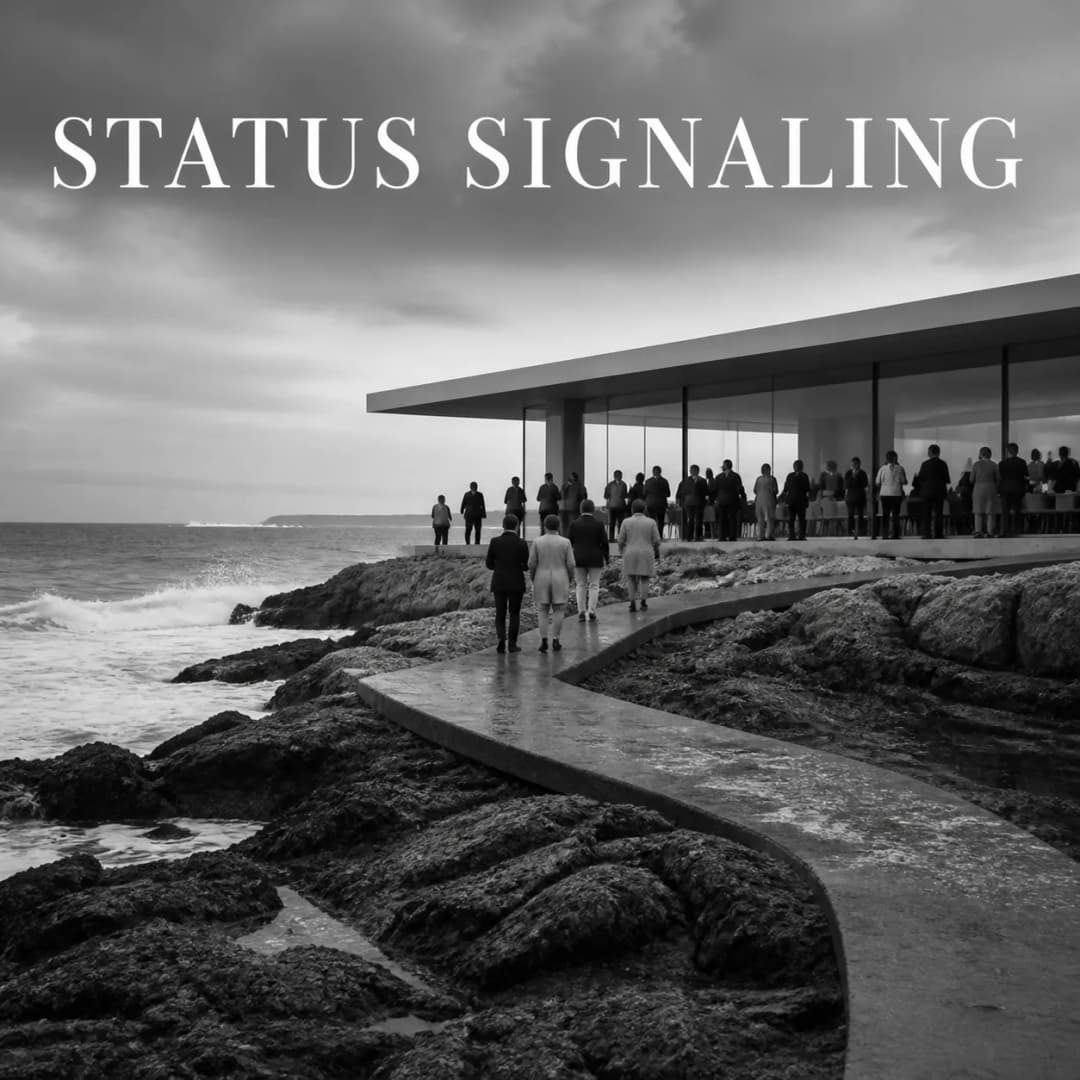
Status signaling is behaviour whose main function is communicating social standing, taste or group membership, rather than producing a direct material benefit. Thorstein Veblen named the consumer version in 1899, conspicuous consumption. The biologist Amotz Zahavi later supplied a reason such signals are believed at all: a costly signal is credible precisely because faking it is expensive. By the late 2010s, the clearest status signal for the most digitally fluent people was no longer a possession but a location, where someone was seen to be mattering more than what they were seen to own.
What it is
A wristwatch, a handbag, a university crest sitting in an email signature. These have worked as status signals for as long as anyone has had the means to display one, communicating standing to anyone fluent enough in the code to read it. The economist Thorstein Veblen gave the pattern a name in 1899: conspicuous consumption, spending visibly and, often, wastefully, as a way of demonstrating that one can afford to. Veblen's insight was that the point of the display frequently is not the object's use at all. It is that producing the display convincingly was expensive enough that only the genuinely well-off could manage it.
What Veblen's account left open is why anyone should believe the signal in the first place, and that is the piece the biologist Amotz Zahavi supplied later. Zahavi's handicap principle, developed to explain costly ornaments and behaviours in animals, a peacock's tail, a gazelle stotting in front of a predator, argues that a signal is credible precisely because it is costly. A cheap signal is trivial to fake, so it carries no reliable information; an expensive one filters out anyone who cannot genuinely afford to send it. Imported into the social sciences, the same logic explains why status goods have to stay genuinely costly, in money, time or reputational risk, to keep functioning. The moment a signal becomes cheap enough to fake, it stops signaling anything, and the status economy moves on to a harder one.
That migration is the part worth paying attention to now. As objects became easier to acquire, on credit, secondhand, counterfeit, the signaling load shifted toward things that stayed expensive: quiet, hard-to-fake taste; access to spaces that screen who gets in; and, increasingly, simply where someone was seen to be. Attending Davos, or Sundance, or the right founder dinner, still costs real money, time and an invitation most people cannot get, which is exactly the property a working signal needs on Zahavi's account. The context effect supplies the other half of the mechanism: a signal only reads as high status inside a context that has already taught its audience what high status looks like, the same logic the white cube describes for how a gallery confers status on whatever it exhibits. And because signals are calibrated to a specific audience rather than to everyone at once, status signaling sits close to tribal psychology: the watch that reads as status inside one circle can read as nothing, or as the wrong thing entirely, inside another.
In effect
Diamonds, watches, and the case for spending wastefully
Thorstein Veblen laid out the argument in The Theory of the Leisure Class (1899): visible, costly consumption functions as proof of standing precisely because it would be wasteful for anyone without the means to sustain it. The pattern that follows from his account, sometimes called a Veblen good, is that demand for certain goods can rise as price rises, because the higher price is what makes the signal work. The good is not being bought despite the cost. It is being bought partly because of it.
Where you were last Thursday
The watch on the wrist and the bag on the shoulder are old signals, and they still work. But for people whose audience already sees past objects, attendance itself became the strongest signal available: Davos, Sundance, Burning Man, the right founder dinner, the right podcast appearance, the right gym at six in the morning. Being in the room, rather than owning a particular thing, is the signal, and "where I was last Thursday" now outperforms "what I bought last Thursday" for the people most fluent in reading it.
The follower count as the new signature
Tim Wu's The Attention Merchants traces two later developments in the same lineage. Geodemographic clustering, the marketing technique behind systems like PRIZM, turned lifestyle and status into a coordinate that could be targeted directly (pp.171–173). And what the book calls microfame turned the status marker itself into something countable and public: a follower total, displayed on a profile, doing the work a watch or a car once did (pp.302–307). The signal moved from the wrist to the profile page without changing its underlying logic.
What it does not say
Status signaling describes a genuine and well-documented pattern, conspicuous consumption, Veblen goods, costly signaling, but the biological mechanism Zahavi proposed for animal ornaments is imported into human social behaviour by analogy rather than by a direct test of the same claim in people. Treat that link as a useful model for why costly signals hold their value, not as a proven mechanism specific to human status behaviour.
Not every costly behaviour is a status signal, and not every status claim is fully conscious or strategic. People frequently report other motives, comfort, quality, convenience, alongside or instead of status, and self-report can understate how much of the behaviour is actually doing signaling work, a version of the gap between declared and revealed preferences. And the specific claim that location has overtaken possessions as the strongest signal describes a particular class of highly online, high-status people in a particular period. It is not a universal replacement of material status signaling, which continues to function strongly elsewhere. A related caution from this vault applies broadly here too: implicit egotism, the self-directed cousin of this effect, has a robust core finding, a preference for things resembling our own initials, alongside life-outcome extrapolations that are considerably more contested. Status signaling research deserves the same care in separating the solid claim from the overreach.
Who developed it
No single person originated status signaling as a concept. Thorstein Veblen named the economic and consumer form in The Theory of the Leisure Class (1899); the biologist Amotz Zahavi supplied the signaling mechanism decades later with the handicap principle. Neither has a dedicated page on this site. Virgil Abloh, Brian O'Doherty and Rory Sutherland each apply the concept from design, art criticism and advertising respectively, rather than having originated it.
Sources
- Veblen, T. (1899). The Theory of the Leisure Class.
- Zahavi, A. Handicap principle (biological signaling theory).
- Wu, T. (2016). The Attention Merchants. pp.171–173, 302–307.
- Where this came from
- 8 books in this library carry this concept, which is corroboration worth knowing about, though these authors read each other and often draw on the same experiments, so it is not independent confirmation.