Techno-Panic
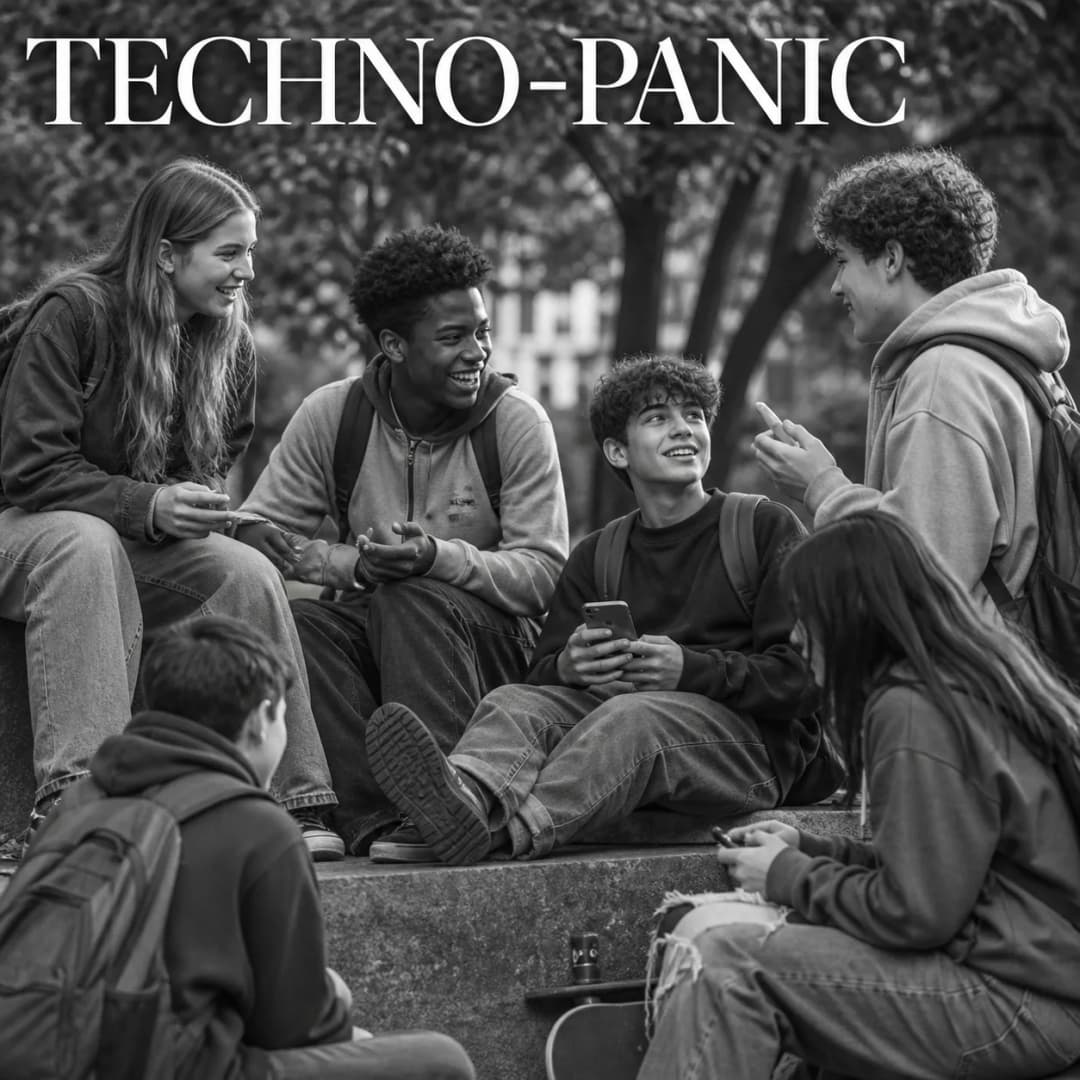
A techno-panic is the recurring pattern in which a new medium is blamed for a decline in the young. The lineage is long enough to be embarrassing: writing, the printing press, the radio, comics, television, arcade games, and now the smartphone. Techno-panic is a historical pattern rather than a testable effect, so it cannot prove any particular alarm wrong. It sets the prior. Claims of this shape have recurred for two and a half thousand years, usually right about the harvesting of attention and wrong about the damage.
What it is
The oldest entry is also the most awkward one for anybody who writes for a living. In Plato's Phaedrus, Socrates relays a story about the Egyptian king Thamus rejecting the god Theuth's gift of writing, on the grounds that it is a recipe not for memory but for reminder, and that it will fill people with the conceit of wisdom without the substance of it. Nicholas Carr traces the genre to that passage in The Shallows, and flags the self-contradiction himself: Plato wrote it down. It is the strongest anchor the pattern has, because it comes from inside the panic rather than from a critic of it.
After that the entries arrive at intervals. In 1474 Filippo di Strata, a Venetian monk, denounced the printing press, calling it a whore. In 1883 a medical journal blamed an "educational craze" for rising insanity, warning that insanity increases with education. In 1936 Gramophone worried about children dividing their attention between homework and the compelling excitement of the radio loudspeaker, a sentence that could be reprinted today with one noun changed. Then comics, television, arcade games and pinball, each in turn, each with its own committee, campaign or parliamentary concern.
Three books in this publication's library document the same cycle from three directions, which is part of why the pattern is treated here as established rather than as a rhetorical move. Nir Eyal supplies the lineage above in Indistractable. Tim Wu tells the same five centuries from the industry side in The Attention Merchants, where each attention-harvesting technology provokes a backlash that Wu calls the attentional revolt, and where the backlash is usually right about the harvesting and wrong about the harm. Carr supplies the ur-text, and is the only one of the three who is also an instance of the pattern he describes.
The current entry is the smartphone, and this is where the pattern stops being a curiosity and starts having stakes. Jean Twenge argues that adolescents are on the brink of the worst mental-health crisis in decades and that smartphone adoption is the cause, a case made in her Atlantic article "Have Smartphones Destroyed a Generation?" and in iGen. Eyal quotes the claim and then answers it with the counter-evidence. Christopher Ferguson, in Psychiatric Quarterly, finds only a negligible relationship between screen time and depression and supports an everything-in-moderation reading. Andrew Przybylski, at the Oxford Internet Institute, finds wellbeing rising with moderate use, and puts the harm associated with the heaviest use at about a third as bad as missing breakfast. Sarah Rose Cavanagh's criticism is methodological rather than statistical: that Twenge reviews only the studies that support her.
Eyal's own phrase for the resolution is that the devil is in the digital details, and his concession is precise rather than blanket. Harm shows up above roughly five hours a day, and it may be a symptom of other problems rather than their cause. That is the shape of the honest position, and it satisfies neither camp. Twenge's core observation, that something changed in adolescent wellbeing around the start of the 2010s, is not what is in dispute. The attribution is.
The reasoning error the pattern keeps producing is worth naming separately, because it is what makes techno-panics feel so convincing from the inside. A new medium is highly visible, it is used most by the young, and it arrives at roughly the same time as whatever is being explained. That is enough for a proximate correlate to be promoted to a root cause, and the promotion happens before anyone has looked for the third variable that might be driving both.
In effect
The sugar-high experiment, and what it tests
The clearest research demonstration in this territory is not about screens at all. In a study Eyal recounts as the parallel case, mothers were told that their sons had been given sugar, when they had in fact been given a placebo. Those mothers rated their sons as more hyperactive than mothers in the control condition, and when the sessions were filmed, they were also seen criticising them more. The belief produced the observation, and then the observation produced the behaviour that seemed to confirm it. That is the mechanism of a panic caught in a single experiment: the harm being reported is partly an artefact of the expectation, and the expectation changes how the adult treats the child, which is its own effect. Anyone assessing a claim about screens and children should hold that study in view, because parental report is doing a great deal of the work in this literature.
The homework and the loudspeaker
The everyday version of a techno-panic is a parent watching a child do two things at once and concluding that the second thing is destroying the first. Gramophone printed exactly that concern about the radio in 1936. The modern instance is the same scene with a phone on the desk beside the schoolbook, and the same inference. What makes the historical parallel useful is not that it proves the modern parent wrong. It is that it identifies which part of the concern is new and which part is the standing form. Divided attention during homework is a real, measurable thing to worry about. The claim that a generation is being cognitively remade by the device is the part that has been made about every medium in the list, and has not once survived in the form it was first stated.
Panic as a product, and the wellbeing features sold as its cure
The pattern has a commercial engine on both sides. An alarming claim about children is one of the most saleable propositions in publishing and broadcasting, which is a structural reason that the strong version of each panic reaches many more people than the qualified version that follows it. Twenge's Atlantic headline asks whether smartphones have destroyed a generation, and it travelled enormously further than Przybylski's estimate about breakfast ever will. Then the same platforms accused of causing the problem ship the remedy: Apple's Screen Time and Google's Digital Wellbeing are dashboards that quantify the very thing the panic is about, sold as self-control tools, and their existence tacitly concedes the premise while keeping the user inside the product. It is worth adding that the sceptics have positions too. Eyal's earlier book, Hooked, was written for companies designing habit-forming products, and Indistractable argues the panic is overblown; both are on the record and are read together here.
What it does not say
Identifying a claim as a techno-panic does not refute it. This is the single most common misuse of the concept, and it is a formal fallacy dressed as historical literacy. The fact that people were wrong about comics and pinball tells you nothing about whether they are wrong about recommendation algorithms, and a pattern of past false alarms does not entail a present false alarm. The pattern adjusts how much evidence a claim should have to carry. It does not supply the answer.
Techno-panic is also not a research finding, and it is tagged not-a-research-claim here for that reason. It is a historical observation and a term of art. There is no effect size for it, no replication record, and no experiment that could confirm or falsify it. Anything on this site that presents it as a demonstrated phenomenon is overstating what the vault holds.
The scepticism it licenses has limits that the vault records explicitly. The concession in Indistractable is that harm does appear above roughly five hours of use a day, and that the harm may be a symptom of other difficulties rather than their cause. Ferguson's negligible relationship and Przybylski's breakfast comparison are findings about averages across populations, and an average that is close to zero is fully compatible with real harm concentrated in a minority. This is a live, unresolved dispute in which the effect sizes are small, heavily moderated, and contested as to direction of causation. It is not a settled debunking, and this page should not be cited as though the question were closed in the sceptics' favour.
Nor does the pattern establish that nothing has been lost. The Flynn effect, the sustained twentieth-century rise in measured IQ, is the standing counter-evidence to any claim that modern media are making people less intelligent, and Carr meets it directly rather than avoiding it: he concedes the rise is real, and points to Flynn's own account that the gains are concentrated in abstract and classificatory reasoning while vocabulary, general knowledge and arithmetic have been flat or falling. The effect has also slowed or reversed in several countries since the 1990s. Anyone using the history of failed panics as a blanket reassurance is helping themselves to more comfort than the evidence provides.
Who developed it
No single person originated the concept, and the vault deliberately does not credit one. The pattern is documented from Plato's Phaedrus onward. Its modern statement in this publication's sources comes from three writers at once: Nir Eyal, who supplies the dated lineage in Indistractable; Tim Wu, who tells the same cycle from the industry side in The Attention Merchants; and Nicholas Carr, who located the ur-text in Plato and who is also, unavoidably, an example of the genre. The best-known current claim in the pattern belongs to Jean Twenge, and the best-known counter-evidence to Andrew Przybylski and Christopher Ferguson.
Sources
- Plato, Phaedrus. The Thamus and Theuth passage, as traced by Carr.
- Carr, N. (2010). The Shallows: What the Internet Is Doing to Our Brains. W. W. Norton. Tenth-anniversary edition with new afterword, 2020.
- Eyal, N. (2019). Indistractable: How to Control Your Attention and Choose Your Life. BenBella Books. Chapter 2, pp. 14-15, for the historical lineage; chapter 29, pp. 213-217, for the screen-time argument, the Ferguson, Przybylski and Cavanagh material, and the sugar-high placebo study.
- Wu, T. (2016). The Attention Merchants. The attentional revolt chapters, covering the same cycle from the industry side.
- Twenge, J. "Have Smartphones Destroyed a Generation?", The Atlantic, and iGen.
- Ferguson, C. Negligible screen-time and depression relationship, Psychiatric Quarterly.
- Przybylski, A., Oxford Internet Institute. Wellbeing rising with moderate use; heaviest-use harm about a third as bad as missing breakfast.
- Evidence status set 2026-09-01: a historical pattern and a term of art rather than a testable effect.
- Where this came from
- 4 books in this library carry this concept, which is corroboration worth knowing about, though these authors read each other and often draw on the same experiments, so it is not independent confirmation.