Temptation Bundling
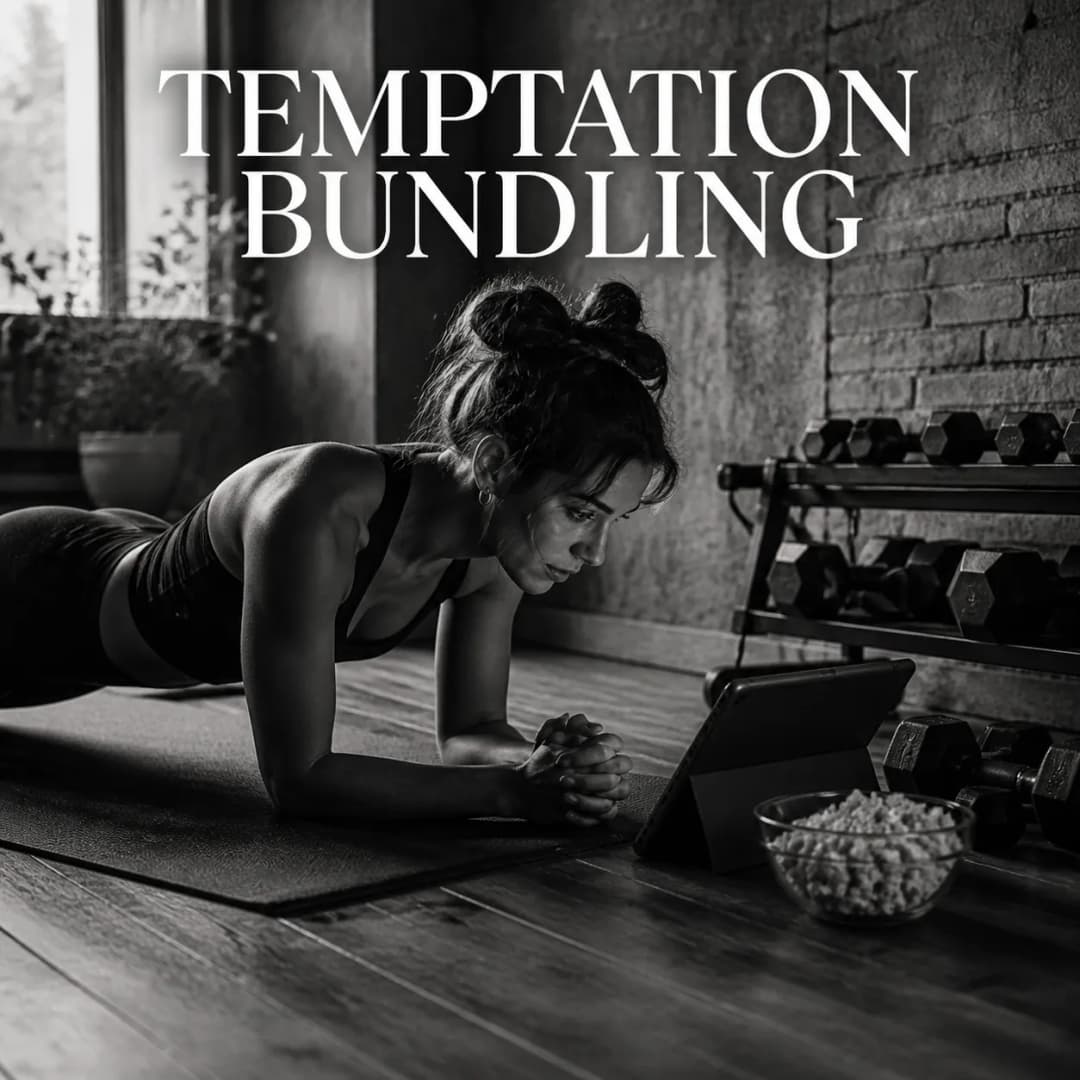
Temptation bundling is Katherine Milkman's technique of making something you want available only alongside something you should do, so the want supplies the motivation and the restriction supplies the adherence. The best-powered test of it, Kirgios and colleagues in 2020 with 6,792 participants, found gains of 10 to 14 per cent in weekly workout odds, persisting to 17 weeks. The widely repeated 51 per cent comes from one condition of a much smaller 2014 study whose effect decayed.
What it is
The device is a restriction, not a reward. You take something you genuinely want, an audiobook you are gripped by, a programme you are following, and you make a rule that you may only have it while doing the thing you keep not doing. Nothing is added to the should. The want is simply moved so that it sits inside it.
Katherine Milkman, at Wharton, built the original test around gym attendance. Participants were given iPods loaded with page-turner audiobooks, The Hunger Games and the Twilight series among them, which they could listen to only at the gym. The mechanism she is isolating is exclusivity rather than pleasure. An audiobook you can hear anywhere buys nothing, because the gym is then competing with the sofa for the same experience. An audiobook you can hear only in one place has been converted into a reason to go there.
That is a genuinely different bet from most self-control advice, and it is the reason the technique keeps getting repeated. It asks for no willpower at the moment of action, no identity change, no delayed gratification. It asks for one decision, made in advance and in the abstract, about where a pleasure lives.
The number everyone quotes is the wrong one to lead with, and this is where our own vault had to be corrected. Milkman, Minson and Volpp's 2014 paper in Management Science ran three conditions. Full restriction, where the audiobooks were locked to the gym, produced 51 per cent more gym visits. An intermediate condition, where bundling was merely encouraged, produced 29 per cent. The sample was about 226 undergraduates, the study ran nine weeks, and the abstract states plainly that treatment effects declined over time, noticeably after Thanksgiving. Our own record of that paper is at abstract level, because the published version is paywalled, and this publication's rule is that a claim reached at one remove keeps that flag permanently.
The better citation now exists. Kirgios and colleagues, with Milkman among the authors, published a field experiment in Organizational Behavior and Human Decision Processes in 2020 with 6,792 participants, roughly thirty times the original sample. Gains ran at 10 to 14 per cent in weekly workout odds, and they persisted up to 17 weeks. Smaller effect, far better powered, and durable, which is the trade the whole replication era has taught people to expect and which readers of popular psychology are rarely offered.
So the honest summary is that temptation bundling works and works less than advertised, and that both halves of that sentence come from the same research group. This page carries mixed for exactly that reason: the method is real, the origin is correctly attributed, and the number in circulation belongs to a small, short, decaying study rather than to the effect.
In effect
Research: the same idea, tested twice, thirty times apart
Put the two studies side by side and the useful lesson is not about exercise. In 2014, 226 undergraduates over nine weeks, with a restriction enforced by hardware, produced 51 per cent. In 2020, 6,792 people in the field, taught the technique rather than issued with equipment, produced 10 to 14 per cent that lasted to 17 weeks. Neither result contradicts the other. The first is what the mechanism can do under ideal enforcement in a short window with a captive population, and the second is what it does when it has to survive contact with people's actual lives.
The decay in the 2014 study is the detail most retellings drop, and it is the one that predicts the second result. An effect that is already fading by week nine is not a candidate for a headline figure. Anyone quoting 51 per cent is quoting the strongest condition of the weaker study at its strongest moment.
Everyday life: the thing you are not allowed to have yet
The everyday form is the one the 2020 experiment actually tested, which is worth noticing. Nobody handed those participants a locked iPod. They were taught the idea and left to supply their own temptation, which is what makes this a technique rather than an intervention: a podcast series reserved for the commute, a show that is only ever watched while the ironing is done, an audiobook that exists exclusively in the car.
The failure mode is built into the design and takes about a week to arrive. The rule is enforced by the person it constrains, and the first evening you listen to the next chapter in bed, the pairing is gone and the gym has lost its reason. Exclusivity is the entire mechanism. Once the want is available everywhere again, what remains is a should with no company, which is where the person started.
Commerce and product design: borrowing motivation instead of building it
There is a design principle underneath this and it is not the obvious one. In the Fogg-derived view of behaviour, motivation is the expensive lever and ability is the cheap one, which is why most product work is friction removal and why elements of simplicity is a checklist for finding steps to delete. Temptation bundling ignores that advice and goes for the expensive lever, but it does not build motivation. It borrows some that already exists elsewhere and relocates it.
The commercial catch is the restriction. A product that says you may only use this at the gym is a product asking users to accept less of what they are paying for, which is close to unsellable, and it is why the durable version of the idea has been taught as a practice rather than shipped as a feature. Milkman's own version was effectively a small piece of product design, a lending library of restricted devices run through a university gym, and it existed for nine weeks under a research budget. What survived into the world is the instruction.
What it does not say
It does not support the 51 per cent as the size of the effect. That figure is the full-restriction condition of a study of about 226 undergraduates over nine weeks, whose effects the authors report as declining over time. The number to use is the 2020 field experiment's 10 to 14 per cent, and any piece leading with 51 is leading with the weakest evidence available.
It does not come with a fully verified provenance on the 2014 study. Our record of Milkman, Minson and Volpp is abstract-level, the published version being paywalled, so design detail beyond the abstract is secondhand. Our record of the 2020 field experiment carries no provenance marker at all, which means it has not been established here whether anyone opened the full text. Both facts belong on the page rather than in a file.
It does not show the effect outside exercise. Both studies are about gym attendance. The mechanism looks general and has not been demonstrated to be general, and the domains where people most want it, studying and household admin among them, have not been tested here.
It does not build motivation, and does not claim to. In self-determination theory terms this is external regulation with better staging: the reason to go to the gym is still not about the gym. That is not an objection, since a person who trains for a year on borrowed motivation has trained for a year, but it does mean the technique is doing something different from what identity-based approaches are doing, and the two should not be quoted as if they were the same finding.
It does not survive the person who breaks their own rule, and no version of it has an enforcement mechanism beyond the restriction itself. Price pacts and effort pacts at least put something in the way.
Who developed it
Katherine L. Milkman, at Wharton, with Julia A. Minson and Kevin G. M. Volpp, in a 2014 paper in Management Science. Milkman is also an author on the much larger 2020 field experiment that revised the effect size downwards, which is worth stating plainly: the correction came from the originator's own group rather than from a critic.
Nir Eyal reports the technique in Indistractable, and our own note calls it the strongest single piece of applicable evidence in that book. It is Milkman's, not Eyal's. Milkman has no page on this site yet.
Sources
- Milkman, K. L., Minson, J. A., & Volpp, K. G. M. (2014). "Holding the Hunger Games Hostage at the Gym: An Evaluation of Temptation Bundling." Management Science, 60(2), 283-299. Full restriction 51 per cent more gym visits, intermediate condition 29 per cent, N about 226 undergraduates over 9 weeks, with treatment effects declining over time. Provenance: abstract only. The published version is paywalled and design detail beyond the abstract is secondhand.
- Kirgios, E. L., Mandel, G. H., Park, Y., Milkman, K. L., Gromet, D. M., Kay, J. S., & Duckworth, A. L. (2020). "Teaching temptation bundling to boost exercise: A field experiment." Organizational Behavior and Human Decision Processes, 161(S), 20-35. N = 6,792. Gains of 10 to 14 per cent in weekly workout odds, persisting up to 17 weeks. This is the citation to use. Our record carries no provenance marker.
- Eyal, N. (2019). Indistractable: How to Control Your Attention and Choose Your Life. BenBella Books. Ch. 20, p. 144, where the technique is reported and the 51 per cent figure is the one given.
- Vault correction record, 2026-09-01. The note carried 51 per cent as the effect. Corrected to name the condition, the sample, the duration and the decay, and to prefer the 2020 field experiment. Status set to mixed.
- Where this came from
- 3 books in this library carry this concept, which is corroboration worth knowing about, though these authors read each other and often draw on the same experiments, so it is not independent confirmation.