The Disenchantment Effect
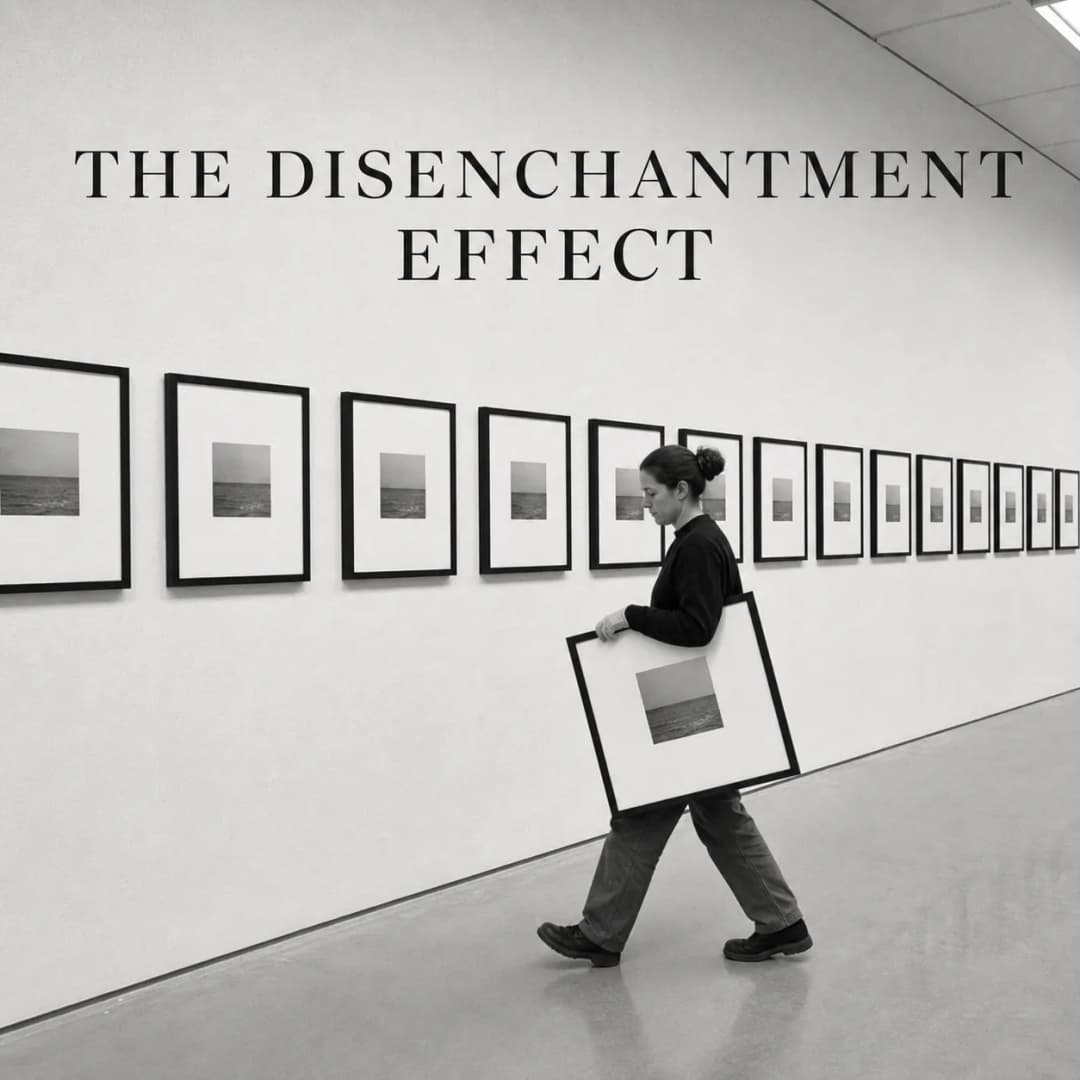
The disenchantment effect is Tim Wu's name for a simple pattern: any format that captures attention loses its power to do so over time, purely through repetition. What thrilled an audience the first hundred times becomes wallpaper, and whoever profits from the format either reinvents it or watches it die. It is the habituation stage of the four-beat cycle Wu traces through The Attention Merchants (2016), capture, race to the bottom, habituate, revolt, and it is the stage that guarantees no format holds the top spot forever.
What it is
Wu's own shorthand for the effect is blunt: the goose that lays the golden egg gets old and dies. A new format, a new kind of image, a new kind of joke, a new kind of shock, seizes attention because it is unfamiliar, and unfamiliar things register more strongly than familiar ones. That is the whole mechanism, and it is also the whole problem for anyone who has built a business on the format, because the very act of running it in front of an audience repeatedly erodes the thing that made it work in the first place. Nothing has to go wrong with the content for the effect to appear. It is enough that the same trick has now been seen many times.
This puts every attention business on a clock it did not set. The company that captured an audience with a genuinely new format has, built into its own success, the seed of that format's decline: the more successfully it is deployed, the faster the audience habituates to it. Wu's four-beat cycle names what tends to follow. A format captures attention cheaply. Competitors race toward more extreme versions of whatever worked, because a diluted repeat of an already-familiar trick works even less well than the original did. Audiences habituate regardless, since escalation buys time rather than immunity. And eventually a public revolt against the format's excesses forces a cosmetic reform, after which the underlying business model migrates to the next medium and the cycle restarts.
The effect is worth distinguishing carefully from a neighbouring idea that sounds similar but describes something else. Wanting vs liking is a claim from neuroscience about two separate systems, one driving pursuit, one driving enjoyment, and about wanting sometimes rising even as liking stays flat or falls. The disenchantment effect is not that claim. It is a claim purely about liking, and specifically about liking decaying over repeated exposure to an unchanged format; it says nothing on its own about whether the pull to keep engaging with that format also weakens. That gap matters, because the two claims can both be true of the same product at once, and when they are, the result is a familiar shape from the inside: something a person keeps opening and keeps complaining about. Liking has quietly declined the way the disenchantment effect predicts. Wanting has not declined at all, or has even sensitised further, which is a separate mechanism entirely. Neither effect explains that combination alone.
In effect
Tom Freston and MTV's stale music videos, 1987
By 1987, Tom Freston, then running MTV, recognised that music videos, the format that had electrified the channel's viewers on launch in 1981, had gone stale; the same footage that once seized reflexive attention no longer did (p.238). That recognition, arrived at from inside the business rather than imposed by an outside critic, is what pushed MTV toward reality television as its next attention format. Nothing about music videos as a medium had failed. Six years of repetition had simply used up the novelty that made them work.
Cancelled once the trick wore off
Wu points to two American television cancellations as instances of the same pattern operating on individual programmes rather than a whole genre: I Love Lucy and Amos 'n' Andy were both retired once their initial novelty had worn off audiences who had, in effect, seen the trick enough times (p.347). A show does not need declining quality to lose its grip. It needs only enough repetition for a once-startling format to become predictable.
Oprah Winfrey's late-career decline
Wu also documents Oprah Winfrey's own late-career viewer decline as an instance of the pattern operating at the scale of a single, long-running personality rather than a format or a show (p.347). Millions of viewers had made watching a daily habit for years, which is exactly the condition under which disenchantment does its work: the very durability of the habit is what wears the novelty down. Wu goes further and predicts the same erosion applies to attention-based politics, arguing that a public style built on constant novelty eventually bores its audience rather than losing an argument on the merits, though this extension is offered as a prediction rather than as documented history.
What it does not say
The disenchantment effect describes a pattern Wu traces across more than a century of media history rather than a finding tested with an experimental design and a control condition; it belongs to journalism and cultural history, not to a peer-reviewed literature with effect sizes attached. It also does not claim that habituation happens on a fixed timetable, some formats decay in years, some in decades, and Wu offers no formula for predicting which. Nor does it say that wanting declines alongside liking. Those are separate claims about separate systems, and treating a rise in one as evidence against decline in the other is a mistake the effect itself does not make.
Who developed it
Tim Wu named and traced the pattern in The Attention Merchants (2016). He does not have a dedicated page on this site; he is referenced here by name because the historical argument, not a biography, is what the concept rests on.
Sources
- Wu, T. (2016). The Attention Merchants: The Epic Struggle to Get Inside Our Heads. pp.238, 347.
- Where this came from
- One book in this library carries this concept. A concept resting on a single popular retelling is roughly twice as likely to be contested, mixed or unverified as one two or more books carry, so treat it as unchecked until it has been taken to a primary source.