The Labour Illusion
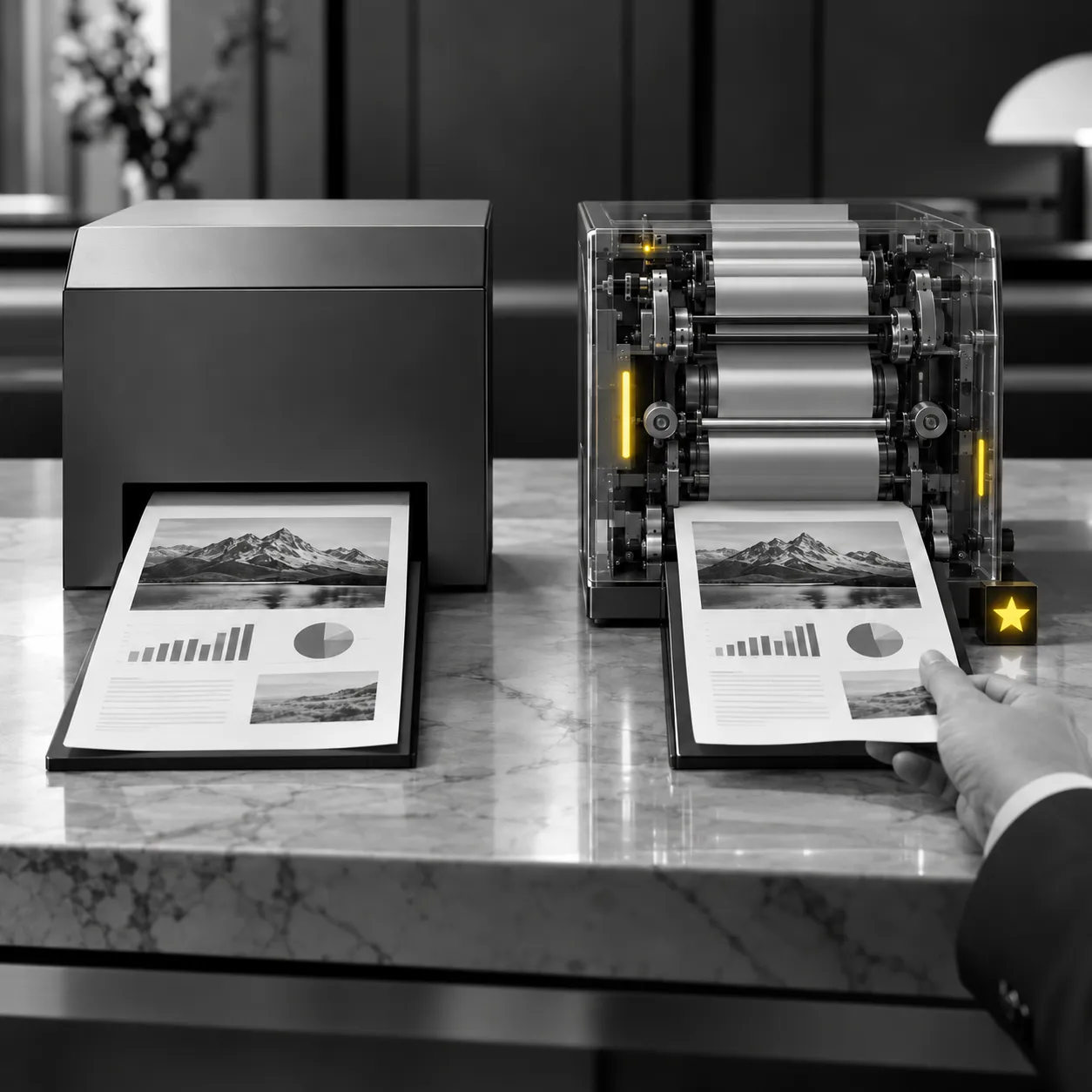
The labour illusion is Ryan Buell and Michael Norton's 2011 finding that a service feels more valuable when the customer can see work being done on their behalf, even where the result is identical. It does not mean longer waits are better. In their own first experiment, wait time had a separate negative effect on perceived value, and transparency raised the whole line without changing its direction. The effect travels through perceived effort and then gratitude towards the provider, and it reverses when the visible work is failing or absent.
What it is
In 2011, Ryan Buell and Michael Norton, both then at Harvard Business School, published five experiments in Management Science under a title they coined for the occasion: the labour illusion. Their own definition is that because of this illusion, when websites engage in operational transparency by signalling that they are exerting effort, people can actually prefer websites with longer waits to those that return instantaneous results, even when those results are identical.
Buell is the first author and Norton is the second. The distinction is worth stating because the trade almost always credits Norton, and because Norton is separately first author of the IKEA effect, a different finding about a different person's effort. Author order on the labour illusion paper was confirmed for this piece at both the Crossref and the OpenAlex item records.
The experiments ran on simulated travel-search and dating sites. A transparent condition showed a changing list of the sites being searched with fares visibly compiling. A blind condition showed a progress bar filling at a uniform rate. One crucial design choice determines what the result can mean: a progress bar sat in every non-zero wait condition, the transparent ones included, placed there deliberately so that reduced uncertainty could not do the explaining. Reported uncertainty did not differ across conditions.
The popular reading of this paper is wrong, and the correction is inside the paper rather than against it. In the first experiment, with 266 people online across thirteen conditions, perceived value came out at 5.36 on a seven-point scale with transparency against 4.96 without. But wait time had a significant main effect of its own, with value showing what the authors call a general downward trend over time. Transparency scored higher at every single time point and the two factors did not interact. Transparency raised the whole line. It did not change the direction the line was travelling in. The authors' own managerial notes record the benefit of transparency beginning to decline after about thirty seconds in the travel simulation and after about fifteen in the dating one.
What the effect does run on is a measured three-step path. Transparency raises perceived effort. Perceived effort raises reciprocity, meaning appreciation and gratitude directed at the provider. Reciprocity raises perceived value. In the path analysis each link was significant, the mediation was full, and nothing off the hypothesised route reached significance at all. On the reciprocity measure itself, the conditions ran 5.19 for showing the work, 4.43 for describing it and 3.44 for a blind bar.
Buell and Norton also drew the ethical line themselves, in the paper. The fact that firms can induce the labour illusion, they write, does not mean that they therefore should induce it. Operational transparency requires honesty and is, on their account, ethically unproblematic. Inducing the illusion moves closer to an ethical boundary, and a firm doing it must take care that customers do not become aware of the attempt.
In effect
Showing beat telling, and telling won the belief contest
The third experiment is the most interesting single result in this literature. 143 people online were put in one of three positions: shown the work, merely told about it with a flashed message that the site was preparing to search a hundred sites and a list of about a hundred names, or given a blind progress bar. Perceived value came out at 5.13 shown, 4.49 told and 3.82 blind. Then the twist. Being told made people believe in far more work: about 53 sites believed searched, against about 28 for the people who actually watched the search happen. Believed quantity of labour predicted neither perceived effort nor perceived value. Volume of work is not the currency. Witnessed work is.
A dining hall, a sandwich counter and a city
Buell's later field work takes the question out of the browser. At a university dining-hall grill station, iPads were used over two weeks to open and close the sight lines between customers and chefs, with 299 customers surveyed; reciprocal transparency is reported as contributing to a 22.2 per cent rise in customer-reported quality. At a sandwich counter, 48 people, perceived value rose even though the transparent group reported waiting more than four times as long, 3.16 minutes against 0.72, and because the sandwiches were pre-made, objective quality did not move at all. In Boston, where closing a Citizen's Connect service request could include a photograph of the work performed, residents went on to submit an average of 59.8 per cent more requests in 37.7 per cent more categories, from 371,992 monthly observations of 21,786 reporters. That last one is real behaviour at scale and it is not a randomised experiment.
The progress display a product team is about to build
The commercial temptation this finding creates is a loading screen that narrates. The evidence supports it only under conditions that the trade version drops. The fourth experiment varied how much work was actually done behind the display, three sites against thirty-six, with everyone waiting thirty seconds. The main effect held across the design, 4.89 against 4.46, but the simple effect appeared only in the high-labour cell, 5.16 against 4.47; in the low-labour cell the figures were 4.65 against 4.44, which the study could not distinguish from nothing. Read strictly, the only cell where transparency measurably worked was the one with real work in it. A narration with nothing behind it is the case the evidence does not cover.
What it does not say
It does not say that longer waits raise value. Wait time had its own significant negative main effect on perceived value in the first experiment, and the authors report the benefit of transparency declining after about thirty seconds in travel and about fifteen in dating. Anyone selling a slower service on the strength of this paper is selling something the paper does not contain.
It does not say the effect works without real work to show. In the low-labour cell of the fourth experiment the gap was 4.65 against 4.44, which the study could not distinguish from nothing.
It does not say the effect is robust to a poor outcome. The authors' own fifth experiment, 280 people in a laboratory on a simulated dating site, found that with an unfavourable result a transparent fifteen-second wait scored 2.47 against 3.24 for an instant one, and fell to 2.10 at thirty seconds. Their reading: when a service demonstrates that it is trying hard and yet still fails to come up with anything but poor results, people blame the service for this failure and rate it accordingly.
It does not say effort information raises willingness to pay. The nearest literature, the effort heuristic, was re-tested by Ignazio Ziano and colleagues in 2023 across 1,405 preregistered participants, who found support for an effect on liking and quality and no support for an effect on monetary value.
And it has not been independently replicated. Searching for this piece across four passes, covering failed and preregistered replications, nulls in operational transparency, recent interface work and the citation record at OpenAlex and Crossref, turned up no independent replication and no failed replication either. The honest description is extended but not independently replicated, which is narrower than either of the two things usually said about it. The widely repeated figure of 8 per cent higher value appears nowhere in the paper's reported statistics and is not used here.
Who developed it
Ryan W. Buell is first author of the 2011 paper and of the field programme on operational transparency that followed. Michael Norton is second author. Robert Bray's 2023 analysis of 4.68 million parcel deliveries supplies the strongest challenge to the paper's premise, on the ground that genuine transparency makes idleness visible as well as industry.
Sources
- Buell, R. W., & Norton, M. I. (2011). "The Labor Illusion: How Operational Transparency Increases Perceived Value." Management Science, 57(9), 1564-1579. doi:10.1287/mnsc.1110.1376. Read in full from the publisher PDF hosted at hbs.edu; the published version at pubsonline.informs.org would not load and is recorded as not read.
- Bray, R. L. (2023). "Operational Transparency: Showing When Work Gets Done." Manufacturing & Service Operations Management, 25(3), 812-826. doi:10.1287/msom.2020.0899. Read in full. The challenge to the premise.
- Ziano, I., Yeung, S. K., Lee, C. S., Shi, J., & Feldman, G. (2023). '"The Effort Heuristic" Revisited: Mixed Results for Replications of Kruger et al. (2004)'s Experiments 1 and 2.' Collabra: Psychology, 9(1), 87489. doi:10.1525/collabra.87489. Abstract and opening read in full; the full results sections were not read.
- Hwang, E., Lee, S. A., & Legendre, T. S. (2024). "Operational Transparency as a Service Design: An Investigation on Labor/Effort Observation Effect." Journal of Hospitality & Tourism Research. doi:10.1177/10963480231223146. Reconstructed abstract only; no sample size is printed from it here.
- Anderson, S. T., Anderson, J. E., & Nguyen, C. A. (2025). "The value of visible work: Operational transparency in digital healthcare interfaces." Health Marketing Quarterly. doi:10.1080/07359683.2025.2564584. Reconstructed abstract only.
In these themes
- AI and Human Judgement
When we trust machines, when we resist them, and why.