The Medium Is the Metaphor
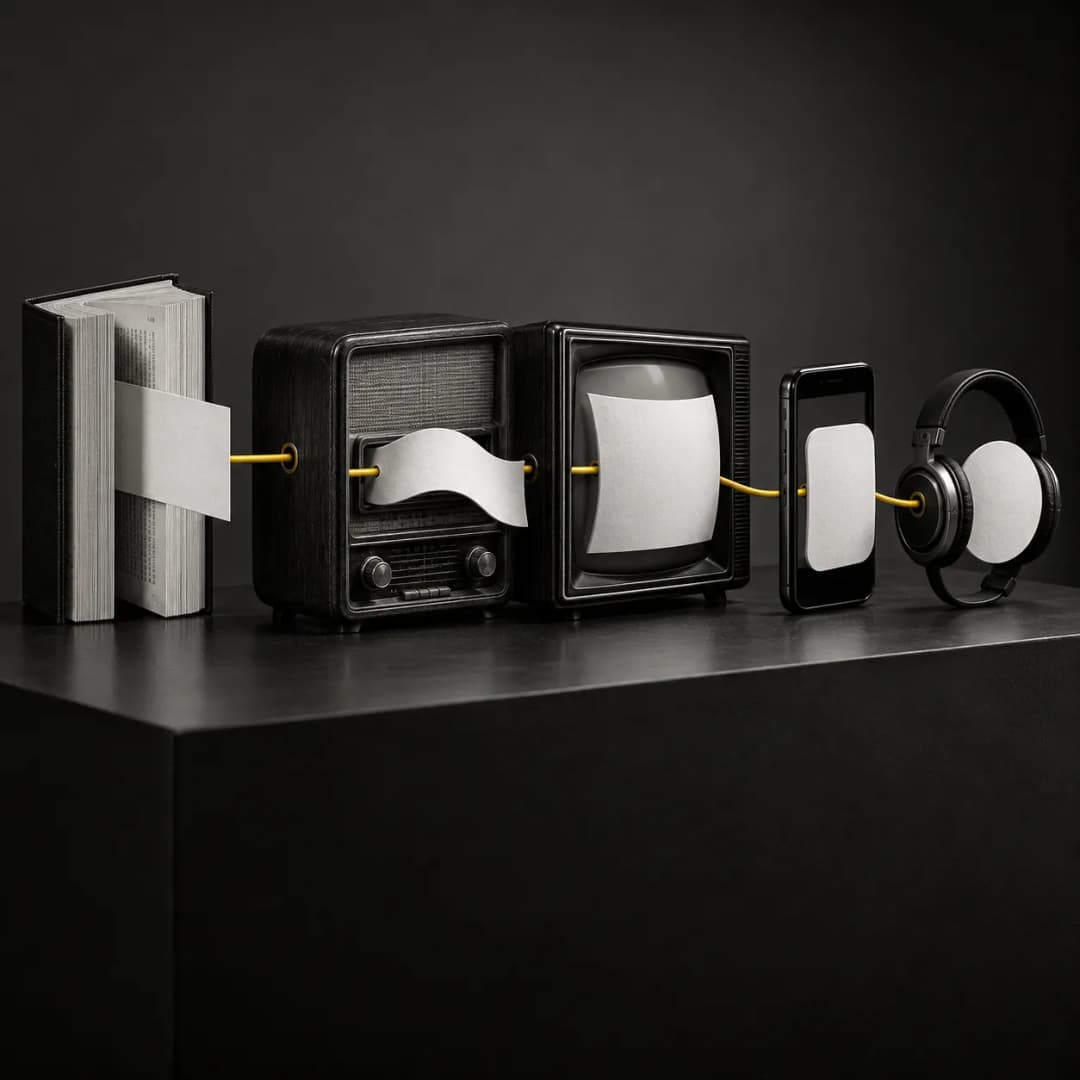
The medium is the metaphor is Neil Postman's adaptation of Marshall McLuhan's phrase. It holds that the form of a medium shapes what can be said through it, so that the dominant medium of a culture decides what counts as knowledge. In Amusing Ourselves to Death (1985) he applied it to television and argued that the problem is not that television offers entertaining subject matter but that all subject matter is presented as entertaining. It is a theory of form, not a research finding, and the studies that bear on it point mostly to the market.
What it is
Postman's phrase alters McLuhan's "the medium is the message". Where McLuhan's slogan says the medium matters more than any content it carries, Postman's says that each medium works as a metaphor for how the world is to be understood. On the summaries of the book used for this page, oral, literate and televisual cultures process information differently, and each medium suits a different kind of knowledge. Reading demands active, dialectical engagement, and television asks only for passive involvement. The book itself was not opened for this page, so every statement about it here is taken from reference summaries and from the two passages that can be quoted from a reproduced excerpt.
The book is Amusing Ourselves to Death: Public Discourse in the Age of Show Business, published in 1985 by Viking Penguin in the United States. It grew out of a 1984 talk at the Frankfurt Book Fair on Orwell's 1984. Its framing is that Huxley's Brave New World, not Orwell's 1984, is the better guide to what happens to public life: people give up their rights to amusement instead of being coerced. A twentieth-anniversary edition appeared in 2005.
Applied to news, the complaint is about packaging rather than topics. Postman's complaint is that the trouble lies less in television offering entertaining subject matter than in all subject matter being presented as entertainment. On the news programme specifically, he held that a news broadcast is a vehicle for entertainment rather than for education or reflection. A serious subject, shown through a form built for entertainment, becomes a show.
Study-guide summaries of the book's fifth chapter report that Postman placed an earlier break at the telegraph, which he said launched an attack on print's definition of discourse by bringing in irrelevance, impotence and incoherence, and by making non-contextualised information acceptable. If that summary is right, Postman did not treat television as the origin of the change. On that reading, television extends a change that began in the nineteenth century.
In effect
Research: what the studies can say about form
A theory of form predicts that the softening of news follows the medium. Thomas Patterson's analysis of 5,331 stories spans television, newspapers and newsmagazines, and his explanation is competition from cable and entertainment, which is a market explanation. Markus Prior's survey finds that as media choice grew, entertainment-minded viewers left the news instead of learning less from it, so the mechanism he reports is departure. Neither study isolates form. Together they leave the theory neither refuted nor supported as a cause, and they put the weight on audiences and competition.
Everyday life: "Now... this"
The device most associated with Postman's account of television news is the phrase "Now... this". A reference summary of the book says that television introduced the phrase and that it implies no connection between the topics it links. On his argument, a bulletin that moves from one subject to another with that bridge teaches the viewer that the items carry the same weight and need no relation to one another. This is his claim about what the form does to a viewer, and it is not a measured result.
Commerce: See It Now and the schedule
Tim Wu's history gives the form theory its hardest test. In 1954 See It Now took on the senator behind the Red Scare, and in Wu's reading the same screen that made Edward R. Murrow seem serene and dependable made his target look like a monster. The programme then lost its commercial footing. Its sponsor Alcoa dropped it in 1955, saying it wanted something "perhaps fictional", CBS sold the vacated slot to a tobacco company for a quiz show, and in 1958 it was cancelled for good. Wu records that CBS later launched 60 Minutes, which he calls "an obvious bid to resurrect See It Now" and which showed that investigative journalism could win top ratings. Wu also records a moderate view that the medium was essentially neutral, with Murrow's credo as its summary: television "can teach, it can illuminate; yes, and even it can inspire. But it can do so only to the extent that humans are determined to use it to those ends." On Wu's account the medium carried both the serious programme and the game show, and the schedule decided between them.
What it does not say
It is not a research finding. The vault classes it as not a research claim: it is an argument about the effect of form, and it is cited on this site as an argument, attributed to Postman.
It does not say that television cannot carry serious news. Wu's account of See It Now and 60 Minutes is a counter-case on the same medium, and Postman's own phrasing is about how subject matter is presented, not about what can be broadcast.
It does not, in the studies gathered for this site, receive direct support as a cause of the softening of news. Patterson's sample includes newspapers and newsmagazines, and his explanation is competition. Prior's mechanism is that entertainment-minded viewers left.
It does not settle whether a sober print age existed for television to end. Wu's penny press history shows print selling entertainment at scale in 1835. A defender of Postman can answer that the penny press was a new mass slice of print and that the argumentative press he admired sat beside it, which is a fair reply and also concedes that print carried entertainment at scale.
Finally, the quotations on this page come from a reproduced excerpt and from reference summaries. Page numbers are not given because the book was not opened.
Who developed it
Neil Postman, in 1985, adapting Marshall McLuhan's phrase. See Neil Postman.
Sources
- Postman, N. (1985). Amusing Ourselves to Death: Public Discourse in the Age of Show Business. Viking Penguin. The two quotations are from a reproduced excerpt; the thesis and the Frankfurt Book Fair origin are from the reference summary of the book.
- "Amusing Ourselves to Death." Reference-work summary of the book's thesis, publication details and the "Now... this" device. https://en.wikipedia.org/wiki/Amusing_Ourselves_to_Death
- "Chapter 5: The Peek-a-Boo World." LitCharts study guide, summary of Postman's argument about the telegraph. https://litcharts.com/lit/amusing-ourselves-to-death/chapter-5-the-peek-a-boo-world
- Patterson, T. E. (2000). Doing Well and Doing Good. Shorenstein Center, Harvard Kennedy School. https://shorensteincenter.org/how-soft-news-critical-journalism-are-shrinking-news-audience/
- Prior, M. (2005). "News vs. Entertainment: How Increasing Media Choice Widens Gaps in Political Knowledge and Turnout." American Journal of Political Science, 49(3), 577-592. doi:10.1111/j.1540-5907.2005.00143.x
- Wu, T. (2016). The Attention Merchants: The Epic Struggle to Get Inside Our Heads. Knopf. The See It Now, Alcoa, 60 Minutes and public broadcasting passages in the television chapters; the penny press, chapter 1.
- Murrow, E. R. (1958). Speech of October 1958, reprinted in Columbia Journalism Review, Summer 1965. https://www.cjr.org/60th/edward-r-murrow-indictment-of-broadcasting.php