The Portion Size Effect
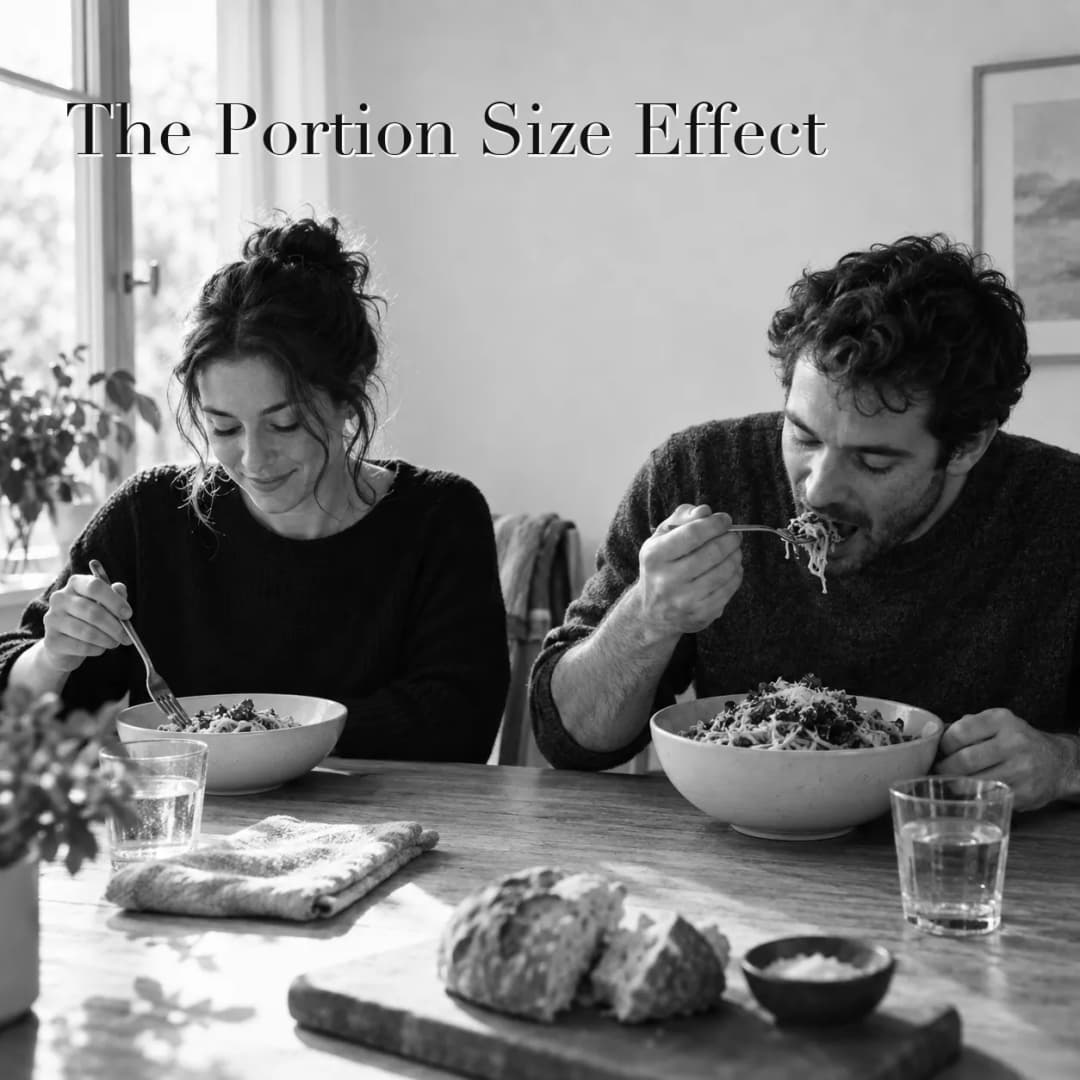
Give people a larger serving and they tend to eat more of it, by a modest but reliable amount, and they do not report feeling any fuller for having done so. The size of what is put in front of a person is doing work that the person neither notices nor reports. It is one of the better-evidenced findings in appetite research, and it is a description of an environment rather than an instruction to a reader.
What it is
The clean experimental demonstration belongs to Barbara Rolls and colleagues, in 2002. Fifty-one adults were served macaroni cheese at four different portion sizes across four weekly lunches, and were free to eat as much or as little as they wanted. Larger portions produced larger intakes. Participants did not report feeling any more full for having eaten more.
Two terms are worth glossing, because both get used loosely. Portion size is the amount put in front of a person, before they decide anything. Satiation is the sense of having had enough that builds during a meal and stops it. The finding is that the first shifts how much gets eaten without shifting what the second reports, which is why nobody experiences this happening to them.
Portion size is established. Plate size is a different claim and is not. The popular version of the plate claim, that a smaller dish makes a smaller meal feel like more, runs through a laboratory whose data cannot be trusted, and this site keeps the two apart deliberately. See Plate Size.
In effect
The review
Hollands, G. J., Shemilt, I., Marteau, T. M., Jebb, S. A., Lewis, H. B., Wei, Y., Higgins, J. P. T., & Ogilvie, D. (2015). "Portion, package or tableware size for changing selection and consumption of food, alcohol and tobacco", Cochrane Database of Systematic Reviews. Sixty-one studies and 6,711 participants. People consistently consumed more when given larger portions or packages. The effect was small to moderate, and the evidence was graded moderate quality, marked down for incomplete reporting in the underlying studies.
One figure that needs handling
The review's authors estimated that removing larger portions altogether might reduce daily energy intake by up to roughly a sixth in adults in the United Kingdom, and rather more in the United States. That is a modelled projection rather than something anyone measured, and it should never be quoted as a measured result. It is the kind of number that travels well and means less than it sounds.
What this describes
An environment. Restaurants, packages, serving dishes and default sizes are the things this evidence is about. The effect is reliable at the level of a population eating from a food supply, and it says nothing about what any individual should put on their own plate.
What it does not say
It does not say larger portions make people feel fuller. The point of the finding is the opposite. Intake moves and the reported sense of fullness does not, which is why self-report is a poor instrument here. See The Self-Report Problem.
It does not say the effect is large. Small to moderate, on moderate-quality evidence, is the honest description.
It does not support the plate-size claim. That is a separate proposition with a separate and much weaker record.
It is not a weight-loss technique and this site does not present it as one. Nothing here licenses telling anyone what to serve themselves, and no page on this site attaches calorie targets or eating plans to it. See YMYL.
Sources
- Rolls, B. J., Morris, E. L., & Roe, L. S. (2002). "Portion size of food affects energy intake in normal-weight and overweight men and women", American Journal of Clinical Nutrition, 76(6), 1207 to 1213. Fifty-one adults, four weekly lunches with no limit on how much could be eaten. The clean primary.
- Hollands, G. J., and colleagues (2015). "Portion, package or tableware size for changing selection and consumption of food, alcohol and tobacco", Cochrane Database of Systematic Reviews. Sixty-one studies, 6,711 participants, moderate-quality evidence.
- Vault verification record, 2026-09-11. Evidence status robust, with the modelled projection marked as modelled and the plate-size claim held separately.
- Where this came from
- No book in this library is the source of this concept. It entered the vault from Why You Are Hungry an Hour After a Big Lunch, built from primary sources rather than from a book.