The White Cube
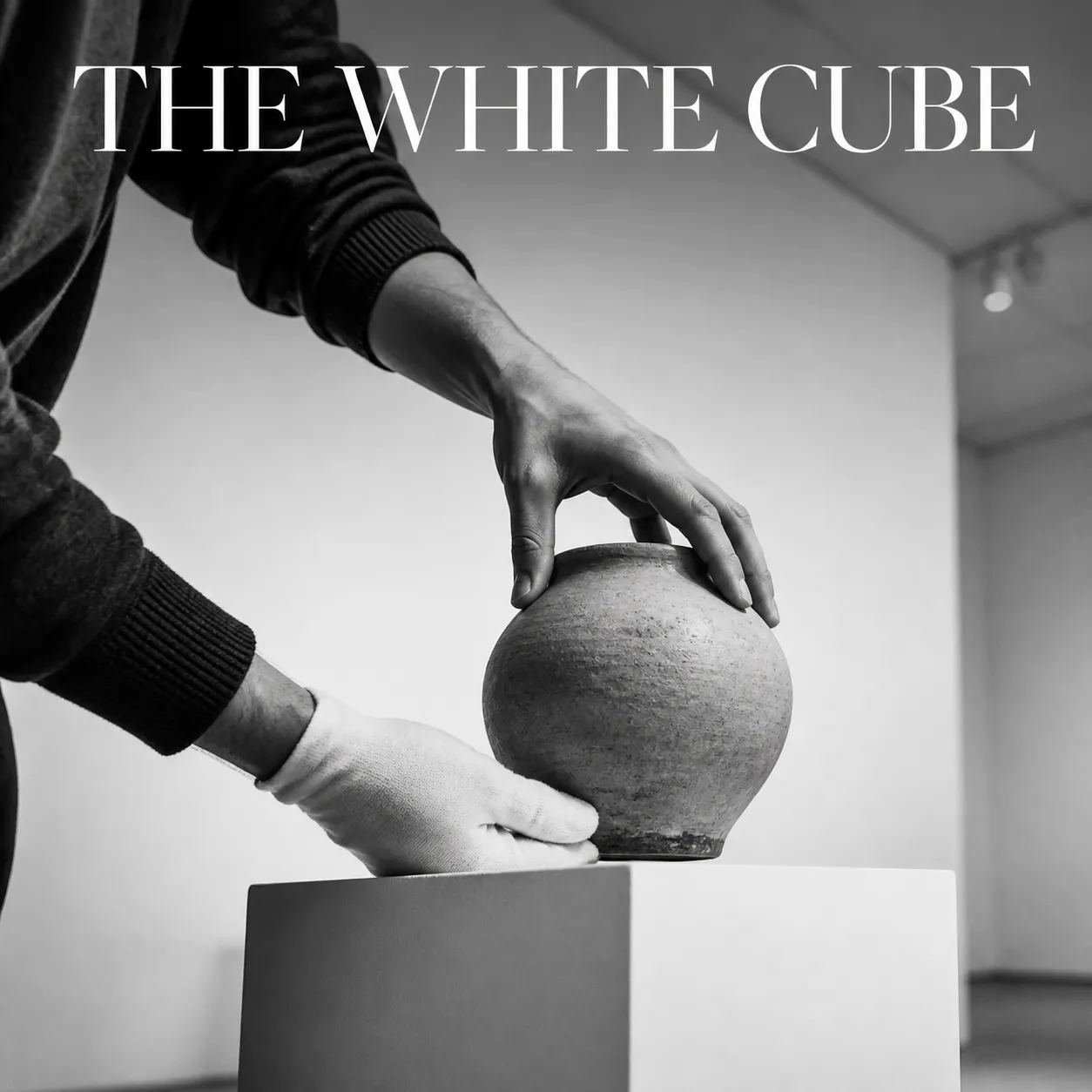
The white cube is Brian O'Doherty's name for the modern gallery's blank walls, controlled lighting and objects isolated on plinths, treated not as a neutral way to display art but as an ideology in its own right. He coined the term in his 1976 Artforum essays, later expanded into the book Inside the White Cube. His argument is that the room performs rhetorical work while presenting itself as an absence. Strip an object of its ordinary surroundings and place it inside that room, and the room alone can turn it into Art.
What it is
Most descriptions of an art gallery treat the space as a formality, four white walls that get out of the way so the work can be seen. Brian O'Doherty's argument, made across three essays in Artforum in 1976 and expanded into Inside the White Cube: The Ideology of the Gallery Space in 1986, is that this is precisely backwards. The white cube is not a neutral container. It is a set of conventions, blank walls, even and shadowless light, objects placed alone on plinths or hung at eye level with generous space around them, that were built up over the twentieth century to do a specific job: strip an object of its ordinary context, its history, its function, its price, and re-present it as something to be looked at purely as Art. The room works precisely because it hides that it is working. It reads as absence, as a blank space that simply lets the object speak, when it is in fact a heavily engineered argument about what the object is.
This is the art-world instance of a more general mechanism. The context effect is the empirical, laboratory version of the same claim: that people do not read value off an object directly, they read it off the object plus its surroundings. O'Doherty's contribution is not a controlled experiment with a measured outcome; it is a critical and historical argument, built from close reading of gallery conventions and their effects on viewers, rather than from a study with a sample size. That distinction matters for how much weight the claim can bear, and it is worth stating plainly rather than leaving it implied by a tag: the white cube is a theory about how a specific kind of space works, not a data point with a confidence interval.
The white cube is also, on O'Doherty's account, a status-conferring space, which is why it connects directly to status signaling. Access to the room, having a show in it, being invited to exhibit inside its walls, is itself a signal, separate from and layered on top of whatever the room does to the perceived value of the individual object. And because the room's blankness is itself a kind of message, a deliberate framing choice dressed up as no framing at all, the concept sits comfortably next to framing as a specific, physical case of the same general move.
In effect
The urinal that became a milestone
Marcel Duchamp's Fountain (1917), a mass-produced urinal signed "R. Mutt" and submitted to an exhibition as sculpture, became one of the most influential artworks of the twentieth century without any change to the object itself. The plumbing did not change. What changed was the willingness of a room to present it as art rather than as a fixture, and the object has been read through that framing ever since. Fountain predates O'Doherty's coinage by nearly sixty years, but it is the case his theory was later built to explain: value assigned by frame, not by the object.
A candle in two rooms
Virgil Abloh, the designer and founder of Off-White, compressed the same argument into a single image: a candle is art inside an all-white gallery and trash inside a garage, and the object never changes across that threshold, only the room does. Abloh's version is not a scholarly restatement of O'Doherty. It is the same underlying claim, arrived at independently from the side of contemporary design and branding rather than art criticism, which is part of why it travels so easily as an example.
The boutique box as a miniature white cube
Rory Sutherland's observation that a watch movement reads as a different product in a velvet-lined boutique box than in a blister pack, discussed in full on the context effect, is the white cube's logic operating at retail scale. The boutique display case does structurally what O'Doherty says the gallery does: it isolates the object, controls the light and setting around it, and removes the ordinary commercial context that would otherwise let a buyer judge it as merely a mechanism. It is a smaller, commercial cousin of the same room.
What it does not say
The white cube is a critical and historical argument about a specific set of gallery conventions that developed in a particular period and culture, chiefly Western, chiefly twentieth-century modernist and postmodernist institutions. It does not claim to describe every exhibition space equally well: artist-run spaces, site-specific installation, outdoor work and non-Western display traditions were built on different assumptions and do not necessarily submit to the same critique.
It also does not claim that the room is the only thing that determines an artwork's lasting significance. Fountain's status has been sustained for over a century by an accumulating body of art-historical argument about Duchamp's broader project, not by the plinth alone continuing to do the work. And because O'Doherty's argument is theoretical rather than experimental, it should not be read as validated or falsified by the separate, empirical context-effect literature on price and taste; the two describe a related mechanism using entirely different kinds of evidence, one a critical reading, the other a peer-reviewed study.
Who developed it
Brian O'Doherty, the Irish-American artist and critic, named the white cube in his 1976 Artforum essays, expanded into book form in 1986. He is not the John O'Doherty who co-authored the Plassmann wine-pricing study discussed on the context effect; the two share a surname and nothing else, one an art critic, the other a neuroscientist.
Sources
- O'Doherty, B. (1976). Inside the White Cube essays. Artforum.
- O'Doherty, B. (1986). Inside the White Cube: The Ideology of the Gallery Space.
- Where this came from
- 2 books in this library carry this concept, which is corroboration worth knowing about, though these authors read each other and often draw on the same experiments, so it is not independent confirmation.