Two-Response Paradigm
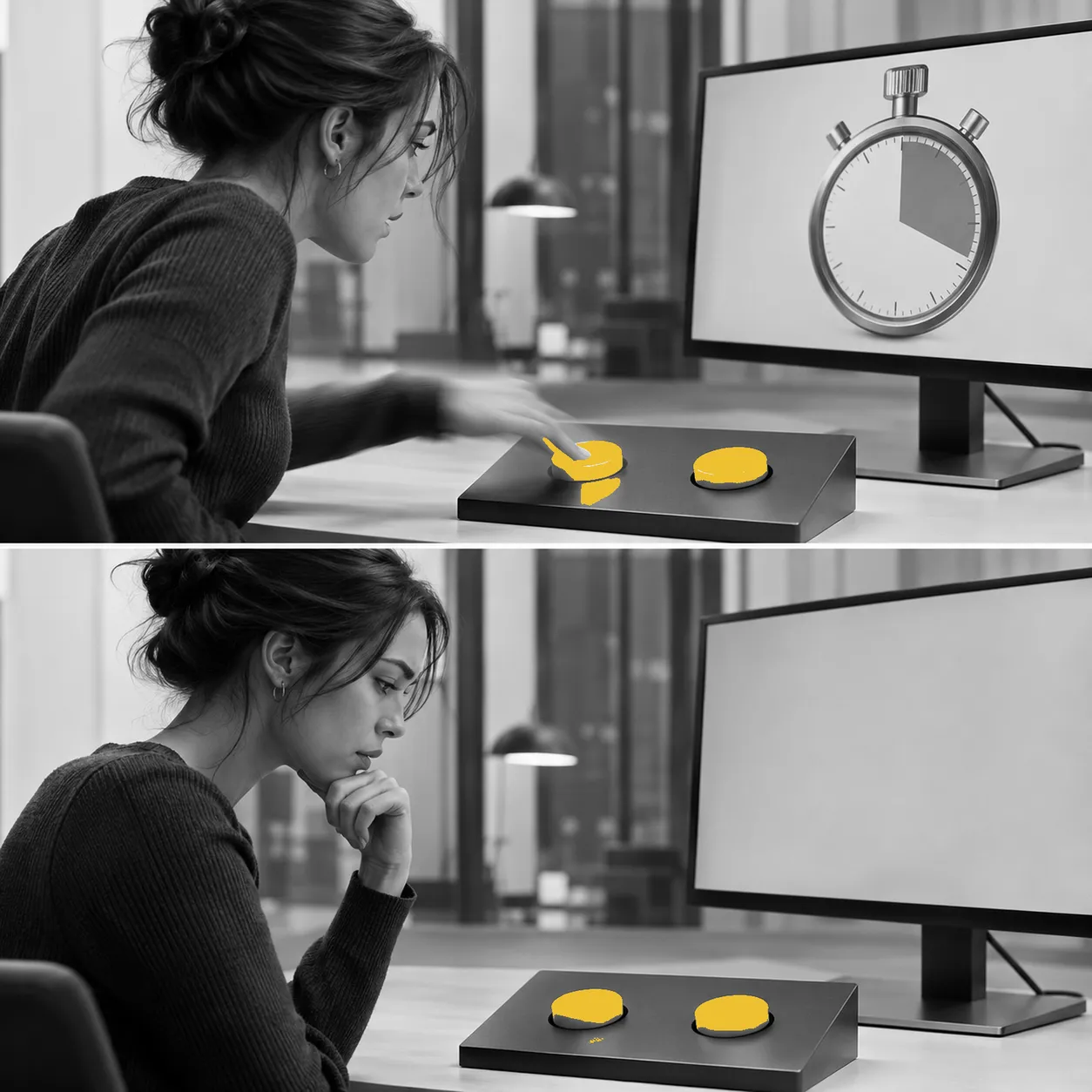
A method in which people give a first answer under time pressure and load, then a second after free deliberation.
What it is
In a two-response design, people answer a reasoning problem twice: first quickly, under time pressure and often a mental load, then again with as much time as they like. The first answer stands in for intuition and the second for the result of deliberation, so researchers can see whether a final answer was reached by correcting the first. Bago and De Neys, and Raoelison and De Neys, used it on the bat-and-ball problem.
In effect
In the article on System 1 and System 2 thinking, it is the method that let researchers see correct answers arriving before deliberation.
What it does not say
The first answer is only a stand-in for intuition, and the method cannot rule out that some quick thinking happens even under time pressure.
Sources
- Bago, B., & De Neys, W. (2019). The smart System 1: Evidence for the intuitive nature of correct responding on the bat-and-ball problem. Thinking & Reasoning, 25(3), 257-299.
- Raoelison, M., & De Neys, W. (2019). Do we de-bias ourselves? The impact of repeated presentation on the bat-and-ball problem. Judgment and Decision Making, 14(2), 170-178.