Upward Social Comparison
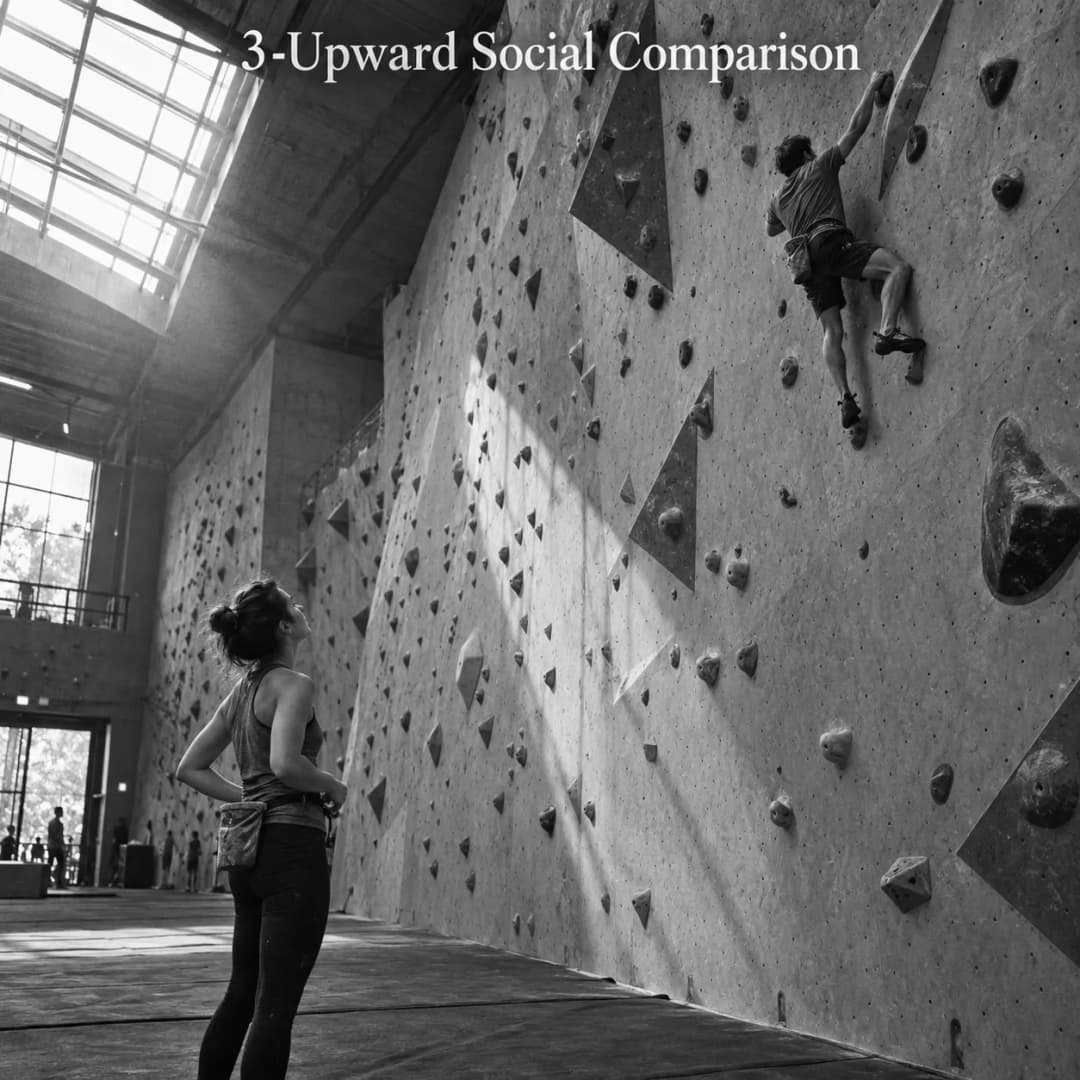
Upward social comparison is the case of social comparison in which the person being measured against appears to be doing better, further along or more capable. The short-run evidence is good and the long-run evidence is thin, and those are two different statements rather than one muddle. Experiments reliably find that looking at idealised bodies makes people feel worse about their own, at g = -0.31 in one 2023 meta-analysis and g = -0.61 in the experimental arm of another. Follow the same people over months and the effect falls to almost nothing, Fisher's Z = -0.08. And none of that evidence measured exercise behaviour.
What it is
Festinger's framing treats upward comparison as the default direction, since people tend to evaluate themselves against someone slightly above them, where the information is worth having. The effects run both ways. The same comparison can supply a target worth chasing or evidence that the gap is not closeable, and which of the two happens turns largely on whether the person believes they could get there.
A beginner watching somebody who has trained for ten years is the clean case. If the gap reads as a route, it is a reason to keep going. If it reads as a verdict, it is a reason to stop. The second reading is likelier when the comparison target is a curated feed rather than a person in the same room whose early years were also visible.
This page is kept separate from the parent theory on purpose, because the evidence status differs. Festinger's 1954 statement is robust. What comparison does to people is contested, and folding the two together would borrow authority the modern work has not earned.
In effect
Research, first side: the short-run effect is well evidenced
The correlational picture is consistent and not small. A 2024 review in Body Image covering 83 studies and 55,440 participants put the association between online social comparison and body image concern at r = .454, and with eating disorder symptoms at r = 0.36. This publication does not print its first author, because that name was not confirmed from the abstract record, and the house rule is that an unopened source does not get a byline in our prose.
The experimental picture agrees on direction. McComb, S. E., Vanman, E. J., & Tobin, S. J. (2023), in Media Psychology, 26(5), 612 to 635, meta-analysed exposure to upward comparison targets on social media and found a body-image effect of g = -0.31, with subjective wellbeing at g = -0.19 and mental health at g = -0.21.
Research, second side: and it is larger in experiments and near zero over time
de Valle, M. K., Gallego-García, M., Williamson, P., & Wade, T. D. (2021), in Body Image, 39, 276 to 292, did the thing that makes this literature legible: they meta-analysed the experimental and the longitudinal evidence separately, and the two arms do not say the same thing. In the experiments, where people are shown idealised images and asked shortly afterwards how they feel about their own bodies, the effect was larger than McComb's figure, at g = -0.61. In the longitudinal studies, following the same people over months and years, it fell to Fisher's Z = -0.08.
There is a third strand that cuts in the same direction. Christopher Ferguson and colleagues argue from meta-analytic work in Body Image (2021) that causal direction is not established, since people who already feel worse about their bodies may simply use these platforms more, and the longitudinal nulls are real: no effect on body esteem at six months in Ferguson, Muñoz, Garza and Galindo (2014), and no relationship between Facebook time and body image two years later in Tiggemann and Slater (2017).
Where we land
Both bodies of work are doing honest science on a hard question, and this is not a dispute between camps. The designs that produce the large correlations cannot establish direction, and the designs that can establish direction mostly find small or null effects. That is a limitation of what is measurable.
Our reading, September 2026: the short-run effect on how people feel is well evidenced, and what is thin is the evidence that it carries forward into what they do. That is a sharper statement than "the evidence is mixed", and it is the one the data supports. If you want to know whether an hour of scrolling makes somebody feel worse about their body this evening, the answer is yes, modestly. If you want to know whether it changes their training over a year, nobody has shown that.
What it does not say
It does not say anything about exercise behaviour. Almost none of this research measured whether anybody trained. Extending it from body image to "this is why you quit the gym" is an inference, and when this publication makes that step it marks it as the author's argument rather than as a finding.
It does not establish durable harm. The experimental effects are short-run by construction, measured minutes after exposure. The longitudinal arm, which is the one that could establish accumulation, is where the effect disappears.
It does not settle direction of causation. People who feel worse may use these platforms more. The cross-sectional correlations are compatible with either story.
It does not make upward comparison bad. The same mechanism supplies the model, the coach and the reason anyone believes a thing is possible. What determines the sign is whether the gap reads as a route or as a verdict, and the literature does not tell you which reading a given person will take.
It does not license a single headline effect size. Two competent meta-analyses of overlapping literatures report g = -0.31 and g = -0.61 for related questions. Quoting either alone would be quoting a choice.
Sources
- Festinger, L. (1954). "A theory of social comparison processes", Human Relations, 7(2), 117 to 140. The framework.
- McComb, S. E., Vanman, E. J., & Tobin, S. J. (2023). Media Psychology, 26(5), 612 to 635. Exposure to upward comparison targets on social media: body image g = -0.31, subjective wellbeing g = -0.19, mental health g = -0.21.
- de Valle, M. K., Gallego-García, M., Williamson, P., & Wade, T. D. (2021). Body Image, 39, 276 to 292. Experimental effect g = -0.61; longitudinal effect Fisher's Z = -0.08.
- 2024 review in Body Image, 83 studies, 55,440 participants, r = .454 with body image concern and r = 0.36 with eating disorder symptoms. First author unconfirmed and therefore not named here.
- Ferguson, C. J., et al. (2021). Body Image. The causal critique, with the longitudinal nulls from Ferguson, Muñoz, Garza & Galindo (2014) and Tiggemann & Slater (2017).
- Vault verification record, 2026-09-11. Evidence status contested, with both sides kept and the verdict stated.
- Where this came from
- No book in this library is the source of this concept. It entered the vault from Nobody Is Born Consistent, built from primary sources rather than from a book.