Variable Rewards
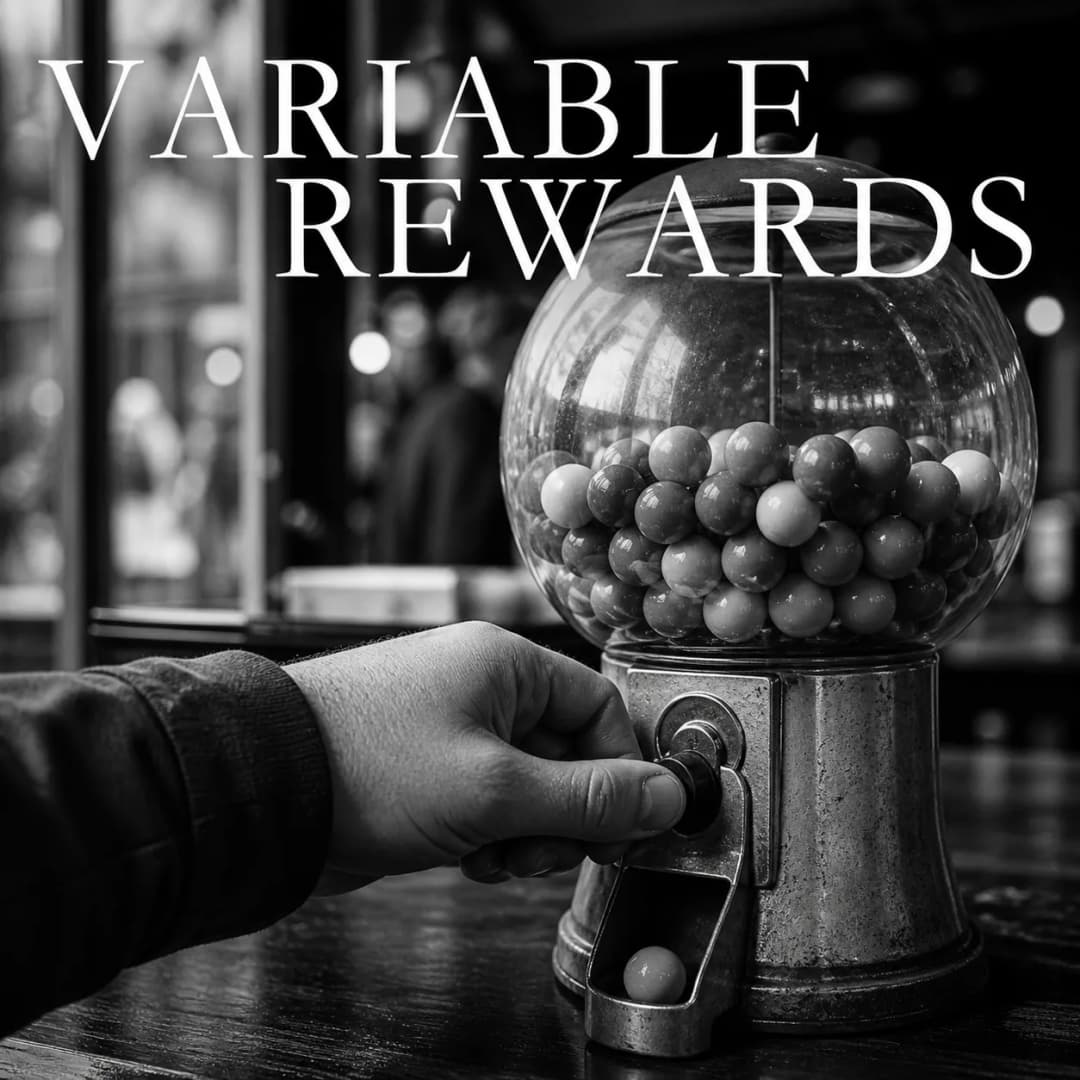
Variable rewards are payoffs delivered unpredictably, sometimes large, sometimes nothing at all, rather than on a fixed, reliable schedule. The pattern comes from B.F. Skinner's operant conditioning research: a variable-ratio or variable-interval schedule produces behaviour that is more frequent and far more resistant to extinction than a fixed schedule delivering the same average payoff. Nir Eyal's Hooked and Adam Alter's Irresistible both name this the strongest lever in habit-forming product design, because the brain cannot predict when the next reward is due, so it keeps checking.
What it is
Skinner's laboratory finding, developed across decades of work with pigeons and rats pressing a lever for food, is one of the sturdier results in experimental psychology. Reward a lever press every single time and the animal presses at a steady, moderate rate, and stops almost as soon as the rewards stop. Reward the same lever press on a variable schedule, an unpredictable number of presses per reward, or an unpredictable interval of time, and the animal presses faster, more often, and keeps pressing long after rewards have stopped arriving altogether. The uncertainty itself is what sustains the behaviour. A brain that cannot predict when the next payoff is coming has no stable point at which to conclude the payoffs have ended.
This is not a minor variation on ordinary reinforcement. A fixed schedule teaches an animal, or a person, roughly when to expect a reward, and behaviour tracks that expectation closely, rising just before a reward is due and falling once it has passed. A variable schedule removes the expectation entirely, and removing it is what makes the schedule so much harder to walk away from. The uncertainty is not a side effect of the mechanism. It is the mechanism.
Applied to software, the logic transfers cleanly enough that Eyal built an entire stage of his Hook Model around it, and Alter names it as one of six ingredients of behavioural addiction, arguably the most potent of the six on its own. Eyal's version sorts variable rewards into three types: rewards of the tribe, social validation from other people; rewards of the hunt, the pursuit of resources or information, the mechanic a slot machine and a search results page share; and rewards of the self, a sense of mastery or completion. None of the three is a category of pleasure. All three describe a different flavour of pull, which is consistent with the underlying Skinnerian mechanism, a schedule shapes how often behaviour recurs, not how much anyone enjoys it.
The design implication is specific rather than general: variability has to attach to something the user already wants, or it does nothing. Gamification schemes that added unpredictable point rewards without an underlying reason to care have failed commercially for exactly this reason, cash payouts on a predictable schedule have been outcompeted by unpredictable status rewards precisely because status, not the payout mechanic alone, was the thing worth chasing.
In effect
Skinner's pigeons, and the schedule that outlasted the food
B.F. Skinner's operant chamber experiments, conducted across the 1930s to 1950s, compared fixed and variable reinforcement schedules directly. Pigeons and rats rewarded on a variable-ratio or variable-interval schedule, an unpredictable number of responses or an unpredictable stretch of time before the next payoff, kept responding at a high rate long after the experimenter stopped delivering any reward at all, a pattern far more resistant to extinction than fixed-schedule responding. Skinner took the underlying schedule seriously enough to build an entire wartime programme, Project Pigeon, around training pigeons to guide a missile using the same reinforcement logic. The schedule, not the food itself, was doing the work of sustaining behaviour.
The inbox that keeps getting checked
Tim Wu's The Attention Merchants traces the same mechanism directly into the office. An inbox is mostly routine correspondence and junk, and yet it gets checked again and again, because the next message might be the one that matters, and there is no way to know in advance which one that will be. The cognitive scientist Tom Stafford, quoted by Wu, put it plainly: "Checking email is a behavior that has variable interval reinforcement." The same schedule, applied without anyone designing it deliberately, explains why gambling, slot machines and fishing all produce the same compulsive checking, you never know when the payoff comes, so you never settle into not looking.
Reddit's "the button", and the market that runs on this schedule
In 2015, Reddit launched a feature called "the button": a 60-second countdown timer that reset every time someone clicked it, with no announced purpose or reward beyond the click itself. Roughly 35 million users engaged with it before it ended, driven by nothing but the unpredictability of what pressing it, or not pressing it, might mean. Adam Alter cites it in Irresistible alongside the penny-auction model, where bids of a few cents each let a television listed at $2,999 close for a fraction of that price, a business built entirely on the unpredictability of whether the next small bid will be the winning one. Neither mechanism pays out reliably. Both are built on exactly the schedule Skinner described, moved from a laboratory lever to a browser tab.
What it does not say
Variable rewards do not explain why a person values what they are pursuing in the first place. The schedule shapes how often a behaviour recurs and how resistant it is to stopping, not whether the outcome is worth wanting or enjoyable once obtained. Gamification programmes that bolted an unpredictable reward mechanic onto something nobody cared about have failed commercially for exactly this reason: variability amplifies an existing pull, it does not manufacture one from nothing.
Nor is variability morally neutral by default. The same schedule sustains a fishing trip, a research habit, a slot machine and a checked inbox, and the mechanism does not distinguish between them. Whether a given use of variable rewards is manipulative depends on what is being pursued and on whose behalf, not on the schedule itself, which is simply a well-documented fact about how reinforcement works. Robinson and Berridge's wanting and liking dissociation supplies the piece variable-reward research does not: a schedule can keep pulling someone back with no guarantee, and no requirement, that liking is rising alongside it.
Who developed it
B.F. Skinner established the underlying finding through operant conditioning research from the 1930s onward; the site does not carry a page for him. Nir Eyal operationalised it as the third stage of the Hook Model in Hooked (2014), and Adam Alter named it as one of six ingredients of behavioural addiction in Irresistible (2017).
Sources
- Skinner, B. F. Operant conditioning and reinforcement schedule research, conducted from the 1930s through the 1950s, including Project Pigeon.
- Eyal, N. (2014). Hooked: How to Build Habit-Forming Products. Portfolio/Penguin. (Three reward types, pp.95–99; Mahalo and Quora comparison, pp.115–117.)
- Alter, A. (2017). Irresistible: The Rise of Addictive Technology and the Business of Keeping Us Hooked. Penguin Press. (Ch.5, "Feedback", p.121: Reddit's "the button" and the penny-auction model.)
- Wu, T. (2016). The Attention Merchants. Knopf. (Skinner's pigeons and Project Pigeon, pp.186–188; Tom Stafford quotation, p.188.)
- Where this came from
- 7 books in this library carry this concept, which is corroboration worth knowing about, though these authors read each other and often draw on the same experiments, so it is not independent confirmation.