Daniel Hamermesh
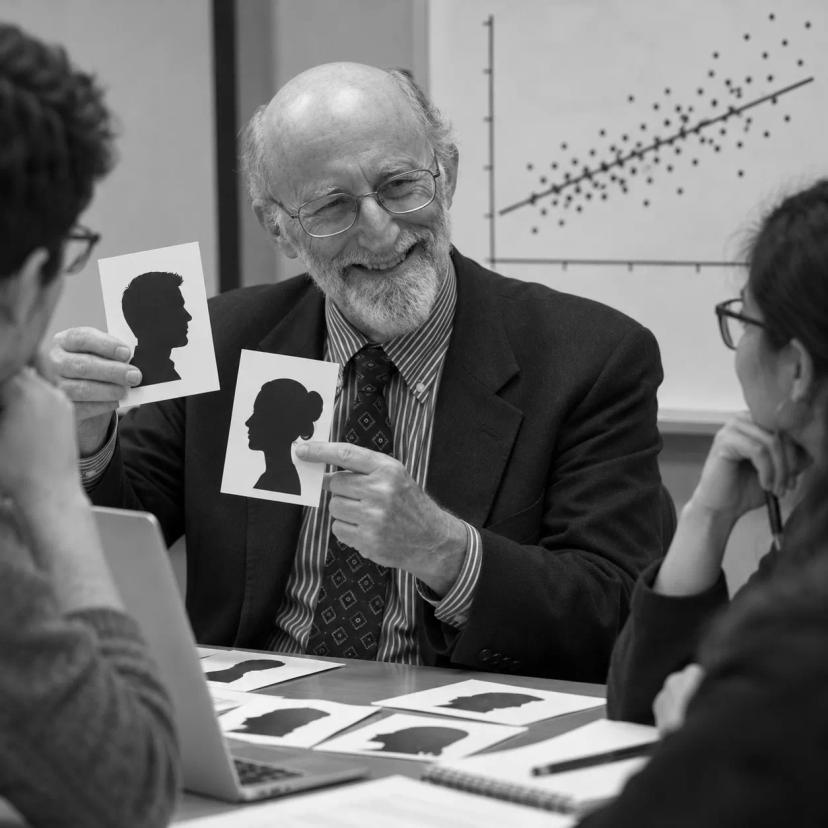
Daniel Hamermesh is a labour economist and the first author of Beauty and the labor market, published with Jeff Biddle in the American Economic Review in 1994. The paper is the survey-based anchor for the claim that good-looking people earn more. It found that plain people earn less than people of average looks, who earn less than good-looking people, and it put the plainness penalty at 5 to 10 per cent.
Who they are
Hamermesh works in labour economics, the field that studies wages, work and hiring. This site records him for one piece of work: the 1994 study with Biddle, which treated physical appearance as a measurable variable in a pay equation, in the same way economists treat schooling or experience. He also wrote a later book on the subject, Beauty Pays: Why Attractive People Are More Successful (Princeton University Press, 2011).
The International Network for Social Science profile of Hamermesh lists a PhD from Yale and an AB from the University of Chicago, and academic posts at Princeton (1969 to 1973), Michigan State (1973 to 1993), the University of Texas at Austin (1993 to 2008), Maastricht University (2009 to 2012), then Royal Holloway, University of London and a returning chair at Texas. It describes him as professor emeritus at Royal Holloway and Sue Killam Professor Emeritus at Texas, and as chief coordinator of the IZA Network and editor in chief of IZA World of Labor.
The same profile gives his research areas as labour demand, time use, the economics of beauty, sleep and television watching, academic labour markets and the replicability of economic research. Other books it lists are Labor Demand (Princeton University Press, 1993), Demand for Labor: The Neglected Side of the Market (Oxford University Press, 2017) and Spending Time: The Most Valuable Resource (Oxford University Press, 2019). Honours listed include the IZA Prize in Labor Economics and the Jacob Mincer Award for Lifetime Contributions to Labor Economics, both in 2013, and the John R. Commons Award in 2014.
Key papers
Hamermesh and Biddle (1994), in the American Economic Review, used interviewers' ratings of physical appearance from three surveys. Holding demographic and labour-market characteristics constant, the authors found a ladder: plain people earn less than average-looking people, who earn less than good-looking people.
The size matters more than the direction. The plainness penalty is 5 to 10 per cent, slightly larger than the beauty premium. The authors also report that men's looks matter at least as much as women's, and that unattractive women have lower labour-force participation rates and marry men with less human capital.
The paper asks a second question, which is whether the premium reflects better productivity or employers' preferences. Better-looking people tend to enter occupations where looks may be more productive. The effect of looks is nonetheless mostly independent of occupation, and the authors read that as evidence of employer discrimination.
Key ideas
Appearance as a priced variable. Before this paper, the attractiveness stereotype was studied mainly as a belief. Hamermesh and Biddle asked what it costs and pays in the labour market, and gave a number.
A penalty larger than the premium. The headline asymmetry is that being plain costs slightly more than being good-looking gains. A claim that beauty "pays" without the penalty side describes half the result.
Occupation does not explain it away. Sorting into occupations exists, but the authors found the effect of looks mostly independent of occupation. That is the finding the article on this site, Do Good-Looking People Earn More, relies on when it says the gap is not simply a better match between looks and jobs.
What survey ratings cannot show. The ratings were made by interviewers, and the data cannot show what any employer was thinking. Later experiments, including Mobius and Rosenblat's wage market, were built to reach that question.
Sources
- Hamermesh, D. S., & Biddle, J. E. (1994). 'Beauty and the labor market.' American Economic Review, 84(5), 1174-1194. NBER Working Paper 4518 (1993) carries the same study.
- Kirkus Reviews listing for Beauty Pays by Daniel S. Hamermesh, release date September 2011, used only to confirm the book exists.
- International Network for Social Science, profile of Daniel S. Hamermesh. socialscience.international/daniel-hamermesh
- Vault note: [[Daniel Hamermesh]].
Studies on this site by Hamermesh
- Beauty and the Labor Market
Hamermesh (1994) · American Economic Review
Articles that cite Daniel Hamermesh
- Do Good-Looking People Earn More
The claim that good-looking people earn more is repeated without a source in a popular psychology book. Four studies, a survey, an experiment pool, a wage experiment and a CV field test, put figures…
Concepts on this site
- The Attractiveness Premium
The attractiveness premium is the systematically better treatment physically attractive people receive across situations that have nothing to do with appearance. It is the applied face of the…