Daniel Kahneman
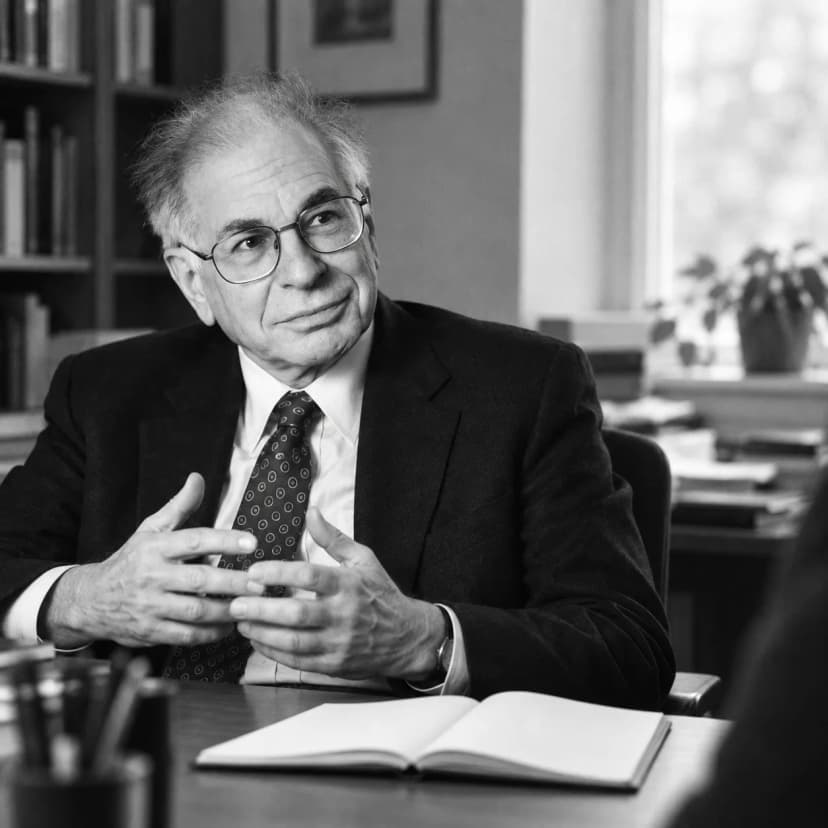
Daniel Kahneman, 1934 to 2024, was an Israeli-American psychologist whose work with Amos Tversky on judgment under uncertainty founded the heuristics-and-biases programme and, in prospect theory, the descriptive theory of choice that behavioural economics was built on. He was Eugene Higgins Professor of Psychology Emeritus at Princeton, and received the Nobel Memorial Prize in Economic Sciences in 2002, shared with Vernon Smith. The psychology half went to him alone because Tversky had died in 1996 and the prize is not awarded after death. Thinking, Fast and Slow (2011) is his synthesis of four decades of that work, and it is dedicated to Tversky. He died in 2024.
Who they are
He is this site's most powerful magnet for misattribution, so this page is deliberately strict about what is his and what is not.
What is his. Prospect theory, with Tversky, who has no page on this site yet. The heuristics-and-biases programme. The 1993 cold-water study, "When more pain is preferred to less: adding a better end", where he is legitimately the first author. And the account in Thinking, Fast and Slow that routes the sunk cost fallacy through mental accounting, the habit of keeping separate mental books for separate projects, so that abandoning one means closing it at a loss.
What is not his alone. Duration neglect and the snapshot model of remembered experience are Fredrickson and Kahneman (1993), with Barbara Fredrickson as first author, published in the Journal of Personality and Social Psychology. That paper used film clips rather than pain, and it comes three years before the medical work.
What is not his at all. The colonoscopy and lithotripsy studies, which are the ones everybody quotes, are Donald Redelmeier's, in 1996 and again in the randomised trial of 2003. Kahneman is a co-author on both. He is not the first author on either.
This record got it wrong twice and corrected it in the open on 11 September 2026, first from Kahneman alone to Redelmeier and Kahneman, which fixed the famous-name problem and created a chronology problem, and then to Fredrickson and Kahneman, which is right.
Key papers
Fredrickson, B. L., & Kahneman, D. (1993). "Duration neglect in retrospective evaluations of affective episodes", Journal of Personality and Social Psychology, 65(1), 45 to 55. Second author.
Kahneman, D., Fredrickson, B. L., Schreiber, C. A., & Redelmeier, D. A. (1993). "When more pain is preferred to less: adding a better end", Psychological Science, 4(6), 401 to 405. First author, legitimately.
Thinking, Fast and Slow (2011).** Chapter 32 places the sunk cost fallacy inside mental accounting, and chapter 29 locates it in the cell of his fourfold pattern covering likely losses, where people become willing to gamble rather than book a certain loss. That is the mechanism, and it is the piece this site uses.
Key ideas
Credit the first author. It costs a clause and it is the difference between a record and a legend.
He qualified his own sunk cost account. He notes that the effect can be overcome in some settings, and that graduate students in economics and business are more willing to walk away. That sits directly against Catherine Blumer and Hal Arkes's tenth experiment, which found economics training made no difference at all, including among students taught sunk cost by the professor handing them the questionnaire. Neither claim carries enough attached evidence to settle the other, so this site records both.
The thing most worth recording about him is the self-correction record. No other author on this site revises himself at this density. He wrote that his original base-rate claim was too strong. He listed prospect theory's blind spots and called one of its assumptions certainly wrong. He changed his mind in print about how to define well-being. When his own income-and-happiness result was contradicted, he co-authored the paper that superseded it. In 2017 he publicly conceded the chapter on priming, writing that he had placed too much faith in studies too small to support it.
He is also on record that studying the biases did not debias him. He reports that his own intuitive thinking remained as prone to overconfidence and to the planning fallacy as ever, and that he improved only at recognising the situations where errors are likely. Anyone writing "read Kahneman and think better" is contradicted by Kahneman.
On the failed material. Priming, ego depletion, glucose, facial feedback and disfluency have all failed or are badly contested, and several are load-bearing for arguments in his book. That is a fact about those findings rather than a verdict on him. He documented most of the damage himself, in public, at cost to his own book. The editorial posture here is to drop the failed chapters and keep the statistical spine.
One disclosure the body text of his book omits. The endnotes record that he was a senior scientist with the Gallup Organization while writing about Gallup well-being data. It is worth naming wherever those chapters are used.
Concepts on this site
Prospect Theory, with Tversky
Duration Neglect and Peak-End Rule, where the credit chain is set out in full
The Experiencing Self and the Remembering Self
Ego Depletion, one of the constructs that did not survive
Reference Point, Diminishing Sensitivity and Decision Weights are related and have no page on this site yet
Sources
- Thinking, Fast and Slow (2011).** Read in full in the vault, 2026-09-02, including both reprinted papers and the endnotes. Chapter 32 for mental accounting and sunk cost, chapter 29 for the fourfold pattern. The hub's reliability audit governs what may be cited from it.
- Fredrickson, B. L., & Kahneman, D. (1993). Journal of Personality and Social Psychology, 65(1), 45 to 55.
- Kahneman, D., Fredrickson, B. L., Schreiber, C. A., & Redelmeier, D. A. (1993). Psychological Science, 4(6), 401 to 405.
- Redelmeier, D. A., & Kahneman, D. (1996). Pain, 66(1), 3 to 8, and Redelmeier, D. A., Katz, J., & Kahneman, D. (2003). Pain, 104(1 to 2), 187 to 194. The medical work, first-authored by Redelmeier.
- Vault verification record, 2026-09-11. Attribution of duration neglect corrected twice and logged in the open.