Ronald Fisher
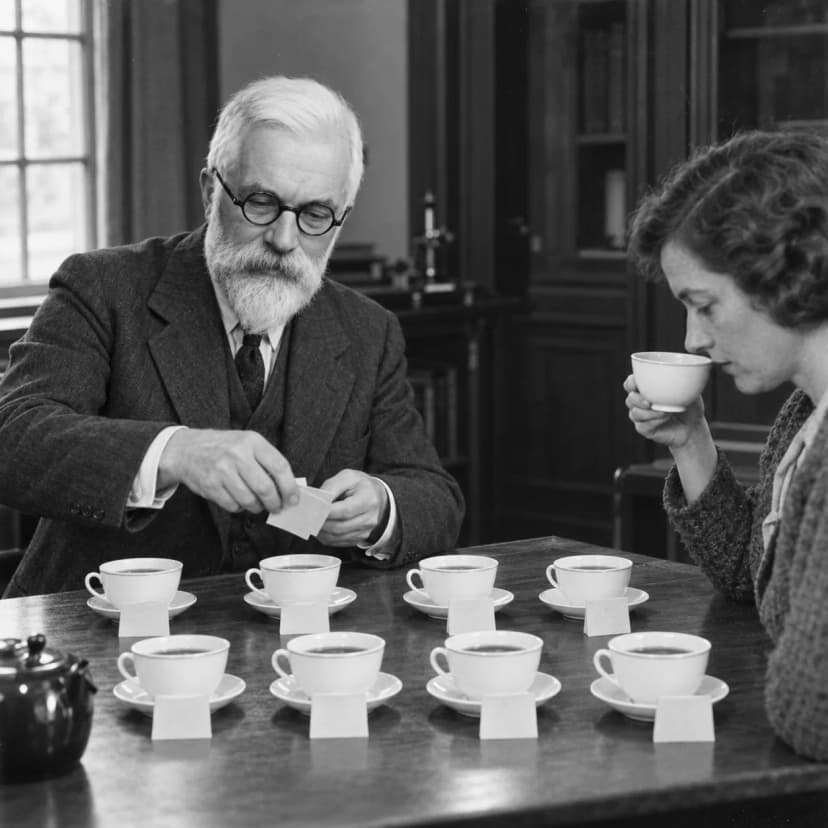
Ronald Fisher was a British statistician and geneticist who applied statistical procedures to the design of scientific experiments. His 1925 book introduced the 5 per cent level of significance, his 1935 The Design of Experiments contains the tea-tasting example in which cups are served in random order, and his methods underlie the randomised trial and, through it, the modern AB test.
Who they are
Fisher was born in London on 17 February 1890 and died in Adelaide on 29 July 1962. He won a scholarship in 1909 to study mathematics at the University of Cambridge and graduated in 1912. Encyclopaedia Britannica describes him as a British statistician and geneticist who pioneered the application of statistical procedures to the design of scientific experiments, and records that he received the Copley Medal in 1955.
After a temporary position at Rothamsted Experimental Station in Hertfordshire, he stayed there for 14 years. The draw, according to a biographical article by Heinz Klaus Strick, was a large body of crop data collected since 1842 in the Classical Field Experiments. At Rothamsted he gained experience in experimental design, aiming to measure many factors with few experiments, and he criticised the approach of varying one factor at a time as slow and costly. He published Studies in Crop Variation in 1921, which Strick describes as a first application of analysis of variance. He later held a chair in genetics at Cambridge from 1943 to 1956.
This page covers his work on statistics and the design of experiments. It does not assess his other writing.
Key papers
Key ideas
The tea-tasting test. In the example from The Design of Experiments, a woman claims she can tell whether milk or tea was poured into the cup first. Fisher proposes serving her eight cups, four of each kind, in random order. If she were guessing, the chance of identifying every cup correctly is 1 in 70, about 1.4 per cent, so at the 5 per cent level the claim of no ability can be rejected only if she is right about all eight. The example shows the logic of the null hypothesis: a starting assumption of no effect, which an experiment can try to disprove and cannot prove. See Randomised Controlled Trial.
The 5 per cent limit. In 1925 he introduced p = 0.05 as a limit for statistical significance. Adam Kucharski, in the fourth chapter of Proof (2025), argues that the fixed threshold is a historical accident that merged rival schools of thought, those of Fisher and of Jerzy Neyman, and the vault's note records that Fisher feuded with Neyman and Egon Pearson. See Adam Kucharski.
Many factors from few experiments. Strick reports Fisher's criticism of one-factor-at-a-time experiments, which he regarded as slow and costly, and his aim of learning about many factors from few experiments. The tea-tasting arithmetic also shows why the number of trials is fixed before the experiment: the 1 in 70 figure holds for eight cups. A preprint by Johari, Pekelis and Walsh argues that inferences from samples chosen by continuous monitoring, where a test is stopped when it first looks significant, are wholly unreliable.
A line to the AB test. Online experiments apply the same logic to page views and accounts. The 2007 KDD paper by Kohavi, Henne and Sommerfield describes an AB test as the simplest controlled experiment, with users randomly exposed to one of two variants. See AB Testing and Ron Kohavi.
Sources
- Encyclopaedia Britannica. 'Sir Ronald Aylmer Fisher.' britannica.com/biography/Ronald-Aylmer-Fisher (dates, education, Copley Medal).
- Strick, H. K. (2023). 'Ronald Aylmer Fisher.' Translated by J. O'Connor, MacTutor History of Mathematics, University of St Andrews. First published in Spektrum der Wissenschaft.
- Fisher, R. A. (1935). The Design of Experiments. Edinburgh: Oliver and Boyd.
- Kucharski, A. (2025). Proof: The Uncertain Science of Certainty. London: Profile Books, chapter 4.
- Johari, R., Pekelis, L., & Walsh, D. J. (2015). 'Always valid inference: bringing sequential analysis to A/B testing.' arXiv:1512.04922.
- Kohavi, R., Henne, R. M., & Sommerfield, D. (2007). 'Practical guide to controlled experiments on the web: listen to your customers not to the HiPPO.' KDD 2007.