Tim Wu
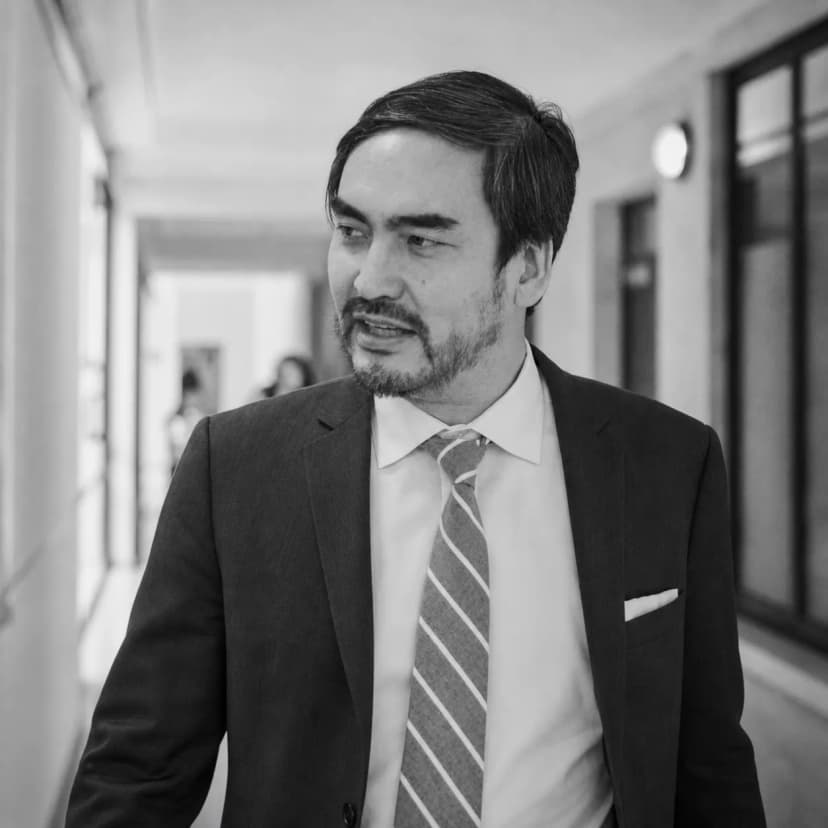
Tim Wu is a law professor at Columbia who coined the term net neutrality and later worked on competition policy inside the White House. For this site he matters as the historian of attention as a business. The Attention Merchants (2016) traces the trade in human attention from the nineteenth-century penny press through radio, television, the web and the smartphone, and it supplies both halves of the prime-time argument at once: the origin story of mass simultaneous attention, and the fragmentation counter-history that says the mass audience broke up and is not coming back. His method is documentary rather than experimental, which is a strength almost everywhere in the book and a weakness in the one place this site depends on him most.
Who they are
Tim Wu is a professor of law at Columbia Law School. He is best known outside academia for coining the phrase network neutrality in a 2003 law journal article, the argument that a network carrier should not discriminate between the traffic it carries, which became the organising term for two decades of American internet regulation. In 2021 he was appointed special assistant to the president for technology and competition policy, having previously worked on competition policy in the Obama administration. His academic work sits at the junction of antitrust, media history and communications law, and the through line is structural: who owns the pipe, who controls what moves through it, and what that ownership does to everyone downstream.
His books apply a single historical method. Find the moment a business model is invented, then trace it forward through every medium it goes on to colonise. The Master Switch (2010) does this with the cycle by which open information technologies close into empires. The Attention Merchants (2016) does it with advertising, and it is the book this site draws on. Wu's account of prime time is the useful part. Prime time was not a natural fact about evenings but an invention with a date. Amos 'n' Andy, from 1929, established the mechanism, and the mechanism was not the comedy but serialisation: an unfinished story engineered to return the same audience to the same hour tomorrow (pp. 85-94). What that produced, in Wu's phrase, was "a massive ritual of collective attention" (pp. 91-94). Irna Phillips then proved the technique had nothing to do with the hour by running it in daytime (p. 93), and William Paley turned it into CBS's ratings dominance from 1955 to 1976 (pp. 128-141).
Wu is also the strongest witness against the argument this site builds on him. The second half of his television history is the case for fragmentation: Jonathan Robbin's PRIZM sorting the country into forty lifestyle clusters, cable narrowcasting to slices rather than to a nation, and Rupert Murdoch and Barry Diller assembling Fox out of the audiences the incumbents had left alone (pp. 170-180). His reading of the remote control belongs to the same story: sold as viewer sovereignty, delivered as channel surfing, aimless flipping with no intention behind it (pp. 178-180). That history is well documented and this site does not dispute it. What it disputes is the conclusion, that the mechanism died with the free version of it.
One caution about how he is used. Wu invokes joint attention as the psychological explanation for what a mass audience is (p. 115), and he is a legal historian rather than a psychologist. Joint attention as a construct comes from developmental psychology, from Scaife and Bruner's 1975 Nature paper on infants following a caregiver's gaze, not from Wu. The claim that the same mechanism scales from a caregiver and a baby to a hundred million strangers in separate rooms is an extrapolation, and the best objective test of it, Noam Mairon and colleagues in 2020, found no amplification of attention or memory at all. We take Wu's history as reliable and his psychology as unproven, and this site says so wherever it uses him.
Books
Wu's influence runs through books written for a general readership and through law journal articles, not through experimental research. He is a documentary historian of business models, and that is the register in which his claims should be read.
Wu, T. (2003), "Network Neutrality, Broadband Discrimination," Journal of Telecommunications and High Technology Law. The paper that named net neutrality.
Wu, T. (2010), The Master Switch: The Rise and Fall of Information Empires, Knopf. The cycle by which open information technologies close into monopolies, and are opened again.
Wu, T. (2016), The Attention Merchants: The Epic Scramble to Get Inside Our Heads, Knopf. The history of attention as a harvested and resold resource, from the penny press to the smartphone. The source for this site's prime-time material.
Wu, T. (2018), The Curse of Bigness: Antitrust in the New Gilded Age, Columbia Global Reports. The antitrust argument that followed from the media history.
Key papers
Wu, T. (2003), "Network Neutrality, Broadband Discrimination," Journal of Telecommunications and High Technology Law. The paper that introduced the term net neutrality.
Wu, T. (2010), The Master Switch: The Rise and Fall of Information Empires, Knopf. The cycle by which open information technologies close into monopolies, and are opened again.
Wu, T. (2016), The Attention Merchants: The Epic Scramble to Get Inside Our Heads, Knopf. The history of attention as a harvested and resold resource, from the penny press to the smartphone. The source for this site's prime-time and narrowcasting material, and for the Paley, Sarnoff and Fox history.
Wu, T. (2018), The Curse of Bigness: Antitrust in the New Gilded Age, Columbia Global Reports. The antitrust argument that followed from the media history.
Affiliation and public appointment are taken from the Columbia Law School faculty page.
Key ideas
Attention is a resource that businesses harvest and resell, and the model recurs in every new medium rather than belonging to any one of them.
Prime time was an invention with a date, 1929, and the invention was serialisation rather than any particular programme.
The same history supplies the counter-argument: narrowcasting, cable and Fox dismantled the free mass audience deliberately, and it did not survive on those terms.
His framing is structural rather than moralising. The attention merchants are actors responding to an incentive that rewards whoever captures the most attention at the lowest cost, which is the tone worth borrowing.
His joint-attention claim (p. 115) is the weakest load-bearing thing he says, because the psychology it borrows was established with infants and has not held up under objective measurement at scale.
Concepts on this site
Find them elsewhere
The Bluesky account states his Columbia professorship, his New York Times column and his 2025 book, and the X account of the same handle carries the same identity. No LinkedIn or Scholar profile confirmed
Checked 2026-09-10. Handles and affiliations go out of date, so treat this block as a snapshot rather than a standing fact.
Sources
- Wu, T. (2016), The Attention Merchants: The Epic Scramble to Get Inside Our Heads, Knopf. Amos 'n' Andy and serialisation, 1929, pp. 85-94; "a massive ritual of collective attention," pp. 91-94; Irna Phillips and daytime, p. 93; joint attention, p. 115; Paley and CBS ratings dominance, pp. 128-141; PRIZM and narrowcasting, pp. 170-180; MTV, BET, Bravo and Fox, pp. 175-176; the remote control, pp. 178-180.
- Wu, T. (2010), The Master Switch: The Rise and Fall of Information Empires, Knopf.
- Wu, T. (2018), The Curse of Bigness: Antitrust in the New Gilded Age, Columbia Global Reports.
- Wu, T. (2003), "Network Neutrality, Broadband Discrimination," Journal of Telecommunications and High Technology Law.
- Columbia Law School faculty page, Timothy Wu. Affiliation and White House appointment.
- Scaife, M. & Bruner, J. S. (1975), "The capacity for joint visual attention in the infant," Nature, 253, 265-266. The origin of the joint-attention construct.
- Mairon, N., Nahum, M., Stolk, A., Knight, R. T. & Perry, A. (2020), "Behavioral and EEG Measures Show no Amplifying Effects of Shared Attention on Attention or Memory," Scientific Reports, 10, 8458.