Lie Detection Accuracy
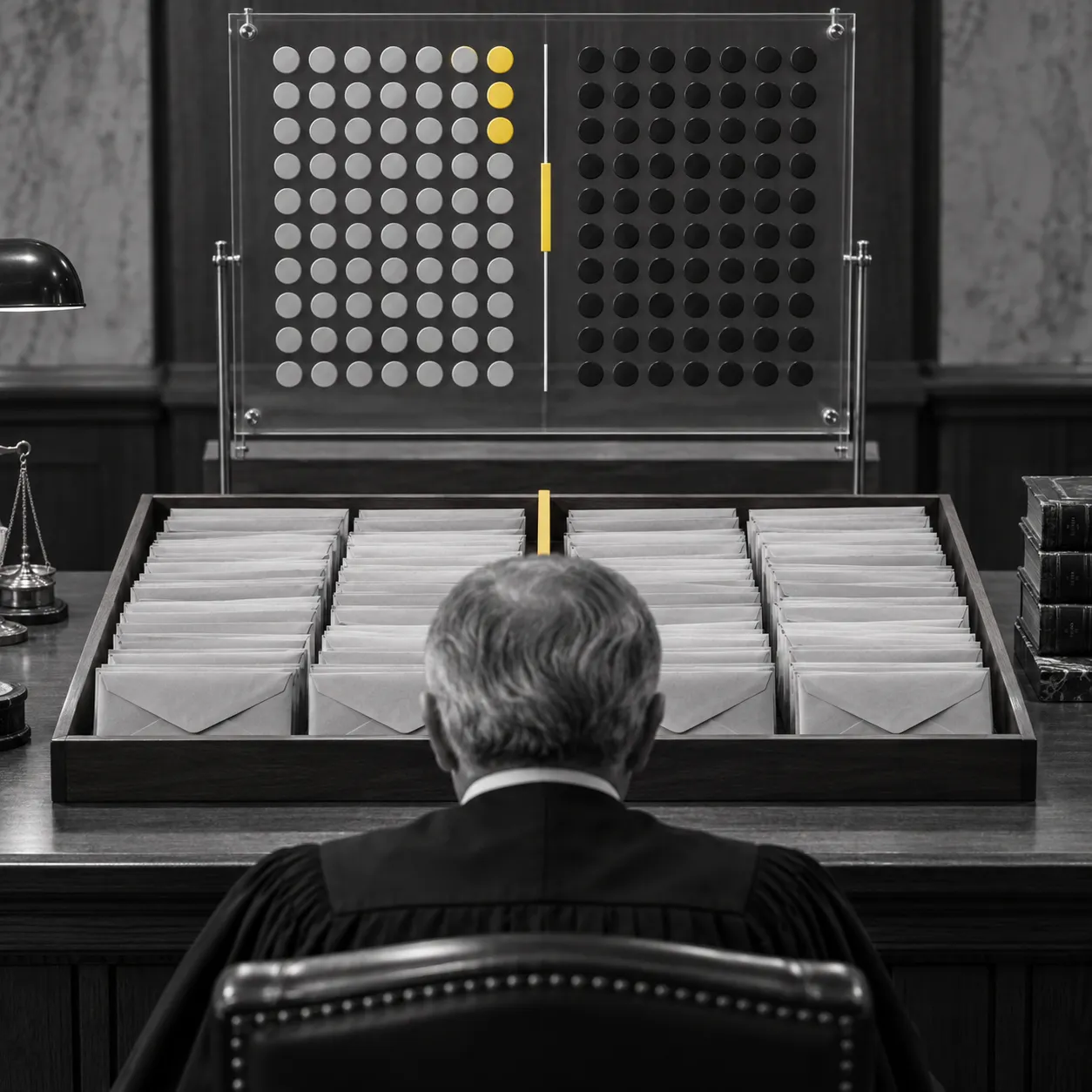
Lie detection accuracy is how often people correctly sort lies from truths when asked to judge them. The largest pooled estimate, from Charles Bond and Bella DePaulo in 2006, is 54 per cent against 50 for guessing, made up of 47 per cent of lies identified and 61 per cent of truths accepted. Differences between judges are small, and the cues people trust, such as gaze, do not reliably separate liars from truth-tellers. The result is real, narrow and hard to improve by watching harder.
What it is
The concept answers a plain question: when someone says something and a listener has to decide whether it is true, how often is the listener right? The research that measures it uses a standard design. A group of senders is recorded or interviewed, some telling the truth and some lying, and a group of judges rates each message as honest or deceptive. Accuracy is the share of messages the judges classify correctly.
The reference result is Bond and DePaulo's 2006 meta-analysis in Personality and Social Psychology Review. It pooled 206 documents and 24,483 judges, who rated 6,651 messages from 4,435 senders. All of the studies asked people to tell lies from truths in real time, with no special aids and no training. The average was 54 per cent correct. Judges identified 47 per cent of lies as deceptive and 61 per cent of truths as truthful.
Two features of the result deserve attention. The first is size. The authors put the mean effect at about .40 on their standardised scale, around the 60th percentile of social psychological effects. That is a measurable result, which is why it is described as above chance, and it is also small enough to be of little use in any single case.
The second is the asymmetry between lies and truths. Judges rated messages as truthful more often than the facts warranted, with a weighted mean of about 55 per cent of messages judged truthful and an unweighted mean of about 57 per cent. This is the pattern called truth bias, and it accounts for the table: a judge who leans towards belief will recognise honest speakers and miss liars. The same paper reports that lies were easier to detect when they could be heard than when they could only be seen, and that people who are motivated to be believed look deceptive whether or not they are lying.
In effect
The pooled laboratory result
The cleanest illustration is the table above. A judge who guessed would be right half the time, and the average judge in the pooled studies was right 54 per cent of the time. In a run of ten lies the judges missed more than five. In a run of ten truths they accepted six. In 2008 Bond and DePaulo asked whether some judges do much better, and analysed 247 samples of people judging strangers in real time. The differences in judges' ability were minute, with a standard deviation under 1 per cent of lies detected after correcting for measurement error, and the best judges were no more accurate than a chance process would produce.
The belief the result runs against
Most people expect to do better than this, and they expect to do it by watching the speaker. The Global Deception Research Team surveyed people across 75 countries and 43 languages in 2006 and found a dominant stereotype across cultures that liars avert their gaze. The accuracy literature points the other way. Hartwig and Bond, in their 2011 lens-model analysis, wrote that gaze aversion is not a valid indicator of lying. A belief held in dozens of countries and a measurement pooled from more than two hundred documents do not agree, and the measurement is the one that counts when a decision depends on it.
Professionals and the interview
Customs officers and police officers appear in this literature because the stakes of their judgments are high. Hartwig and Bond reported that presumed lie experts, people who routinely assess credibility in their professional lives, do not perform better than lay judges do. Their conclusion on improvement was equally direct: the best way to improve judgment achievement is to increase behavioural differences between liars and truth-tellers, not to train observers in the cues that are valid. The practical consequence is that the lever lies in the design of the conversation and not in the sharpness of the watcher.
What it does not say
It does not say that people cannot tell at all. Fifty-four per cent is above chance, and the authors treat it as a genuine effect. It does not say that every judge is equally poor in every setting; the pooled studies were laboratory studies in which strangers were judged in real time, and they cannot speak for every kind of conversation. It does not say that accuracy is fixed. The 54 per cent figure describes unaided observation, and the researchers who study interviewing argue about how much structured questioning can raise it. Those claims are contested in print, and this page does not rest on them.
It also does not say that liars are undetectable. It says that the signals people use to detect them are weak. The companion page on Cues to Deception sets out which behaviours do and do not differ between liars and truth-tellers.
Who developed it
The keystone synthesis is by Charles Bond and Bella DePaulo, whose 2006 and 2008 meta-analyses define the field's estimates. Maria Hartwig and Bond added the 2011 lens-model analysis, which explains why accuracy stays low even though people's use of cues is sensible.
Sources
- Bond, C. F., Jr., & DePaulo, B. M. (2006). "Accuracy of deception judgments." Personality and Social Psychology Review, 10(3), 214-234. doi:10.1207/s15327957pspr1003_2
- Bond, C. F., Jr., & DePaulo, B. M. (2008). "Individual differences in judging deception: Accuracy and bias." Psychological Bulletin, 134(4), 477-492. doi:10.1037/0033-2909.134.4.477. Figures for the 2008 analysis as reported in Bower, B. (2008, July 4). "Lie defectives." Science News.
- Hartwig, M., & Bond, C. F., Jr. (2011). "Why do lie-catchers fail? A lens model meta-analysis of human lie judgments." Psychological Bulletin, 137(4), 643-659. doi:10.1037/a0023589
- The Global Deception Research Team (2006). "A world of lies." Journal of Cross-Cultural Psychology, 37(1), 60-74. doi:10.1177/0022022105282295
- Vault note: [[Lie Detection Accuracy]].