Losses Disguised as Wins
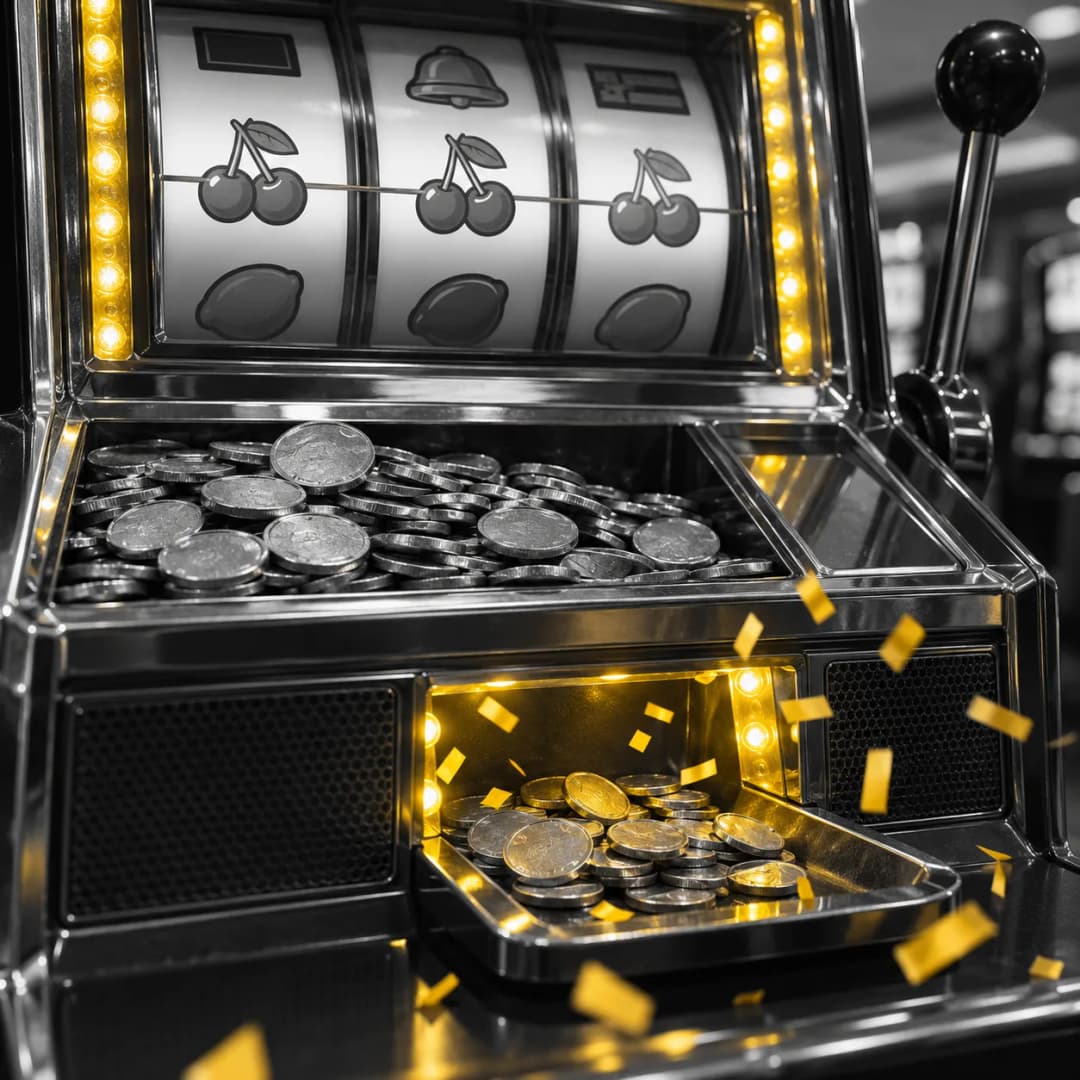
A loss disguised as a win is a spin on a multi-line slot machine that returns less than the player staked but still wins on one line, so the machine plays its usual win lights and sounds. A 2010 study at the University of Waterloo found that players' skin conductance responses to these spins were similar to their responses to real wins, and larger than their responses to ordinary losses. It is the best-measured single feature of slot machine design in this library, and it has been measured only on gaming machines.
What it is
Early slot machines were simple devices with three mechanical reels and one line. Modern video machines let a player bet on many lines at once, in some cases several hundred. Adam Alter, in Irresistible (2017), gives a worked example. On a machine charging ten cents a line, playing all fifteen lines costs $1.50 a spin. If one line pays $1, the player has been paid back less than was staked, a net loss of fifty cents, yet the machine celebrates with the same bright lights and catchy tunes it plays for a genuine win. Alter notes that a casino is content for players to spread bets this way, since it beats them fifteen times faster, while the player is fifteen times more likely to win on at least one line.
The phrase is credited to Mike Dixon's team in 2010 on his University of Waterloo profile, which says the team introduced the term for outcomes in which a player wins back less than the amount bet. Alter, writing in 2017, says the label is one that Natasha Dow Schüll and other gambling experts use. Who coined it first is not settled here, and the study below is the one that put a measurement on it.
In effect
The 2010 paper, published in Addiction by Dixon, Kevin Harrigan, Rajwant Sandhu, Karen Collins and Jonathan Fugelsang, asked whether disguised losses would be as arousing as wins and more arousing than ordinary losses. The team recorded skin conductance and heart rate from 40 novice players on a multi-line machine, a modified commercial game, betting the maximum of 15 lines at 5 credits each, which is 75 credits a spin. Skin conductance is a standard physiological measure of arousal, the same sweating response Alter describes when he reports the study.
Across the session, wins came on 15.6 per cent of spins, disguised losses on 17.1 per cent and ordinary losses on 67.3 per cent. At that bet size, in other words, a disguised loss was slightly more common than a genuine win. Skin conductance responses to wins and disguised losses did not differ significantly, and both were significantly larger than those to ordinary losses. Heart rate told a slightly different story: only genuine wins produced a larger deceleration than the other outcomes, and only at one of the measured intervals. The authors suggested that the heightened arousal following disguised losses may have implications for the development of problem gambling.
Alter also reports that Dixon's team calculated that players are more likely to hit a disguised loss than a genuine win whenever they play six or more lines per spin. That figure is Alter's retelling and has not been checked against the paper here. The 2010 data are consistent with the direction of the claim at fifteen lines.
Dixon's profile describes later work from the same programme on what the team calls dark flow, a deep absorption that problem gamblers, particularly depressed ones, report during slots play, and says that the work on disguised losses has contributed to policy changes in Australia. Both statements are the university's description, not claims tested here. The absorption it describes is close in spirit to Schüll's machine zone.
What it does not say
The study is small, with 40 novices in the skin conductance analysis, one machine and one session type. It measures arousal during play, not how long people go on playing afterwards, how much they spend or whether they develop gambling problems. Novices are not the players for whom the question matters most, and a laboratory session is not a casino floor.
It also says nothing about apps. A reward that costs nothing has no stake to fall short of, so an app version of a disguised loss, if one exists, would need a different definition, and none of the studies drawn on here tests one. In the article Where Slot Machine Design Meets Apps, this is the row of the comparison marked as established for the machine only.
A related feature, the near miss, has weaker support. A 2019 review and set of experiments led by Jeffrey Pisklak could not pin down a reinforcing effect of near misses in a controlled extinction procedure, which is discussed in the library's article on random rewards in loyalty apps. The two features should not be treated as one finding: the disguised loss has a measured physiological signature in humans, and the near-miss effect remains contested.
Sources
- Dixon, M. J., Harrigan, K. A., Sandhu, R., Collins, K., & Fugelsang, J. A. (2010). Losses disguised as wins in modern multi-line video slot machines. Addiction. doi:10.1111/j.1360-0443.2010.03050.x. Author-hosted copy at the University of Waterloo read, 22 October 2026.
- Dixon, M. J. Faculty profile, School of Psychology, University of Waterloo. Read 22 October 2026.
- Alter, A. (2017). Irresistible. Penguin Press, chapter 5. Read through the vault's page-referenced source notes.
- Pisklak, J. M., Yong, J. J. H., & Spetch, M. L. (2019). The near-miss effect in slot machines: a review and experimental analysis over half a century later. Journal of Gambling Studies.