The Machine Zone
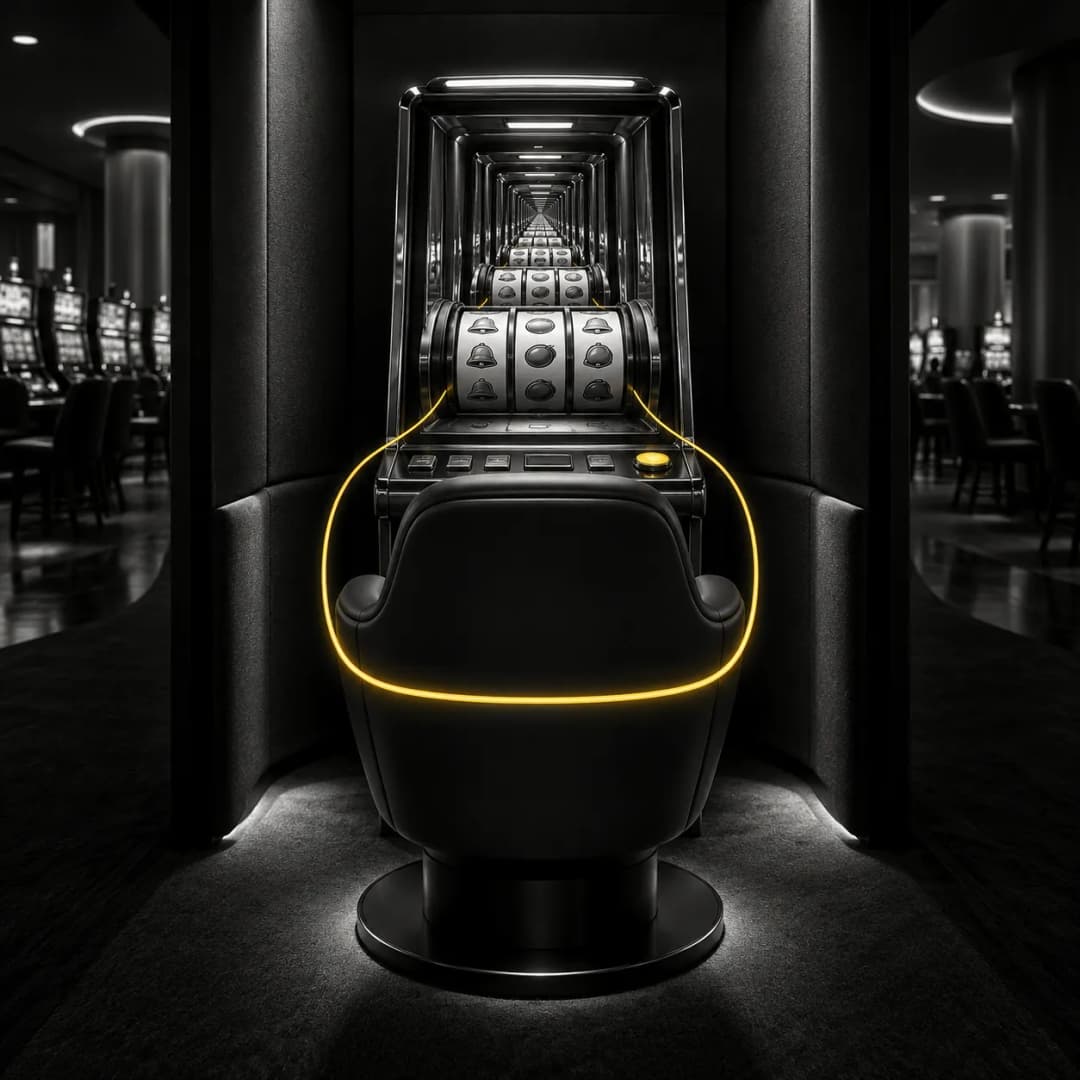
The machine zone is Natasha Dow Schüll's name for the trancelike absorption that machine gamblers describe, a state in which daily worries, social demands and awareness of the body fade and the aim becomes to keep playing, not to win. It comes from her ethnography of Las Vegas, published as Addiction by Design in 2012. The industry's matching measure is time on device, the length of an uninterrupted stretch at one machine.
What it is
The term belongs to Schüll, a cultural anthropologist, and to her book Addiction by Design: Machine Gambling in Las Vegas (Princeton University Press, September 2012). On her own account of the book, it draws on fifteen years of fieldwork in Las Vegas and examines solitary, rapid, continuous machine play, which she argues is driven less by the thrill of competition than by a trancelike state that gamblers themselves call the machine zone. The book moves from industry conventions and casino floors to gamblers' daily lives, the planning of game algorithms, Gamblers Anonymous meetings and regulatory arguments over whether addiction comes from the consumer, the product or the interaction between them.
Hansen Hsu, reviewing the book in Social Studies of Science in 2013, summarises the zone as a state of calm absorption in which the player loses a sense of self and body. Machine gamblers, he writes, play to keep playing and not to win. The zone arises from a tight loop between player and machine with instant feedback, and players reach it by speeding up their bets until the risk of each bet smooths out into a predictable loss. Hsu describes the result as a paradox: the player feels in control while being out of control, and embodied while disembodied. The publisher's description makes the same points in plainer terms, adding that casinos design for time on device, the longest possible engagement with each machine.
Adam Alter reports the industry side of this in Irresistible (2017), in the chapter on feedback. The success of slot machines, he writes, is measured by time on device, and "the longer the average player stays seated at the machine, the better the machine". Because most players lose more the longer they stay, the metric works as a proxy for profit. The zone and the metric describe one arrangement from two positions: the player seeks continuity, and the operator is paid for it.
In effect
Hsu's review summarises how the industry changed its machines in light of this. Having noticed in the 1990s that players preferred frequent medium wins and fast play, designers redesigned machines in the 2000s: buttons replaced levers, animations could be skipped, virtual credits could be instantly re-bet, ergonomics improved, and enclosed layouts were made to feel safe. Payout patterns were adjusted to produce more small wins, and marketing, loyalty programmes and data gathering were aimed at repeat play. Each of these shortens the gap between one spin and the next, which is the gap the zone depends on.
One feature of that design has been measured in a laboratory. In a 2010 study published in Addiction, Mike Dixon and colleagues at the University of Waterloo recorded skin conductance from 40 novice players on a multi-line machine. Spins that returned less than the stake but still won on one line, which the team called losses disguised as wins, produced arousal similar to real wins and larger than ordinary losses. That is evidence about a feature of the machine and about arousal. It does not show that the zone was entered, and it does not measure later play.
The idea has travelled beyond the casino. The philosophers Cristina Voinea, Lavinia Marin and Constantin Vică argued in a 2024 paper in Topoi that social platforms work as attentional scaffolds, digital slot machines. CNBC reported that Netflix's chief executive said on the company's April 2017 earnings call that it was competing with sleep, on the margin, which is a time-on-device target stated in a different industry's words. The article Where Slot Machine Design Meets Apps separates what carries across (the target) from what does not (the stake).
The state also sits comfortably beside wanting and liking, Kent Berridge's separation of the drive to pursue a reward from the pleasure of having it. Players who describe wanting to continue without describing enjoyment fit that split, though Schüll's fieldwork measures neither and the match is one of consistency.
What it does not say
It is an ethnographic description of an experience, so it names a mechanism and measures no effect size. It cannot say how many players enter the zone, how often, or how long it lasts, and it does not by itself show that apps produce the same state. Hsu's review raises a related open question: Schüll argues that the properties of an activity separate harmful absorption from beneficial flow, but he asks what exactly distinguishes the two, for example in an activity such as programming.
The term should not be confused with the ludic loop. Alter's Irresistible credits Schüll with that phrase, and the attribution has not been confirmed; the machine zone is the term her own book is built around. Alter also calls the trade's labels for slots, among them crack cocaine of gambling and electronic morphine, sensationalised, while saying they capture how easily people become hooked.
Hsu notes that Schüll's wider claims, that the casino models a control society and that its profit logic anticipated predatory finance, are ambitious and extend beyond the zone itself. The concept is best used for what the fieldwork supports: a description of what continuous machine play feels like to those who seek it, and of the design that serves them and the operator at once.
Sources
- Schüll, N. D. (2012). Addiction by Design: Machine Gambling in Las Vegas. Princeton University Press. Author's book page and publisher's description read, 22 October 2026.
- Hsu, H. (2013). Review of Addiction by Design. Social Studies of Science, 43(6), 952-956. Read at the author's site, 22 October 2026.
- Alter, A. (2017). Irresistible. Penguin Press, chapter 5. Read through the vault's page-referenced source notes.
- Dixon, M. J., Harrigan, K. A., Sandhu, R., Collins, K., & Fugelsang, J. A. (2010). Losses disguised as wins in modern multi-line video slot machines. Addiction. doi:10.1111/j.1360-0443.2010.03050.x.
- Voinea, C., Marin, L., & Vică, C. (2024). Digital slot machines: social media platforms as attentional scaffolds. Topoi.