Media Choice and Knowledge Gaps
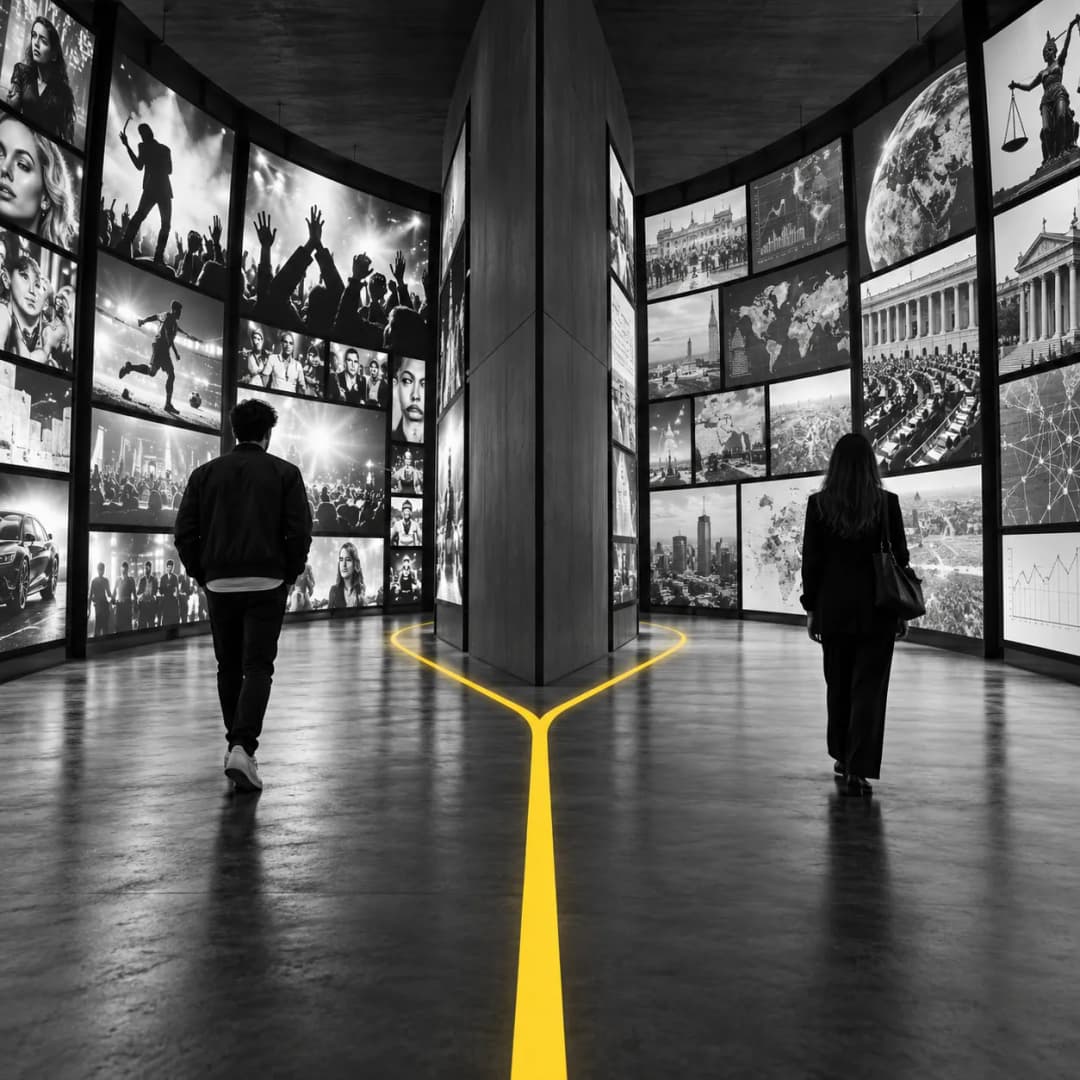
Media choice and knowledge gaps is Markus Prior's finding that more media choice widens the gap between people who like news and people who prefer entertainment. In a survey of 2,358 U.S. residents, he found that content preference predicted political knowledge and turnout better as choice grew. News-oriented people became more knowledgeable and more likely to vote, and entertainment-oriented people turned away from news and became less informed and less likely to vote. The mechanism is departure, not format.
What it is
Prior started from a puzzle. Cable television and the internet had put far more political information in front of Americans, yet political knowledge and turnout had not changed noticeably. His answer, in a 2005 paper in the American Journal of Political Science, is that greater media choice lets people find the content they prefer. People who like news use the abundance to become more knowledgeable and more likely to vote. People who prefer entertainment drift away from news, which leaves them less informed and less likely to vote. The average stays flat because two groups are moving in opposite directions.
To test it, Prior built a measure of media content preference and included it in a representative survey of 2,358 U.S. residents. The result is that content preference predicts political knowledge and turnout more strongly as media choice increases. Access to cable and the internet widens the gaps in knowledge and turnout between news-oriented and entertainment-oriented people.
He developed the argument in a book, Post-Broadcast Democracy: How Media Choice Increases Inequality in Political Involvement and Polarizes Elections, published by Cambridge University Press. A Princeton news item of November 2007 describes it as new and as an expanded version of a dissertation that won the American Political Science Association's E. E. Schattschneider Award for the best dissertation in American government. According to that item, almost half of Americans watched a network newscast on a typical weeknight in the broadcast era, against under 10 per cent at the time of writing, and about 20 per cent of survey respondents preferred news to other genres. It reports that these "news junkies" gained knowledge and voted more, while "entertainment fans" who disliked news became less informed and less likely to vote. The two groups were similar in education, age, gender and income. The main difference was that news junkies were much more partisan. The item's survey count is given as 2,300 people, against 2,358 in the paper's abstract, and this page uses the abstract's figure for the paper.
The concept turns on incidental exposure. In the broadcast era, a person who wanted to watch television in the evening often met the news because little else was on. Remote controls and multichannel options let people avoid it. That is why the concept is a claim about choice rather than about the content of news programmes: nothing about the news changed for the entertainment-minded viewer except that leaving became easy.
In effect
Research: the 2005 survey
The paper's design is the cleanest example. A measure of content preference, a representative sample of 2,358 U.S. residents, and an outcome measured two ways, political knowledge and turnout. The finding is an interaction: preference matters more where there is more choice. A reader should hold on to the shape of that result. It does not say entertainment-minded people are less informed everywhere. It says the gap between them and news-oriented people grows where alternatives are available.
Everyday life: the remote control
The Princeton item attributes the fall in incidental news exposure to remote controls and multichannel options. The everyday version is a household with two or three channels, where the early-evening newscast is what is on, and a household with many, where the viewer who prefers something else can go there without effort. The first household produces accidental news watchers. The second does not. The knowledge gap Prior reports is what accumulates across millions of such evenings.
Commerce: cable and the market for attention
Prior's paper names cable television and the internet as the sources of the widened gap. Thomas Patterson's 2000 report names competition from cable and entertainment as the reason outlets softened their coverage. Read together, the two describe one market from two sides: outlets moved towards entertainment to compete for audiences, and viewers who preferred entertainment moved away from news when they could. Neither study isolates the form of television as the cause. Tim Wu's history of the attention business gives the same commercial logic an earlier setting in the penny press of the 1830s.
What it does not say
It does not say that news viewers are better people or that entertainment viewers are poor citizens. The Princeton item reports no clear demographic split between the groups on education, age, gender or income.
It does not show that a change in format makes people learn less. The mechanism Prior reports is that entertainment-minded viewers avoid news when they can. For the form-of-television argument, see The Medium Is the Metaphor.
It rests on a survey. The verbs in the abstract, became more knowledgeable and became less informed, describe a pattern inferred from a preference measure and from variation in access to media choice. This page read the paper at abstract level and the book through a university news item.
It does not contradict Matthew Baum's finding that foreign crises shown in entertainment-oriented soft news reached politically uninvolved Americans. Baum studied what reaches people who watch soft news. Prior studied what happens to people who stop watching news. See Soft News.
It describes the media environment of its own period. This page does not extend the finding to later platforms.
Who developed it
Markus Prior, in 2005. See Markus Prior.
Sources
- Prior, M. (2005). "News vs. Entertainment: How Increasing Media Choice Widens Gaps in Political Knowledge and Turnout." American Journal of Political Science, 49(3), 577-592. doi:10.1111/j.1540-5907.2005.00143.x. Read at abstract level through RePEc and the author's Princeton page.
- Prior, M. (2007). Post-Broadcast Democracy: How Media Choice Increases Inequality in Political Involvement and Polarizes Elections. Cambridge University Press. Described through the Princeton news item "Book reveals media choice hurts political participation," 12 November 2007. https://www.princeton.edu/news/2007/11/17/book-reveals-media-choice-hurts-political-participation
- Baum, M. A. (2002). "Sex, Lies, and War: How Soft News Brings Foreign Policy to the Inattentive Public." American Political Science Review, 96(1), 91-109.
- Patterson, T. E. (2000). Doing Well and Doing Good. Shorenstein Center, Harvard Kennedy School. https://shorensteincenter.org/how-soft-news-critical-journalism-are-shrinking-news-audience/
- Wu, T. (2016). The Attention Merchants: The Epic Struggle to Get Inside Our Heads. Knopf.