The Context Effect
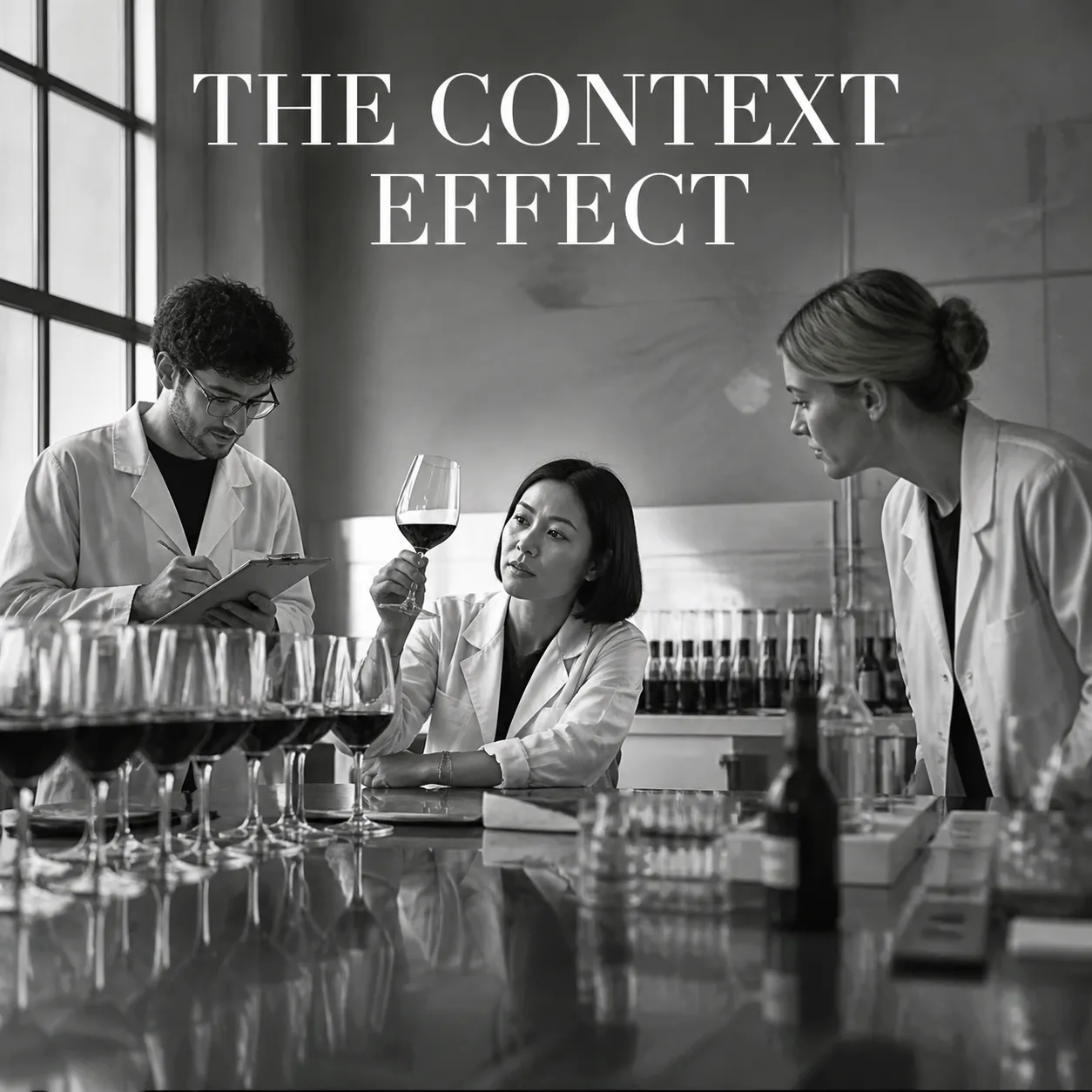
The context effect is the finding that people do not judge an object's worth by some fixed quality inside it. They judge it against whatever surrounds it: a price, a room, a story, a comparison. Tell someone an identical wine costs ninety dollars rather than ten and they rate it more pleasant, and a brain scanner shows more activity in the region that tracks how good an experience feels. The context effect says perception computes value relationally, using the surrounding frame as an input to the judgement, not as decoration around a fact that was already fixed.
What it is
Pour an identical wine from two bottles. Tell the drinker one cost ten dollars and the other ninety. The description that comes back will not be neutral. The ninety-dollar pour gets called smoother, more balanced, more memorable, and if you are watching a brain scanner rather than a tasting sheet, the medial orbitofrontal cortex, the region that tracks how pleasant an experience feels, shows more activity too. Nothing about the liquid changed. What changed was the number attached to it.
That is the context effect: people do not evaluate an object, a wine, a candle, a urinal on a plinth, by reading some property off it in isolation. They evaluate it against whatever surrounds it, the price on the label, the room it sits in, the set of alternatives it is placed against, the story they were told beforehand. Change the surroundings and the judgement has not malfunctioned or been tricked. It has been given a different input, and it returns a different, entirely consistent, output. The brain is not a scale weighing an object on its own. It behaves more like a relative-value calculator, and it will happily return a different number for the same object depending on what else is in the frame.
This sits inside the broader family of findings usually filed under framing, but the context effect is specifically about the surrounding conditions of the object itself, price, container, setting, rather than how a piece of information is worded. The white cube is its art-world instance, where the room does the recalibrating rather than a price tag. And because judgements of social standing run on the same relational logic, status signaling depends on it too: a watch or a location only reads as high status inside a context that has already taught people what high status looks like.
None of this means preference is arbitrary or that people are simply being fooled. The mechanism is efficient rather than broken. Reading value off context is usually a reasonable shortcut, because context usually does carry real information: an expensive wine is often genuinely better made, a curated room usually does contain curated work. The effect becomes interesting, and occasionally troubling, in the specific cases where the context has been decoupled from the object entirely and the judgement moves anyway.
In effect
The price tag that changed the brain's response
Hilke Plassmann led a study, published with John O'Doherty, Baba Shiv and Antonio Rangel in 2008, in which subjects tasted wine inside an fMRI scanner while being told each pour's price. The wine was, in some pairs, the same liquid twice, once presented as a ten-dollar bottle and once as a ninety-dollar one. Subjects rated the higher-priced pour as more pleasant, and their medial orbitofrontal cortex, the brain region that tracks experienced pleasantness, showed correspondingly higher activity. The price was not just changing what people said about the wine. It was changing a measurable neural response to it. This John O'Doherty, a Caltech neuroscientist, is a different person from Brian O'Doherty, the art critic behind the white cube; the shared surname is a coincidence, not a connection.
Wine experts, fooled by red dye
The sensory twin to the pricing study came seven years earlier. Gil Morrot, Frédéric Brochet and Denis Dubourdieu (2001) dyed a white wine red with an odourless colouring and asked trained oenology students to describe it. Fifty-four students, people whose whole discipline is tasting past exactly this kind of interference, described the disguised white wine using red-wine vocabulary: dark fruit, tannin, the language that belongs to a different grape entirely. Expertise did not protect them from the visual frame. If anything, it gave them a richer vocabulary to rationalise it with.
The velvet box and the blister pack
Rory Sutherland, the advertising executive, makes the same point from inside the industry that profits from it. A watch movement presented in a velvet-lined boutique box is, in his account, functionally a different product from the identical movement sold in a blister pack, even though nothing mechanical has changed between the two. The packaging is not marketing layered on top of the watch. It is part of what the customer is actually buying, which is why Sutherland argues that context belongs on the product's balance sheet rather than its decoration budget.
What it does not say
The context effect does not say that quality is meaningless or that any price tag can be swapped for any experience with no limit. The two anchor studies here are specific, peer-reviewed, and falsifiable: Plassmann's finding depends on subjects believing the stated price, and Morrot, Brochet and Dubourdieu's depends on a visual cue that happens to override taste vocabulary, not on wine tasting being generally arbitrary. Context and quality interact; the effect does not claim that context replaces quality outright.
It is also worth keeping this finding separate from the much weaker territory it sometimes gets filed alongside. Adam Alter's Drunk Tank Pink extends a similar argument across names, colours, weather and social priming, and a good deal of that broader literature failed to replicate. The Plassmann and Morrot studies are a sturdier kind of evidence than most of what sits under that wider umbrella, and the difference matters: not every claim about context shaping perception carries the same evidential weight.
Who developed it
No single person originated the context effect; it is a pattern documented independently across neuroeconomics, sensory science and marketing rather than a theory with one named author. Hilke Plassmann supplied the neural evidence, Frédéric Brochet the sensory evidence, and Rory Sutherland the applied, commercial account of the same mechanism.
Sources
- Plassmann, H., O'Doherty, J., Shiv, B. and Rangel, A. (2008). "Marketing Actions Can Modulate Neural Representations of Experienced Pleasantness." Proceedings of the National Academy of Sciences.
- Morrot, G., Brochet, F. and Dubourdieu, D. (2001). "The Color of Odors." Brain and Language, 79(2), 309–320. N = 54.
- Sutherland, R. (2019). Alchemy.
- Where this came from
- 5 books in this library carry this concept, which is corroboration worth knowing about, though these authors read each other and often draw on the same experiments, so it is not independent confirmation.