Matthew Baum
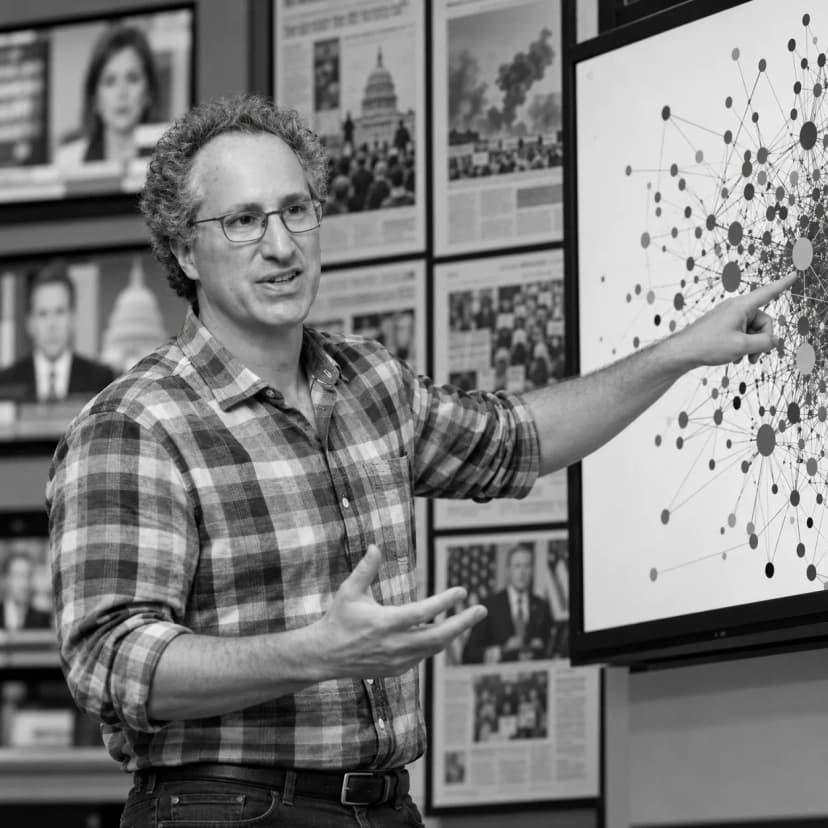
Matthew Baum is a political scientist, the Marvin Kalb Professor of Global Communications at Harvard Kennedy School. His 2002 paper in the American Political Science Review found that foreign crises presented in entertainment-oriented soft news reached politically uninvolved Americans and reduced the disparity in attentiveness between segments of the public. His 2003 book Soft News Goes to War developed the argument. On this site he is the evidence that cuts against a simple reading of Neil Postman: entertainment formats can carry politics to people who were not looking for it.
Who they are
Baum is the Marvin Kalb Professor of Global Communications at Harvard University's John F. Kennedy School of Government, according to his Harvard scholars page. His work sits between political communication and foreign policy, and the question he returns to is how the public comes to know about foreign affairs when most people are not paying close attention.
His 2002 paper, Sex, Lies, and War: How Soft News Brings Foreign Policy to the Inattentive Public, appeared in the American Political Science Review. Its argument is that, because of selective political coverage by entertainment-oriented soft news media, politically inattentive people encounter information about major political issues, especially foreign policy crises, while seeking entertainment. He tested it statistically by comparing individual media use with attention to several recent foreign crises, and compared those with non-foreign-crisis issues. Crises and similar issues presented through soft news reached politically uninvolved Americans, which reduced the disparity in attentiveness across segments of the public.
The 2003 book, Soft News Goes to War: Public Opinion and American Foreign Policy in the New Media Age (Princeton University Press), builds a larger account. Its abstract starts from a puzzle: Americans have reported less concern with foreign affairs since the Cold War, even after 9/11, yet public attention to foreign policy crises has grown. Baum attributes this to changes in how television presents political information, and proposes a byproduct theory of information consumption. Soft news frames scandal and violence, especially attacks against America, as entertainment; this draws viewers who then follow foreign crises for their entertainment value even if they have no interest in foreign policy itself. The book tests the theory with content analyses of traditional and soft news coverage of post-war US foreign crises and with analyses of public opinion surveys.
Two features of the book's abstract deserve a place beside the optimistic reading. It reports that watching soft news reinforces isolationist attitudes among many inattentive Americans. It also describes soft news audiences as a largely overlooked group of unusually persuadable voters. Reaching an inattentive viewer is therefore not the same as informing that viewer well, and Baum does not say it is.
Key papers
Baum, M. A. (2002). "Sex, Lies, and War: How Soft News Brings Foreign Policy to the Inattentive Public." American Political Science Review, 96(1), 91-109. Read at abstract level.
Baum, M. A. (2003). Soft News Goes to War: Public Opinion and American Foreign Policy in the New Media Age. Princeton University Press. Read through the abstract on his Harvard page.
His Harvard publications page also lists "Circling the Wagons: Soft News and Isolationism in American Public Opinion" and "Soft News and Foreign Policy: How Expanding the Audience Changes the Policies". They appear in the search results for this page by title only, and they are not used.
Key ideas
Soft news as a byproduct route to politics. Viewers who come for entertainment pick up political information as a byproduct. See Soft News.
Attention is the measure. The 2002 paper compares media use with attention to foreign crises. It does not measure depth of understanding.
The inattentive are reached, and also shaped. The book's abstract reports reinforced isolationist attitudes among many inattentive viewers.
How the article uses him
The article Was Amusing Ourselves to Death Right uses the 2002 paper for one finding, and states plainly that Baum measured attention, not depth of understanding, so the result leaves Postman's point that entertainment cannot carry an argument untouched. What it adds is that soft news does something Postman's formula excludes, which is putting a foreign crisis in front of people who had not gone looking for one. The paper was read at abstract level only.
Sources
- Baum, M. A. (2002). American Political Science Review, 96(1), 91-109. Abstract via RePEc and Cambridge University Press. https://www.cambridge.org/core/journals/american-political-science-review/article/sex-lies-and-war-how-soft-news-brings-foreign-policy-to-the-inattentive-public/6BE3C86E6A1F2E9AA18E3C74B3A69FCB
- Baum, M. A. (2003). Soft News Goes to War. Princeton University Press. Abstract and author title from his Harvard page. https://mbaum.scholars.harvard.edu/publications/soft-news-goes-war-public-opinion-and-american-foreign-policy-new-media-age